

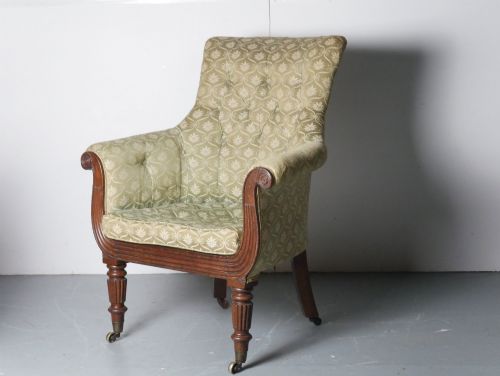
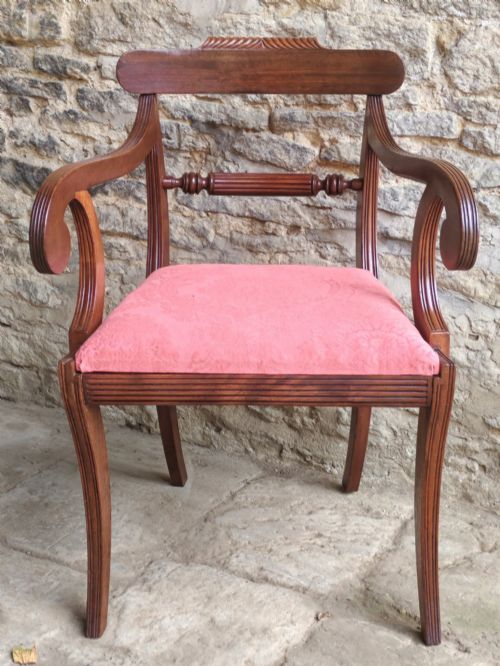

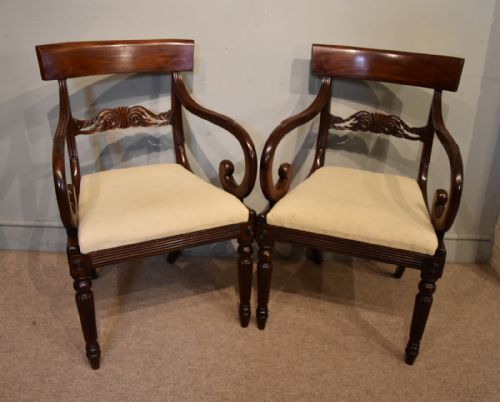


Reeded Arm Chair
These reeded arm chair examples offer classic Regency and Georgian seating for the home, bringing enduring timber character and traditional craftsmanship to any room.
Reeded Arm Chair
A reeded arm chair is a traditional seating form defined by parallel rounded mouldings carved directly into the timber frame. Buyers searching this phrase encounter pieces primarily originating from the Regency, George IV, and late Georgian eras.
The versions most commonly met on this page are constructed from mahogany, appearing as library chairs, desk chairs, and carvers. They often feature drop-in seats covered in velvet, needlepoint, or fabric.
Makers of the period applied these carved linear patterns to arms, legs, and rails to catch the light and add classical detail. These seating options serve as functional desk or elbow chairs with distinct historical provenance.
How they were made
Makers built these chairs using solid mahogany, shaping the timber by hand to form the distinctive reeded mouldings. Frames incorporated structural elements like sabre legs, rope backs, and scroll arms joined with traditional woodworking joints.
Upholstery techniques involved drop-in seat frames padded with natural materials and finished in textiles such as velvet, hessian, corduroy, or needlepoint. Brass hardware occasionally appeared on desk and library variants for mobility or structural enhancement.
Reeded Arm Chair Retail Price Guide 2026
Typical asking prices for reeded arm chair among the pieces listed under this phrase on Sellingantiques today, from the lower quarter to the upper quarter. They describe what is for sale here now, not the wider market.
Listings show these chairs spanning the Regency, George IV, and late Georgian periods, constructed entirely in mahogany with various upholstered drop-in seats.
What varies in quality
The distinction between standard examples and the top of the range rests on the crispness and depth of the carved reeding across the mahogany frame. Superior pieces display precise, even hand-carved lines that retain their sharpness along complex curves like scroll arms and sabre legs.
Overall proportion and timber selection also divide the grades, with finer chairs utilising well-figured mahogany and balanced, elegant frames designed as desk carvers or library seating. The integrity of the original joinery and the execution of details like rope backs further distinguish the better examples.
James Mein Kelso
The Reeded Arm Chair Glossary
- Reeding
- Parallel convex mouldings carved into timber to resemble a bundle of reeds. This decorative technique characterises Regency and Georgian furniture frames.
- Carver
- An armchair designed with open arms, typically taller and wider than standard dining chairs. These served as principal seats at a table or desk.
- Sabre leg
- A curving, outwardly splayed chair leg tapering toward the foot, mimicking the shape of a cavalry sabre. It is a defining feature of Regency design.
- Drop-in seat
- A removable wooden frame upholstered separately and dropped into the seat rails of a chair. This construction allowed for easier recovering over time.
- Bergère
- An enclosed armchair with upholstered back and sides set into a wooden frame. These offer deeper comfort than open arm variants.
Reeded Arm Chair: Frequently Asked Questions
What is a reeded arm chair?
A reeded arm chair is a traditional wooden seat featuring parallel carved mouldings along the frame. These pieces date primarily from the Regency and Georgian periods.
They function as library chairs, desk chairs, and carvers, combining structural timber frames with upholstered drop-in seats.
How do I date a reeded arm chair?
Dating relies on identifying stylistic markers such as sabre legs, rope backs, and scroll arms typical of the Regency and George IV eras. Timber choice, construction methods, and joinery details provide further chronological clues.
Most examples on this page span the late eighteenth century through the early nineteenth century.
Where were these chairs used?
These chairs served multiple domestic and professional roles, functioning around dining tables, writing desks, and in libraries. Their sturdy mahogany construction and upholstered seats suited rooms designated for reading and correspondence.
Elbow and desk variants provided support for working environments within period homes.
How should I care for mahogany frames?
Mahogany requires stable indoor humidity away from direct heat sources to prevent timber movement and cracking. Regular dusting with a soft, dry cloth preserves the polished surface without building up residue.
Upholstery care depends on the specific textile used, whether velvet, needlepoint, or leather.