
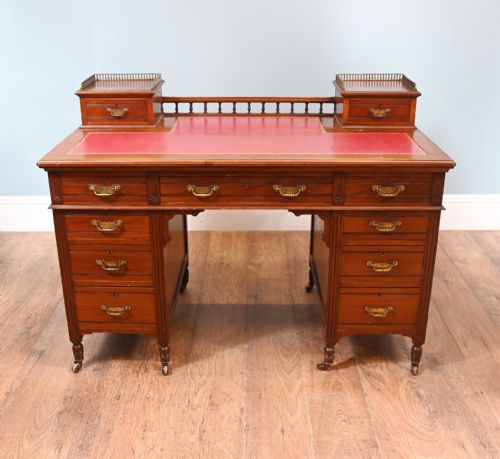


Red Leather Pedestal Desk
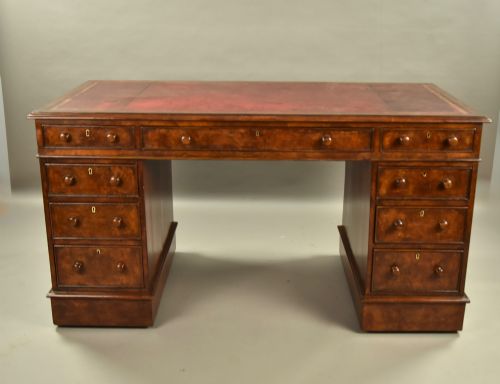
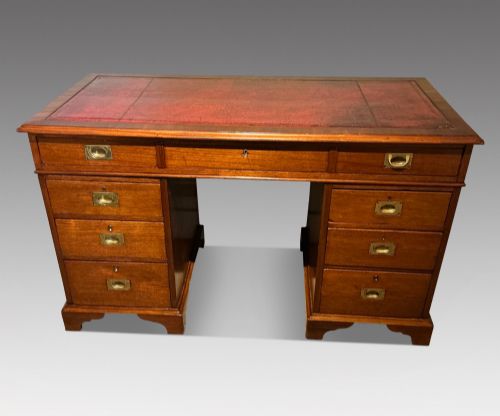
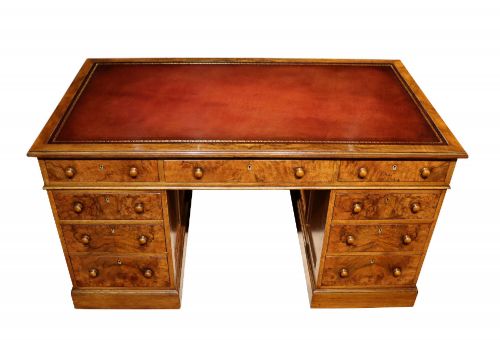
These red leather pedestal desk examples combine substantial timber construction with a practical writing surface for functional daily use.
Red Leather Pedestal Desk
A red leather pedestal desk provides a generous double-sided or single-sided writing surface supported by twin banks of drawers, forming a stable structure for study or correspondence. These pieces appear most frequently in Victorian and Edwardian iterations constructed from mahogany, burr walnut, and oak.
The format encompasses variations such as partners desks, kneehole desks, and Davenport writing desks alongside standard pedestal arrangements. Makers during the nineteenth and early twentieth centuries built these tables to serve libraries, offices, and private studies.
Materials and construction
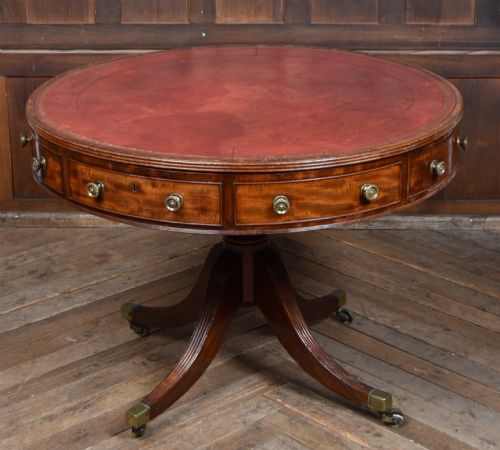
Makers utilised solid timbers and veneers including mahogany, burr walnut, and oak over robust carcases, incorporating brass handles and mounts for operational hardware. Writing surfaces received inset panels of red leather, frequently embellished with blind or gilt tooling along the perimeter.
Cabinets typically divide into three sections - two distinct pedestals and a top writing section - to facilitate movement and placement. Panel construction and drawer framing employ traditional joinery techniques suited to heavy daily use.
One cheerful Victorian oak example arrives complete with a hand-carved Green Man grinning out from beneath the writing surface.
Evaluating quality and finish
Figure and grain selection in the timber differentiate standard utilitarian office pieces from finer domestic examples finished in burr walnut, figured mahogany, or oak. The depth of the timber polish and the crispness of carved details indicate the tier of the original workshop.
Hardware retention, such as original brass handles and working locks with functional keys, contributes to the integrity of a piece. The quality of the red leather insert, including the neatness of the gold tooling and the preservation of the surface texture, influences the overall finish.
Edwards & Roberts·James Winter & Sons
The Red Leather Pedestal Desk Glossary
- Pedestal desk
- A writing table supported by two separate pedestals containing drawers, usually arranged in a twin pedestal configuration.
- Partners desk
- A large double-sided desk designed for two people to work opposite one another, featuring drawer banks on both sides.
- Davenport
- A compact writing desk featuring a sloping top over a set of side drawers, originating in the late eighteenth century.
- Kneehole desk
- A desk with a central recess for the legs, flanked by pedestals containing multiple drawers.
- Tooled leather
- Leather decorated with heated brass tools to impress patterns, lines, or gilt ornamentation around the border of a writing surface.
Red Leather Pedestal Desk: Frequently Asked Questions
How do I clean the red leather?
Wipe the surface gently with a slightly damp, soft cloth to remove dust. Avoid harsh chemical cleaners that can damage the leather or fade the gilt tooling.
Nourish the hide periodically with a suitable leather conditioner to maintain flexibility and prevent cracking over time.
Can I replace the leather top?
Replacement leather panels are fitted when the original surface is worn beyond preservation. Many period desks have received replacement leather inserts during their working life.
Selecting a red hide with appropriate tooling ensures the replacement matches the character of the surrounding timber.
Are these desks easy to move?
Most pedestal desks separate into three components consisting of a top and two drawer pedestals. This modular construction simplifies transport between rooms.
Lifting the sections separately reduces weight and protects the structural joinery during relocation.
How do I date a pedestal desk?
Examine the timber construction, drawer linings, and hardware styles to determine the likely period of manufacture. Secondary woods and fastener types provide reliable clues regarding the decade of production.
Stylistic markers such as Victorian Gothic carving or Edwardian inlay align pieces with specific design eras recorded in the evidence.