

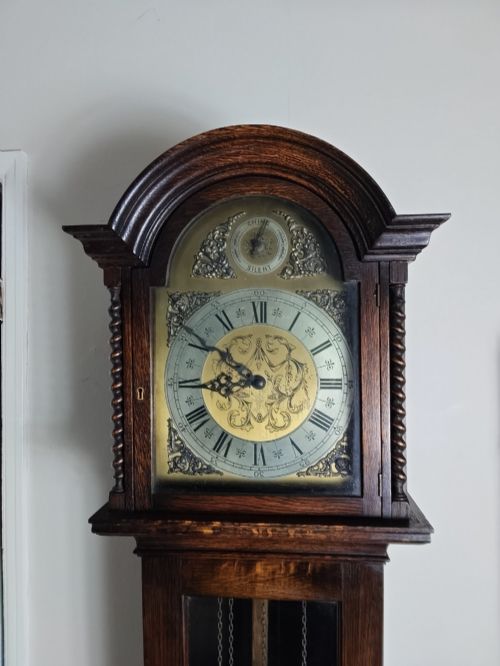
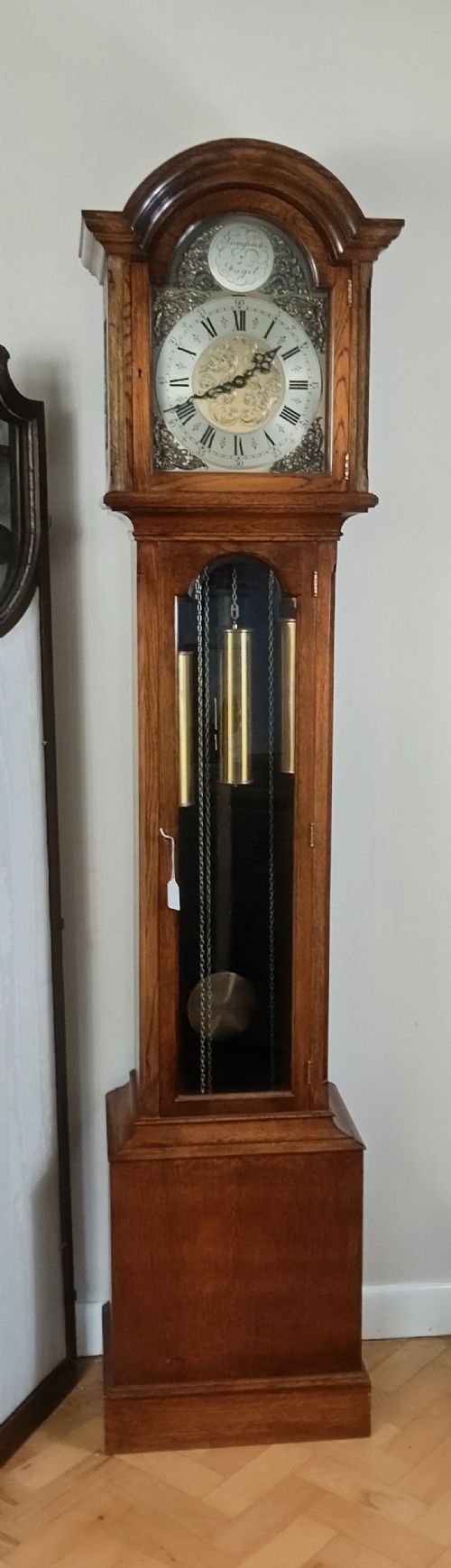


Quarter Chiming Grandfather Clock
A quarter chiming grandfather clock fills a room with rich traditional timekeeping sounds, offering both mechanical complexity and striking presence.
Quarter Chiming Grandfather Clock
A quarter chiming grandfather clock combines tall case construction with sophisticated chiming movements that mark the passage of every fifteen minutes. The pieces found here span the Edwardian era, the Victorian period, and the 1920s and 1930s, featuring revival styles such as Georgian, Jacobean, and Queen Anne alongside early twentieth century English designs.
Buyers will encounter both full-sized grandfathers and smaller grandmother longcase variants, often housed in slim or compact proportions. These taller floor-standing timepieces operate using either weight driven mechanisms or intricate musical cylinders.
Timbers dominate the structural forms on this page, with oak and mahogany appearing alongside walnut and burr walnut. Brass dials, glass viewing doors, and steel internal components complete the construction of these musical timepieces.
How they were made
Cabinetmakers constructed the tall floor-standing cases using solid hardwoods and decorative veneers, selecting oak, mahogany, walnut, and burr walnut to achieve traditional finishes. Glass doors protect the dial face while allowing a clear view of the swinging pendulum inside.
Clockmakers fitted complex mechanical movements driven by weights, incorporating specialised trains of gears to sound the quarters on bells or metal tubes. Dials feature brass components and steel hands, engineered to coordinate both hour strikes and multi-tune musical sequences.
Quarter Chiming Grandfather Clock Retail Price Guide 2026
Typical asking prices for quarter chiming grandfather clock among the pieces listed under this phrase on Sellingantiques today, from the lower quarter to the upper quarter. They describe what is for sale here now, not the wider market.
Listings feature oak, mahogany, walnut, and burr walnut across Edwardian, Victorian, and early twentieth century periods.
What varies in quality
The sophistication of the internal movement dictates the upper tier of these timepieces, distinguishing simple quarter chimes from multi-tune musical mechanisms playing across bells or tubes. Cases constructed from figured veneers like burr walnut exhibit higher levels of cabinetmaking skill than standard plain timber housings.
Proportion and scale also separate the pieces, with slender grandmother clocks and compact small grandfathers requiring precise miniaturisation of full-sized movements. Maker attribution adds distinction, particularly when signed by established firms known for reliable musical longcases.
Enfield·Camerer Cuss And Co
The Quarter Chiming Grandfather Clock Glossary
- Quarter chiming
- A mechanical function that sounds the time at every fifteen minute interval using multiple hammers and gongs, bells, or tubes.
- Grandmother clock
- A smaller, more slender version of the traditional longcase clock, typically produced during the early twentieth century.
- Longcase clock
- The formal term for a tall floor-standing pendulum clock housed in a protective wooden case, commonly called a grandfather clock.
- Burr walnut
- A highly figured wood veneer sliced from walnut tree growths, valued for its swirling grain patterns on furniture and clock cases.
Quarter Chiming Grandfather Clock: Frequently Asked Questions
How do quarter chiming clocks work?
These clocks use complex gear trains driven by hanging weights to activate hammers against bells or tubes every fifteen minutes. The mechanism coordinates both the quarter melody and the subsequent hour strike.
Maintaining the correct sequence requires careful adjustment of the weights and pendulum to ensure the musical train releases at the precise moment.
What is a grandmother clock?
A grandmother clock is a smaller, more slender variation of the traditional grandfather longcase clock. They gained popularity during the early twentieth century for homes with lower ceilings.
Despite their reduced scale, these smaller cases often house sophisticated quarter chiming or musical movements.
Which woods were used for cases?
Cabinetmakers built these tall clock cases primarily in oak, mahogany, walnut, and burr walnut. The choice of timber often reflected the prevailing revival style of the period.
Figured veneers like burr walnut were selected for high-status pieces to add decorative texture to the tall wooden trunk.
How do I identify the period?
Dating relies on stylistic details, timber choices, and construction methods that point towards Victorian, Edwardian, or interwar eras. Revival styles such as Jacobean and Georgian Revival provide further chronological clues.
Signatures on the dial or movement can also help confirm the exact decade of manufacture.