


Precision Brass Scales
Precision brass scales are fine measuring instruments that bring mechanical honesty and bright metalwork into a room.
Precision Brass Scales
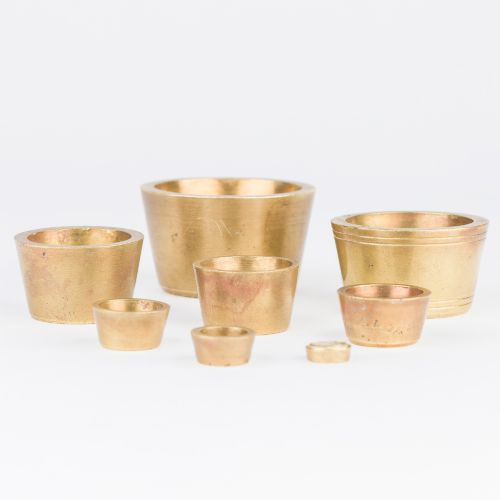
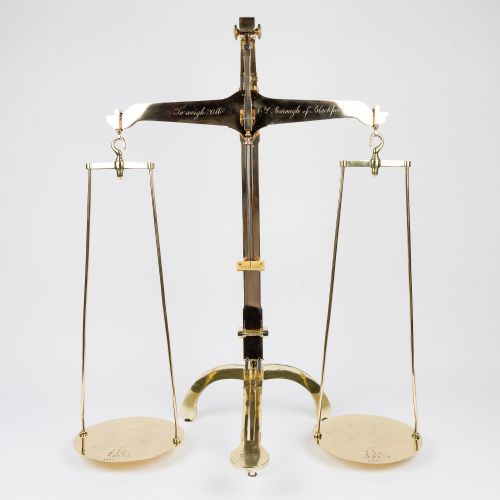
Precision brass scales represent the intersection of scientific utility and nineteenth- and twentieth-century engineering. Buyers seeking precision brass scales encounter items spanning from the Victorian era through the mid-twentieth century, including beam scales designed for chemists, verification balances used by municipal authorities, and sets of Troy ounce weights.
The objects on this page largely comprise scientific instruments and scales and balances, alongside related technical equipment from the same periods. Most examples date from the decades between eighteen-eighty and nineteen-forty, reflecting a time when weighing required meticulous manual calibration and solid metal construction.
How they were made
Makers built precision brass scales using solid brass combined with mahogany bases, glass panels, steel components, and cast iron. Woodwork provided stable mounting surfaces while polished brass formed the beams, pillars, and pans necessary for delicate measurements.
Makers applied paint for lettering and markings, whilst copper and glass appeared in associated scientific apparatus. Construction relied on tight mechanical tolerances to ensure balance and accuracy in professional settings such as assay offices and chemists' shops.
Municipal inspectors once carried heavy brass balances to ensure local shopkeepers gave honest weight down to the last grain.
What varies in quality
Quality in these instruments rests upon the precision of the mechanics, the integrity of the original materials, and the presence of maker signatures. Finer examples retain their original glass panelling, unpolished beam markings, and properly fitted mahogany housing without replacement parts.
The execution of the engraving on beams and weights indicates the standard of the workshop. Instruments made for official verification duties or produced by recognised makers demonstrate a higher level of mechanical refinement than standard commercial models.
De Grave Short And Co·Oertling·Thomas Dunn Of North Street Edinburgh·Negretti And Zambra London
The Precision Brass Scales Glossary
- Beam scale
- A weighing instrument with a central fulcrum and two pans suspended from a balanced horizontal arm. This design formed the basis of most high-accuracy weighing before electronic measurement.
- Troy ounce
- A unit of mass used for precious metals and apothecary weights, distinct from avoirdupois measurement. Sets of these weights often accompany fine balances.
- Verification balance
- A heavy-duty precision scale used by municipal authorities to inspect commercial weights and measures. These instruments required exceptional stability and accuracy.
- Chemist's scales
- Sensitive beam balances enclosed in glass cases to prevent air currents from disrupting measurements. They represent the domestic and commercial application of scientific precision.
Precision Brass Scales: Frequently Asked Questions
How do I clean brass scales?
Maintenance requires only a soft cloth to remove dust from the brass and glass surfaces. Aggressive metal polishes should be avoided as they remove the aged patina that collectors value.
Preserving the original finish ensures the instrument retains its historic character. Care must be taken around delicate indicator needles and balance beams.
Are these scales still accurate?
Most surviving instruments serve as decorative objects and historical artefacts rather than working laboratory equipment. Changes in temperature and wood movement over decades affect their calibration.
Restoring them to working order requires professional adjustment of the knife-edge pivots. Many buyers choose to display them in their static, balanced state.
What periods do these pieces span?
The selection covers items from the mid-nineteenth century through the middle of the twentieth century. Victorian and Edwardian examples dominate the earlier portion of the range.
Later pieces from the nineteen-thirties and nineteen-forties reflect refined industrial design. Each period brings distinct styling to the wooden bases and pillar designs.
Why are some scales in glass cases?
Enclosures protected sensitive balances from air currents and dust that would interfere with minute measurements. The glass allowed operators to view the pointer without opening the door.
These mahogany and glass housings are known as balance boxes or assay cases. They form an integral part of the survival of the instrument.