
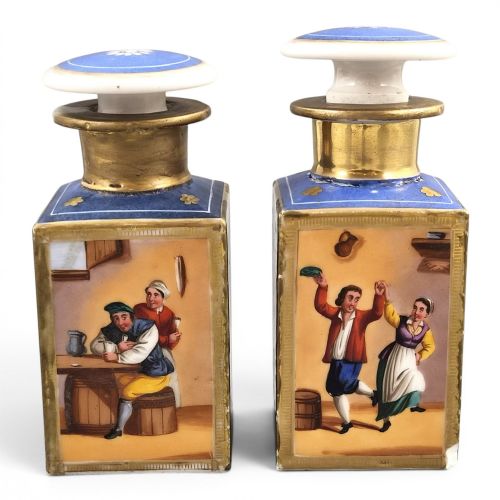


Porcelain Perfume Flask
A porcelain perfume flask brings tactile elegance to a dressing table, offering a pocket of history moulded in hard-paste porcelain or parian ware.
Porcelain Perfume Flask
A porcelain perfume flask is a small ceramic vessel designed to hold scent, encompassing forms such as scent bottles, snuff bottles, and rose water sprinklers. When you search for a porcelain perfume flask, you encounter works spanning the nineteenth century, the Victorian and Edwardian eras, the Regency period, and the nineteen-thirties.
The selections on this page feature both European houses like Jacob Petit and Flight, Barr & Barr, alongside Qing dynasty Chinese porcelain snuff bottles. You are most likely to meet nineteenth-century specimens decorated with enamels or figural scenes.
Vessels take various configurations, from miniature vases and speckled egg shapes to figural representations like Shoulao. Each piece reflects the specific decorative tastes of its originating period, whether French Restoration, Victorian, or Art Deco.
How they were made
Makers shaped these flasks from hard-paste porcelain or parian ware, applying detailed ceramic techniques before finishing the surfaces. Artisans incorporated enamel painting to render complex figural scenes, such as those seen on Jacob Petit and Famille Rose pieces.
Gilt, gold leaf, and sterling silver mounts frequently complete the composition, providing functional collars, hinges, or decorative accents. Worcester and Macintyre productions demonstrate specific regional potting methods, utilising local clays and specialised kiln firings.
Listings incorporate nineteenth-century Victorian pieces alongside Regency Worcester productions and nineteen-thirties Art Deco ceramics.
What varies in quality
Quality rests upon the crispness of the porcelain moulding and the precision of the hand-painted enamel decoration. Pieces with finely delineated figural work or sophisticated gilding indicate superior workshop standards.
The inclusion of hallmarks on silver mounts or the prestige of specific makers such as Flight, Barr & Barr elevates a piece above standard domestic production. Preservation of the original gilding and enamels without loss dictates the standing of an individual flask.
Jacob Petit·Crown Staffordshire·Macintyre·Flight Barr And Barr
The Porcelain Perfume Flask Glossary
- Hard-paste porcelain
- A dense, durable ceramic composed of kaolin and petuntse fired at high temperatures. It resists scratching and takes glossy lead glazes evenly.
- Famille rose
- A palette of opaque enamel colours dominated by pink, introduced to Chinese porcelain in the eighteenth century. It allows for nuanced shading in floral and figural motifs.
- Rose water sprinkler
- A vessel with a bulbous body and a long, narrow neck designed for sprinkling scented water. These pieces often feature globular forms and fitted stoppers.
Porcelain Perfume Flask: Frequently Asked Questions
How do I date a porcelain perfume flask?
Dating relies on stylistic markers, materials, and any maker marks or stamps found on the ceramic base or silver mounts. Regency and Victorian examples often feature distinct neo-classical or floral motifs.
Later pieces from the nineteen-thirties adopt geometric Art Deco lines, whereas nineteenth-century Chinese pieces display specific Qing period palette characteristics.
How were these flasks used historically?
Owners used them to carry personal scents or refreshing waters during daily outings or social events. Snuff bottles specifically held finely ground tobacco for inhalation.
Many remained stationary on dressing tables as decorative ceramic objects, while smaller versions fitted easily into pockets or small evening bags.
How do I care for antique porcelain flasks?
Care involves gentle dusting with a soft, dry cloth to protect delicate enamel work, gilt highlights, and sterling silver mounts. Avoid using liquid cleaners that might strip the original surface decorations.
Display them away from direct sunlight and secure them on stable surfaces to prevent accidental tipping or impact.