


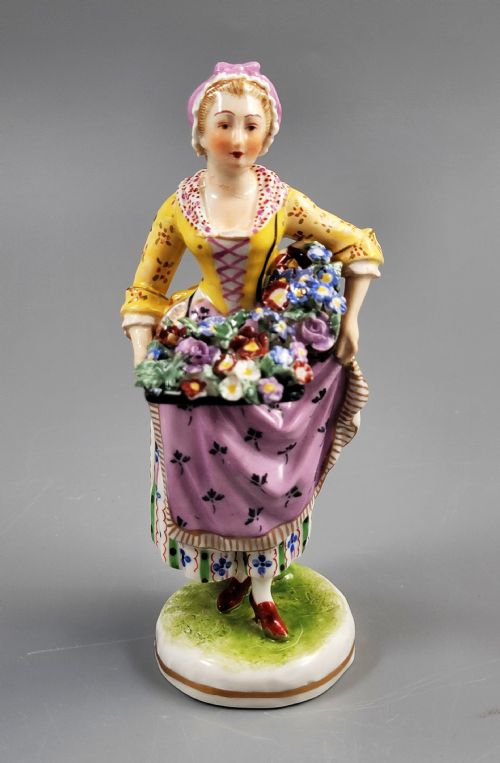

Porcelain Girl Statue
These porcelain girl statue pieces bring character to a room through finely modelled ceramic forms produced across the eighteenth, nineteenth and early twentieth centuries.
Porcelain Girl Statue
When you search for a porcelain girl statue, you encounter figurines and sculptural groups depicting young females in various historical attire and settings. The pieces span periods from the eighteenth century through to the Art Deco era, encompassing styles such as Rococo Revival, Victorian, Art Nouveau, Neoclassical and Japanese Meiji.
You are most likely to meet nineteenth-century figures on this page, including biscuit and parian porcelain representations alongside glazed ceramic works. Formats range from decorative table figurines and figure groups to specialised objects like hatpin holders depicting subjects such as flower sellers, wool spinners and geisha girls.
Materials and production methods
The pieces utilise soft-paste porcelain, hard-paste porcelain, biscuit porcelain and parian porcelain as primary ceramic bodies. These materials allow for varying degrees of translucency and surface texture, from the chalky matte finish of parian to the smooth sheen of traditional glazed ceramic.
Porcelain Girl Statue Retail Price Guide 2026
Typical asking prices for porcelain girl statue among the pieces listed under this phrase on Sellingantiques today, from the lower quarter to the upper quarter. They describe what is for sale here now, not the wider market.
Distinctions in craftsmanship and form
Quality separates along the crispness of moulding and the sensitivity of hand-painted or hand-tooled surface details. Superior examples display sharply defined facial expressions, delicate fingers, and intricate rendering of textiles and foliage without the softening of contours often found in secondary production runs.
The sophistication of the ceramic body and the application of enamel or gold leaf determine the visual depth of a piece. Finer works integrate the glaze and pigment harmoniously with the underlying porcelain, whereas lesser examples show heavy or flat coloration that obscures the underlying sculpture.
Meissen·Derby·Dressel, Kister and Cie·Royal Dux·Helena Wolfsohn
The Porcelain Girl Statue Glossary
- Parian porcelain
- A fine-grained, unglazed porcelain developed in the nineteenth century that resembles carved marble. It is prized for its matte finish and ability to hold crisp sculptural detail.
- Biscuit porcelain
- Unglazed ceramic fired once to create a porous, matte white surface. It is frequently employed for figures where a natural stone-like texture is desired.
- Soft-paste porcelain
- An artificial ceramic composition fired at lower temperatures than hard-paste porcelain. It exhibits a warm, creamy body and a distinctive glaze interaction.
- Hatpin holder
- A hollow ceramic vessel designed to store long decorative pins. These functional sculptures often take the form of figures such as flappers or historical characters.
- Figure group
- A ceramic sculpture comprising multiple interacting human or animal figures set on a unified base. These compositions are typical of eighteenth-century and nineteenth-century manufactories.
Porcelain Girl Statue: Frequently Asked Questions
How do I date a porcelain girl statue?
Dating relies on stylistic indicators, material composition and factory marks stamped or painted on the underside. Eighteenth-century pieces often feature softer pastes and Rococo or Neoclassical styling, while nineteenth-century works introduce parian bodies and Victorian or Art Nouveau aesthetics.
Later pieces from the twentieth century frequently adopt geometric Art Deco lines or specialised forms like hatpin holders. Comparing the modelling technique and colour palette to known factory periods helps narrow the manufacturing window.
What is the difference between bisque and parian?
Bisque refers generally to any unglazed ceramic body that has undergone its initial firing. It presents a porous, matte texture across various porcelain and earthenware formulations.
Parian is a specific nineteenth-century porcelain recipe formulated specifically to imitate carved white marble. It contains a higher proportion of feldspar, which vitrifies during firing to produce a denser and smoother matte surface.
Where were these ceramic figures displayed?
Historically, figures of girls and children occupied prominent positions on mantelpieces, side tables and in dedicated cabinet displays within Victorian and Georgian drawing rooms. Their decorative purpose was to showcase the owner's refinement and appreciation for European or Asian ceramic art.
Functional variants, such as hatpin holders, sat atop dressing tables to organise everyday accessories. Today, they function similarly as cabinet pieces or focal points on bookshelves.