


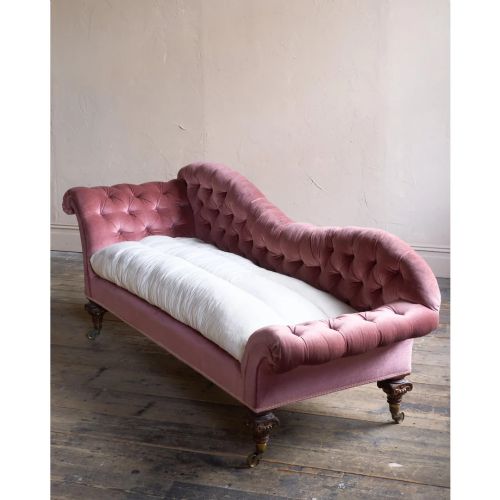


Pink Velvet Lounge Chair
A pink velvet lounge chair brings warmth and tactile depth to a room, offering comfortable seating through Victorian, Edwardian and 1930s forms.
Pink Velvet Lounge Chair
A pink velvet lounge chair search brings up a varied selection of antique seating from the nineteenth century onward, including Victorian bedroom chairs, spoonback armchairs and chaise longues. These pieces combine deep upholstery with wooden frames in walnut, mahogany or general hardwood.
Buyers frequently encounter Victorian examples alongside Edwardian wingback armchairs and 1930s designs. The forms range from open armchairs to button back seating and low bedroom chairs.
How they were made
Frames are constructed from solid timbers such as walnut, mahogany and hardwood, sometimes featuring carved details or brass elements. The structural woodwork supports sprung or padded upholstery finished in velvet and occasionally supported on ceramic castors.
Joinery and carving techniques reflect the specific period of manufacture, from mid-nineteenth century walnut frames to Edwardian and 1930s construction methods.
Pink Velvet Lounge Chair Retail Price Guide 2026
Typical asking prices for pink velvet lounge chair among the pieces listed under this phrase on Sellingantiques today, from the lower quarter to the upper quarter. They describe what is for sale here now, not the wider market.
Listings incorporate Victorian, Edwardian and 1930s pieces utilising walnut, mahogany, hardwood, brass, ceramic and velvet materials.
What varies in quality
Quality rests in the crispness of the timber carving and the integrity of the frame construction, whether in a walnut Victorian armchair or an Edwardian wingback. Finer examples show superior joinery and more substantial woodwork beneath the velvet upholstery.
The sophistication of the silhouette and the harmony between the wooden frame and the upholstered body determine the distinction between standard production and superior craftsmanship.
Holland and Sons
The Pink Velvet Lounge Chair Glossary
- Spoonback
- An armchair design with an oval, concave backrest resembling the bowl of a spoon, popular during the Victorian period. This shape provides ergonomic support for the spine.
- Button back
- An upholstery style where depressions are formed by pulling ties or buttons tightly through the padding into the wooden frame. It creates a distinctive tufted pattern common on Victorian seating.
- Chaise longue
- An upholstered sofa shaped like a chair with a long seat large enough to support the legs. Nineteenth-century examples often feature architectural elements like ionic column legs.
- Wingback
- An armchair with high back and flanking side panels designed to shield the sitter from drafts. Edwardian variations of this form appear frequently in softer seating.
Pink Velvet Lounge Chair: Frequently Asked Questions
What periods do these armchairs come from?
The selection spans the nineteenth century, including Victorian and Edwardian eras, as well as the 1930s. Each period introduces distinct framing styles and proportions.
Victorian pieces often feature walnut or mahogany with carved details, while later decades shift toward Edwardian wingbacks and 1930s silhouettes.
How do I identify a Victorian armchair?
Victorian armchairs typically display dark timber frames in walnut or mahogany, frequently accompanied by spoonbacks or button back upholstery. Turned wooden legs sometimes feature ceramic castors.
Carved ornamentation and robust hardwood frames further point to nineteenth-century manufacture, distinguishing them from lighter Edwardian designs.
What is the difference between an armchair and a chaise longue?
An armchair provides seated support with armrests and a back designed for upright rest. They appear in open, spoonback and wingback formats.
A chaise longue offers an elongated seat combined with a backrest, functioning as a sofa for reclining rather than a standard chair.