

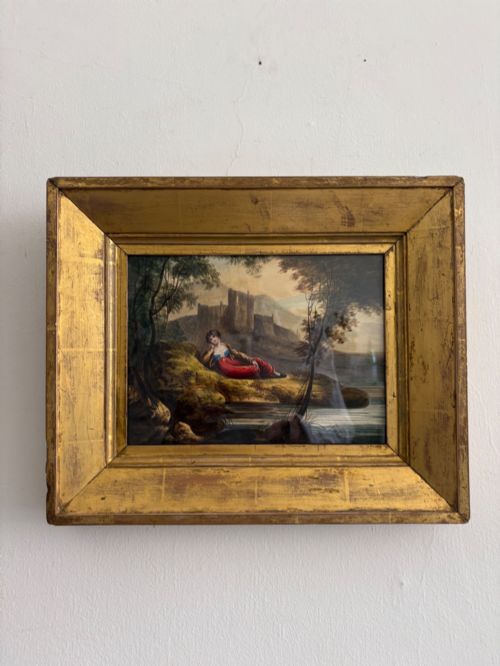


Period Watercolour Landscape
These period watercolour landscape works capture topography and atmospheric countryside views using delicate pigments on paper.
Period Watercolour Landscape
A period watercolour landscape is an original work on paper capturing countryside views, rural scenes, and topographical settings from earlier eras. Buyers seeking a period watercolour landscape will find works spanning the Georgian, Victorian, and Edwardian epochs up to the interwar years.
The selections available here include framed artwork executed by named artists and regional British and European schools. These paintings often depict natural scenery, coastal vistas, and figures within pastoral settings.
Most examples appear behind glass within gilt wood frames that complement the delicate nature of works on paper. These paintings range in date from the early nineteenth century through the Edwardian period and into the twentieth.
Materials and techniques
Artists apply watercolour pigment onto paper supports, occasionally combining gouache for added opacity and highlights. These materials demand precise brushwork, as water-based pigments do not permit the straightforward corrections possible in oil painting.
Surviving pieces are generally mounted behind protective glass and housed within wooden frames finished with gilt or gilding. This framing technique protects the delicate paper and water-soluble pigments from atmospheric damage and handling.
Period Watercolour Landscape Retail Price Guide 2026
Typical asking prices for period watercolour landscape among the pieces listed under this phrase on Sellingantiques today, from the lower quarter to the upper quarter. They describe what is for sale here now, not the wider market.
Listings feature works created across the Georgian, Victorian, Edwardian, and Interwar periods using watercolour pigment on paper.
Factors determining quality
Quality in a period watercolour landscape rests upon the handling of light, atmospheric depth, and the confidence of the brushwork. Stronger compositions demonstrate a assured grasp of perspective and tonal balance across the paper.
The condition of the pigment and the paper support heavily influence the standing of any given work. Well-preserved pieces retain their original colour intensity without excessive fading or paper discoloration from acidic mounts.
Philip Richard Morris·Gaston Cornil·Robert Buchan Nisbet·Edith E Caswall·James H Hulse·Thomas Ivester Lloyd·Thomas Rowlandson
The Period Watercolour Landscape Glossary
- Watercolour pigment
- Finely ground colour particles mixed with a water-soluble binder for application on paper.
- Gilt frame
- A wooden picture frame finished with a thin layer of gold leaf or metallic gilding.
- Gouache
- An opaque water-based medium frequently used alongside transparent watercolour to create highlights.
- Paper support
- The foundational sheet of cellulose material upon which the artist paints the landscape.
- Pre-Raphaelite
- An artistic movement associated with detailed observation of nature and vibrant colour palettes.
Period Watercolour Landscape: Frequently Asked Questions
What periods do these landscapes cover?
The listings span from the Georgian era through the Victorian and Edwardian periods into the early twentieth century.
Porter and painter dates range from the eighteenth century up to the interwar years.
How are these watercolours framed?
Most works are preserved behind protective glass within period wood frames featuring gilt finishes.
This traditional presentation safeguards the delicate paper and water-soluble pigments underneath.
Are these paintings signed by artists?
Several pieces bear signatures from known artists or attribution to specific nineteenth-century regional schools.
Other works remain attributed to broader stylistic periods or anonymous makers of the era.
What subjects do the paintings show?
The artworks predominantly depict countryside landscapes, rural scenes, coastal views, and topographical settings.
Some compositions additionally incorporate human figures, shepherds, or historical genre elements.