


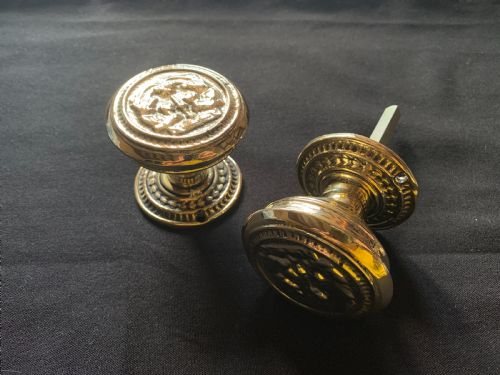


Period Door Knobs
Period door knobs offer an immediate touch of historical substance to a doorway, bringing tactile authenticity to everyday rooms through tactile metal and wood.
Period Door Knobs
Period door knobs comprise hardware designed across the Georgian, Regency, Victorian, and Edwardian eras, spanning simple operational pairs and single centre door pulls. You will frequently encounter Victorian brass examples alongside Regency designs and Arts and Crafts variations.
The selection ranges from sets equipped with matching finger plates and door locks to solitary centre pulls meant for substantial entrance doors. Forms shift from spherical beehive patterns and octagonal cuts to smooth oval shapes and amber glass spheres.
Evaluating Quality
Substance and heft distinguish superior examples, where heavy cast brass or bronze provides a solid weight in the hand. Finer pieces display crisp definition in octagonal facets, sharp turning lines on wooden elements, and clean casting without surface pitting.
The integrity of mechanical components, such as integrated matching door locks and complete pairs with original backplates, elevates an item. Craftsmanship shows in the secure seating of glass or wood inserts within their metal collars.
Some Victorian brass knobs feature a beehive shape, proving that historical hardware designers found inspiration in local apiaries.
The Period Door Knobs Glossary
- Centre Door Knob
- A fixed pull mounted centrally on a main entrance door rather than operating a latch, used primarily for pulling the door closed.
- Bee Hive
- A distinctive turned profile featuring concentric raised ridges resembling a traditional beehive, popular during the Victorian era.
- Finger Plate
- A flat protective metal plate fastened behind a door knob or handle to shield the surrounding surface from marks.
- Octagonal
- Formed with eight distinct sides, a geometric shape frequently utilised on mid-to-late nineteenth century hardware.
- Arts and Crafts
- A design movement prioritising traditional craftsmanship, visible in honest, utilitarian metalwork from the late nineteenth century.
Period Door Knobs: Frequently Asked Questions
What is a centre door knob?
A centre door knob mounts directly to the middle of an exterior entrance door rather than operating a latch mechanism. It serves as a solid pull to draw the door shut behind you.
These pieces tend to be larger and heavier than standard operating knobs, designed to withstand external weather and heavy daily use.
How do I date a door knob?
Dating relies on observing the prevailing style, material combinations, and manufacturing techniques associated with specific eras like Georgian, Victorian, or Edwardian. For instance, heavy geometric facets often point to mid-nineteenth century production.
Matching the overall form - such as an amber glass sphere or a turned ebony grip - against known period records provides further chronological context.
Can I use old door knobs today?
Many period door knobs integrate smoothly with standard modern latches and spindles, provided the square drive bar matches contemporary dimensions. Proper fitting ensures reliable daily operation in modern homes.
Checking the spindle aperture size before installation avoids fitting issues and protects original internal components from undue strain.
What metals were used historically?
Brass and bronze predominate among surviving hardware, valued for their durability and attractive ageing characteristics over decades of use. Iron and steel also appear, particularly in utilitarian or heavier structural contexts.
Foundries cast these metals into solid forms before hand-finishing the surfaces to achieve the desired texture and sheen.