
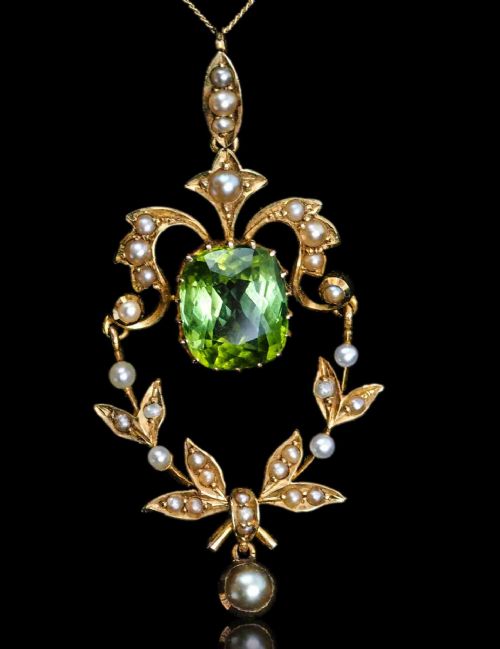


Peridot Pearl Necklace
A peridot pearl necklace brings together crisp green stones and luminous seed pearls in gold settings crafted during the Edwardian, Victorian and Art Nouveau periods.
Peridot Pearl Necklace
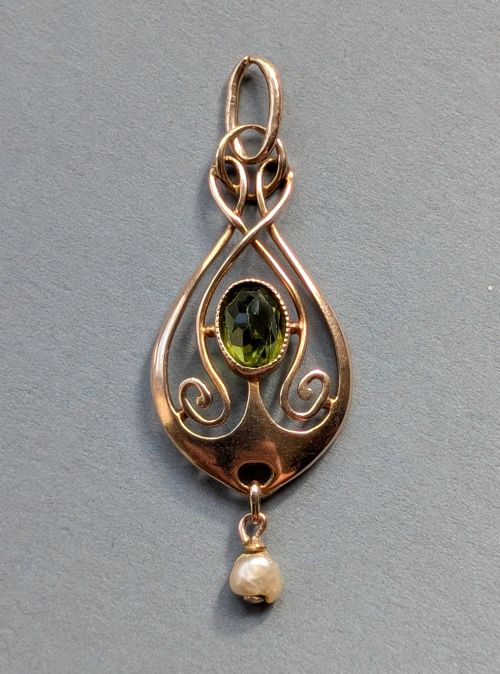
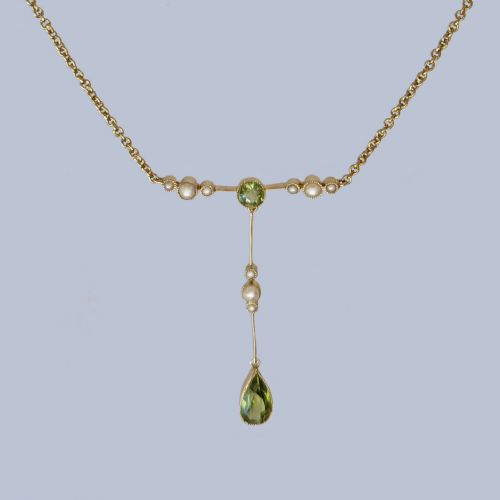
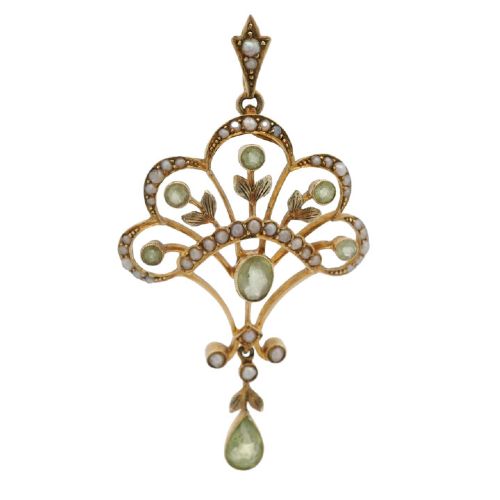
A peridot pearl necklace combines translucent green peridot crystals with delicate seed pearls, set into gold pendants, lavaliers and garland drop necklaces. Buyers seeking a peridot pearl necklace will find pieces predominantly originating from the Edwardian and Victorian eras, alongside creations from around 1900.
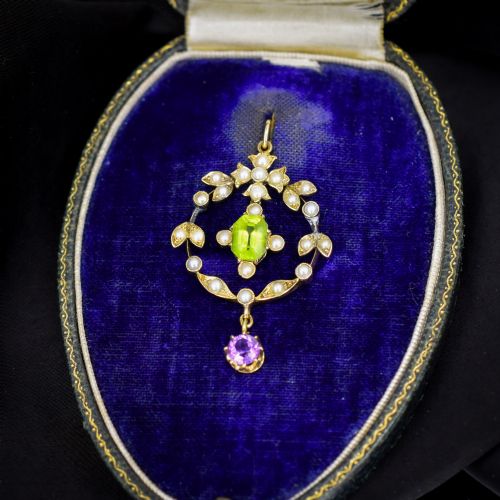
The surviving examples range from symmetrical floral scrollwork and star motifs to flowing Art Nouveau designs and drop lavaliers. Many incorporate secondary gemstones such as amethyst, pink tourmaline or white sapphire alongside the central peridots and pearls.
Pendant necklaces and convertible pendant-brooches represent the standard forms encountered in this category. These jewels reflect the delicate metalwork and specific gem combinations typical of late nineteenth and early twentieth-century jewellery workshops.
Variations in quality and design
Quality in a peridot pearl necklace rests upon the saturation and cut of the peridot stones, the uniformity of the seed pearls, and the intricacy of the gold wirework. Superior pieces display matched, vibrant green peridots without visible inclusions, paired with perfectly graduated and lustrous pearls.
The refinement of the metalwork distinguishes standard production from finer examples. Articulated garland drops, clean plique-à-jour enamel work and substantial 15ct gold framing indicate superior craftsmanship compared to simpler, lighter 9ct gold settings.
Listings feature Edwardian, Victorian, and Art Nouveau periods utilising 9ct gold, 15ct gold, and seed pearls.
Murrle Bennett·BIRKS
The Peridot Pearl Necklace Glossary
- Lavalier
- A pendant necklace featuring a central stone or drop suspended below a main motif on a fine chain. This style gained immense popularity during the Edwardian and Art Nouveau periods.
- Seed pearl
- A very small, naturally formed or cultured pearl, often drilled and strung in tight clusters or used to outline central gemstones in antique jewellery.
- Plique-a-jour
- An enamelling technique where enamel is applied in cells without a backing, resembling miniature stained glass that allows light to pass through.
- Garland style
- A jewellery design motif influenced by eighteenth-century neoclassical decoration, featuring swags, ribbons, flowers and bows rendered in gold and gemstones.
- Suffragette
- A descriptor for antique jewellery featuring green, white and violet stones - such as peridot, seed pearl and amethyst - associated with the women's suffrage movement.
Peridot Pearl Necklace: Frequently Asked Questions
How do I date a peridot pearl necklace?
Dating relies upon stylistic markers, gold carat marks, and construction techniques typical of the Victorian and Edwardian eras. Pieces from around 1900 frequently exhibit Art Nouveau whiplash lines or symmetrical garland motifs.
Assay marks and specific gold standards like 15ct provide further chronological clues. Lower carat marks and certain maker stamps help narrow the production window.
What is a lavalier necklace?
A lavalier is a specific pendant style featuring one or more dangling drops suspended from a central decorative element. These necklaces often hang from delicate gold chains.
Originating in the late nineteenth century, they became a defining form of Edwardian dress jewellery, frequently pairing peridots with seed pearls.
Are seed pearls durable for daily wear?
Seed pearls are delicate organic gems that require gentle care to maintain their lustrous nacre. They are sensitive to cosmetics, perfumes, and moisture.
While suitable for regular wear with proper precautions, antique necklaces featuring seed pearls benefit from occasional restringing and careful storage away from other jewellery.
Why do some necklaces combine peridot and amethyst?
The combination of peridot, seed pearls, and amethyst often relates to the colour scheme of the early twentieth-century women's suffrage movement. These stones represented green, white, and violet.
Such pieces are commonly referred to by collectors as Suffragette jewellery, reflecting the social history of the period alongside its decorative appeal.