
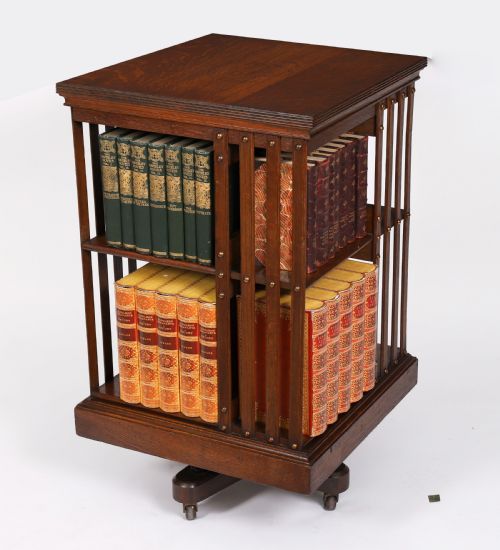


Pedestal Library Bookcase
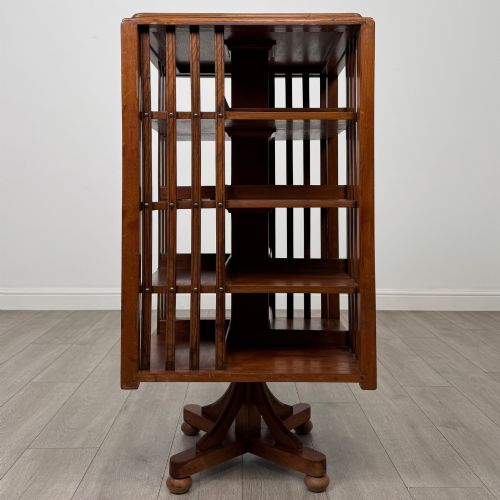
These pedestal library bookcase examples are sturdy revolving bookstands and fitted desks designed for constant daily consultation.
Pedestal Library Bookcase
When you search for a pedestal library bookcase, you encounter compact revolving bookstands alongside larger office sets and reading tables. These pieces emerge primarily from the Victorian and Edwardian eras, spanning from eighteen seventy into the nineteen thirties.
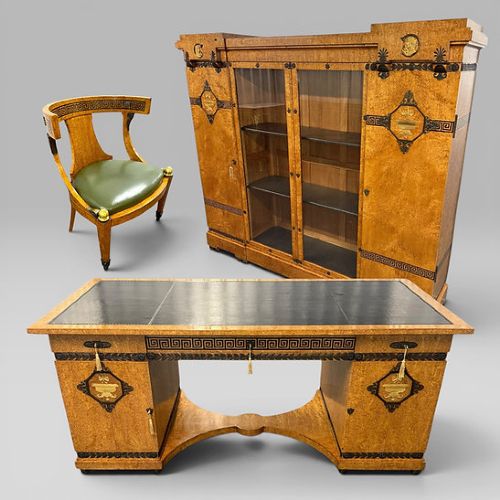
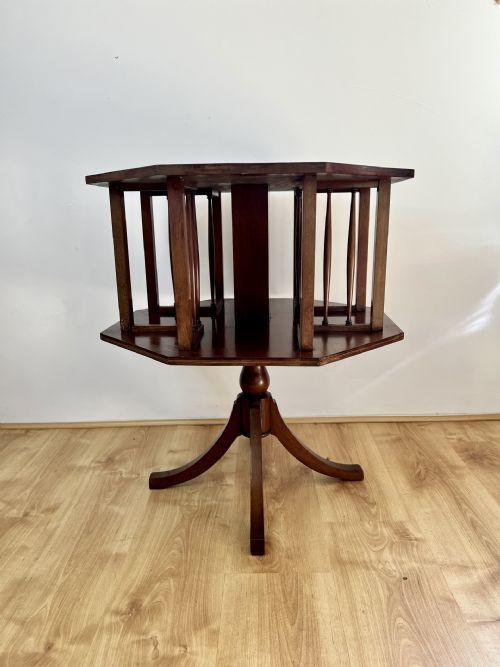
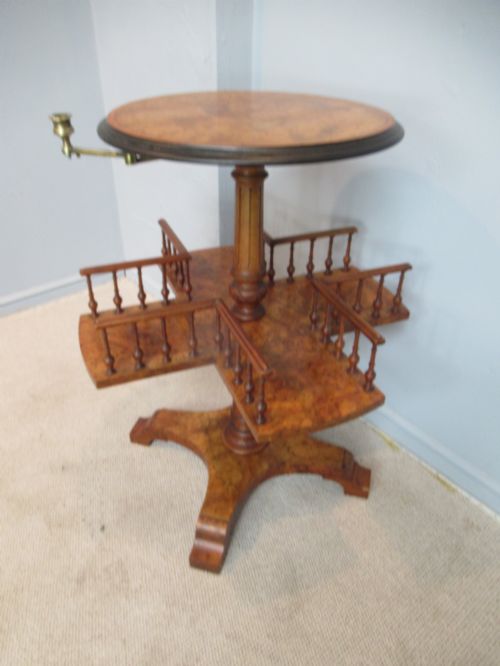
The revolving bookcase dominates the selection, turning smoothly on central floor or tabletop pedestals to keep volumes within arm's reach. You also find specialised forms including reading tables and comprehensive office sets comprising desks and cabinets.
Origins stretch across English, Scottish, French, and Anglo-Indian workshops, showing how different makers adapted the rotating book format for studies and libraries. Oak and mahogany provide the structural backbone for the majority of these revolving designs.
How they were made
Cabinet makers utilised dense hardwoods such as oak and mahogany for structural strength, adding decorative veneers like burr walnut and satinwood to prominent surfaces. Brass fittings and iron internal mechanisms provide the necessary pivot and rotation for heavy book loads.
Inlaid woodwork and parcel gilding appear on select examples to elevate the visual appeal of writing desks and library tables. Traditional joinery methods ensure that vertical partitions and slatted shelves bear the weight of numerous volumes securely.
Object types include standard revolving bookcases, book mills, reading tables, and comprehensive French Neoclassical office sets.
What varies in quality
The smoothness of the internal rotating mechanism defines the mechanical caliber of a revolving bookcase, separating effortless movement from stiff rotation. Superior examples feature robust hidden ball-bearing or spindle systems that support full tiers of books without tilting.
Material selection and surface finish mark the distinction between utility office furniture and high-status library pieces. Finely figured burr walnut veneers, intricate mahogany inlay, and crisp brass hardware indicate workshops of higher distinction.
Mercier Frères
The Pedestal Library Bookcase Glossary
- Revolving bookcase
- A freestanding or tabletop case mounted on a concealed pivot mechanism allowing it to spin freely. This design maximises book storage within a minimal floor footprint.
- Burr walnut
- A highly prized wood veneer derived from the growths of walnut trees, displaying intricate, swirling grain patterns. Cabinet makers selected it for decorative focal points on Victorian and Edwardian furniture.
- Parcel gilt
- A decorative technique where specific carved or moulded details receive a thin application of gold leaf while the surrounding wood remains exposed. It highlights architectural motifs on nineteenth century library tables.
- Inlay
- The technique of embedding contrasting woods, shells, or metals flush into the primary wood surface to create geometric or floral patterns. Edwardian makers utilised this method to ornament mahogany bookcase tops.
- Office set
- A coordinated suite of furniture intended for a study or library, typically comprising a desk, matching cabinet, and seating. These ensembles reflect unified stylistic choices from specific cabinet making firms.
Pedestal Library Bookcase: Frequently Asked Questions
What is a pedestal library bookcase?
It is a rotating bookstand or fitted desk designed to hold reference volumes within easy reach in a study or library.
Most examples turn on a central axis, allowing users to browse titles from a seated position.
How do I date a revolving bookcase?
Dating relies on timber choices, construction techniques, and stylistic markers recorded across the Victorian and Edwardian periods.
Earlier nineteenth century pieces often feature dense mahogany or Scottish burr walnut, while later twentieth century examples display simpler oak construction.
Where were these pieces used?
They served primarily in private libraries, offices, and studies where quick access to numerous volumes was essential.
Compact revolving versions sat beside armchairs or on tabletops, whereas larger office sets anchored executive rooms.
How do I care for wood finishes?
Maintain the polished timber surfaces by keeping them away from direct heat sources and sudden humidity changes.
Apply a traditional beeswax polish periodically to nourish the mahogany, oak, or walnut grain without building up heavy residue.