




Parquetry Semainier
A parquetry semainier is a slender tall chest designed to hold a week of linen or daily papers, prized for its geometric wood veneers and vertical elegance.
Parquetry Semainier
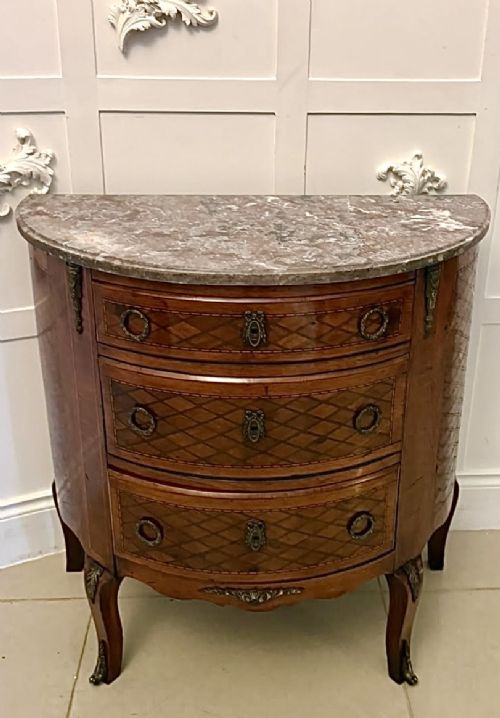
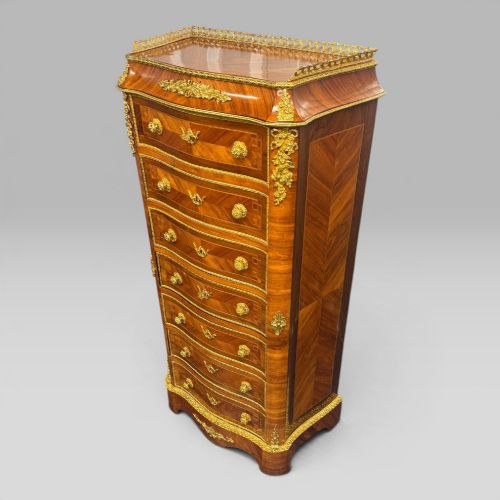
A parquetry semainier takes the form of a tall, narrow chest of drawers typically fitted with seven tiers, reflecting the traditional weekly cycle from which it draws its name. These pieces frequently surface in French revival and transitional styles, combining functional height with a minimal floor footprint.
The materials span rich exotic timbers laid in geometric parquet patterns, often surmounted by marble slabs and mounted with gilt bronze. Buyers encounter various interpretations ranging from nineteenth-century revival interpretations to eighteenth-century cabinetwork stamped by master makers.
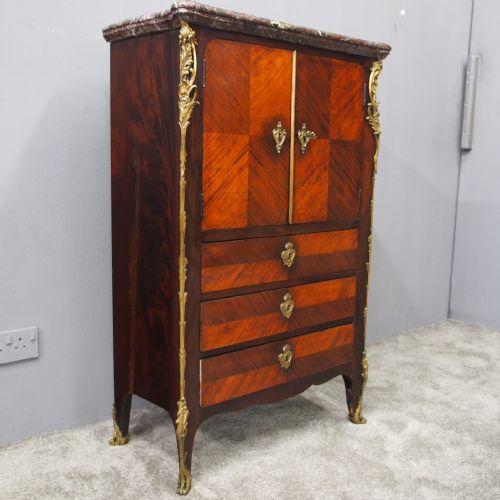
Beyond the standard seven-drawer chest, related forms include taller secretaire cabinets with drop-front writing desks and paired bedside tables sharing the same veneer discipline. These case pieces bring warmth and intricate grain patterns into traditional bedrooms and drawing rooms.
How they were made
Cabinetmakers constructed these frames using sustainable softwood carcasses entirely covered in thin decorative veneers of kingwood, tulipwood, rosewood, and walnut. Artisans cut tiny wooden tiles by hand and assembled them into geometric parquetry patterns that covered the drawer fronts and side panels.
Ormolu mounts cast in brass were fire-gilded and fitted to protect the vulnerable corners and frame the drawer outlines, while heavy marble slabs were shaped to fit precisely atop the carcass. Drawer linings utilised secondary timbers, carefully hand-dovetailed to ensure structural stability over centuries of use.
Parquetry Semainier Retail Price Guide 2026
Typical asking prices for parquetry semainier among the pieces listed under this phrase on Sellingantiques today, from the lower quarter to the upper quarter. They describe what is for sale here now, not the wider market.
A genuine seven-drawer semainier gives you exactly one drawer for each day of the week, proving that eighteenth-century French cabinetmakers invented the ultimate weekly planner.
What varies in quality
The distinction between ordinary cabinetwork and superior pieces rests entirely upon the precision of the veneer geometry and the crispness of the bronze mounts. Finer examples display meticulous grain matching across multiple drawers, whereas lesser pieces rely on repetitive or stamped patterns with minimal variation.
Original marble tops and genuine period ormolu chiseled by hand elevate the standing of a piece considerably. The integrity of the drawer construction and the retention of the original stamped signatures of Parisian makers separate workshop standards.
Leonard Boudin
The Parquetry Semainier Glossary
- Semainier
- A tall chest traditionally featuring seven drawers, one for each day of the week. This form originated in France for personal linen and private correspondence.
- Parquetry
- A geometric mosaic of wood veneers arranged in patterns such as cubes, lozenges, or chequers. It differs from marquetry by using strict geometric shapes rather than pictorial imagery.
- Ormolu
- Gilt-bronze ornaments applied to furniture mounts, feet, and keyhole escutcheons. The process involves coating cast brass with a mercury and gold amalgam before heating.
- Kingwood
- A dense, heavy tropical timber prized for its rich dark violet-brown colour and golden streaks. It is frequently employed in fine eighteenth-century and revival French cabinetry.
- Secretaire abattant
- A tall bureau cabinet featuring a vertical drop-front flap that opens to reveal a writing surface and small pigeonholes. It combines storage with compact workspace.
Parquetry Semainier: Frequently Asked Questions
What is a semainier used for?
A semainier provides tall, vertical storage designed originally to hold seven days of garments or personal papers.
Today, these slender chests fit easily into tighter spaces where standard wide dressers prove impractical.
How do I identify a parquetry semainier?
Look for a tall chest built with seven distinct drawers and decorated with geometric wood veneer tiles.
Most examples also feature marble tops and decorative brass mounts in the French taste.
Where were these chests made?
The majority of these pieces originate from French cabinet workshops working in revival and transitional styles.
Master artisans in Paris developed the tall seven-drawer format during the eighteenth century.
How do I clean wood veneer?
Dust gently with a dry, soft cloth and avoid chemical polishes that can degrade old finishes.
Keep these pieces away from direct heat sources and strong sunlight to protect the fragile veneers.