




Pair Silver Wine Coolers
Pair silver wine coolers bring formal symmetry and chilled bottles to the table, spanning Georgian elegance to Art Deco design.
Pair Silver Wine Coolers
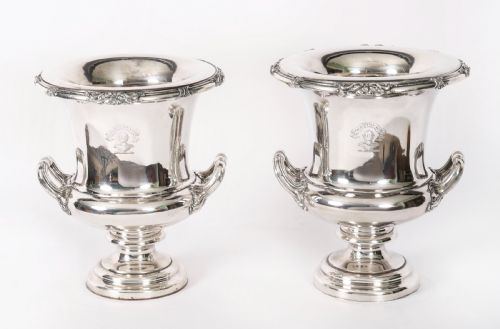
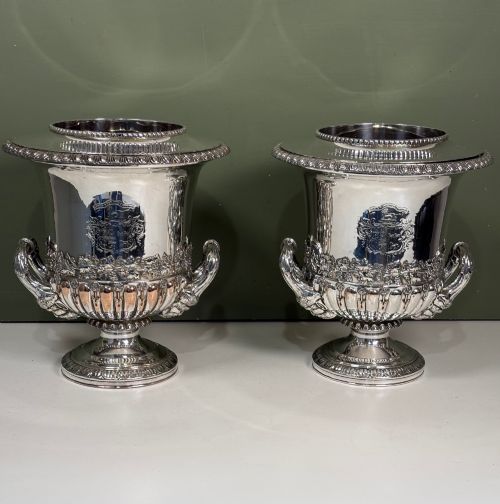
When searching for pair silver wine coolers, you encounter heavy serving vessels designed to chill wine or champagne at the dining table. These matched sets provide symmetrical presence for grand dinners and sideboard display.
The versions most common on this page date from the 19th century and the Georgian period, often utilising Old Sheffield Plate or later silverplating on base metal. Forms range from classical campana urns to floor-standing champagne coolers and twin-handled vases.
Earlier examples display Rococo Revival curves or Regency restraint, while 20th-century pieces embrace Art Deco geometry and clean lines. Makers such as Elkington, Mappin & Webb, and Christofle appear among the recorded archives.
Materials and construction methods
Makers utilised silver plate, Old Sheffield Plate, copper, and sterling silver to achieve durable yet lustrous cooling vessels. Old Sheffield Plate fused a thin sheet of silver to a copper core, leaving characteristic seams or hints of copper where friction revealed the base metal over time.
Silverplating onto base metal or copper became widespread during the 19th century, allowing intricate campana urn shapes and cast handles to be formed with precision. Heavier gauge metal provided the thermal mass necessary to hold ice and chilled water alongside heavy bottles.
Pair Silver Wine Coolers Retail Price Guide 2026
Typical asking prices for pair silver wine coolers among the pieces listed under this phrase on Sellingantiques today, from the lower quarter to the upper quarter. They describe what is for sale here now, not the wider market.
Listings feature silver plate, copper, base metal, and sterling silver across Georgian, Regency, Victorian, and Art Deco styles.
Judging the quality of matched pairs
Quality rests on the crispness of cast ornamentation and the integrity of the silver surface across both vessels. Superior pairs maintain matching proportions, weight, and wear patterns that indicate they belonged together from the outset.
Makers mark placement and the quality of applied handles or crests distinguish standard production items from distinguished silverplate by renowned firms. The retention of the original plating without excessive re-plating preserves the crisp detail of chased or embossed enrichment.
Hawksworth Eyre And Co·Elkington·Mappin And Webb·Lee And Wigfull·Christofle
The Pair Silver Wine Coolers Glossary
- Old Sheffield Plate
- A fused bilayer metal technique combining silver and copper used before electroplating became common. This early method creates a soft glow across 18th-century and Regency vessels.
- Campana
- A bell-shaped vessel design popular for classical wine coolers and urns. It provides stability on the sideboard while offering a wide top rim for ice.
- Silverplate
- A thin layer of silver applied over a base metal such as copper or nickel silver. This technique allowed makers to produce grand dining vessels at a lower cost than solid sterling silver.
- Rococo Revival
- A 19th-century decorative style featuring exuberant scrolling foliage, shells, and asymmetrical curves. Pieces in this style display deeply chased surface detail.
Pair Silver Wine Coolers: Frequently Asked Questions
How were pair silver wine coolers used?
These vessels sat on sideboards or dining tables filled with ice and water to chill bottles during long meals. The matched pair allowed hosts to serve red and white wines simultaneously or balance a large dining setting symmetrically.
Servants replenished ice and retrieved bottles directly from the coolers throughout the course of a dinner. Their substantial weight ensured stability when holding heavy glass bottles and melting ice.
How do I clean silver plated wine coolers?
Maintenance requires gentle washing with warm water and mild soap, followed by drying with a soft cloth to prevent water spots. A proprietary silver polish used sparingly protects the thin plate on older pieces.
Avoid harsh abrasive cleaners that wear away silverplate or expose the underlying copper base metal, particularly around raised decorative borders and handles.
How can I tell Old Sheffield Plate from later silverplate?
Old Sheffield Plate reveals thin lines of copper along cut edges and high points where the outer silver layer wore down through decades of polishing. This fusion method creates a warmer tone compared to later electroplated items.
Electroplated silver applied after the mid-19th century covers the base metal uniformly without copper bleed-through. Examination of the interior and rim under good light clarifies the manufacturing method used.
Can I use these coolers for champagne?
Modern champagne bottles fit comfortably into many 19th-century and 20th-century variants listed here, particularly larger campana urns and floor-standing bucket forms. Art Deco and mid-century designs accommodate modern bottle dimensions easily.
Checking internal depth and rim diameter ensures standard bottles sit securely amongst ice without tipping over the edge during social gatherings.