

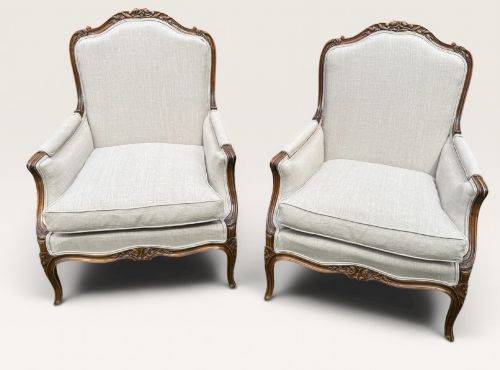
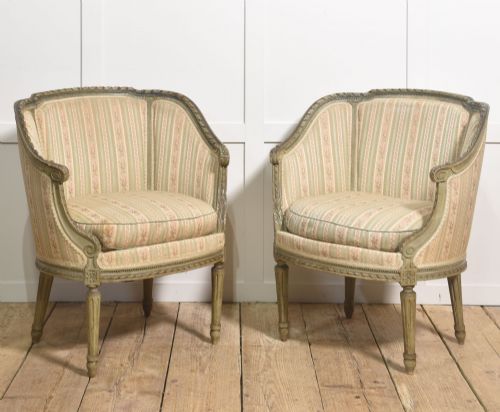
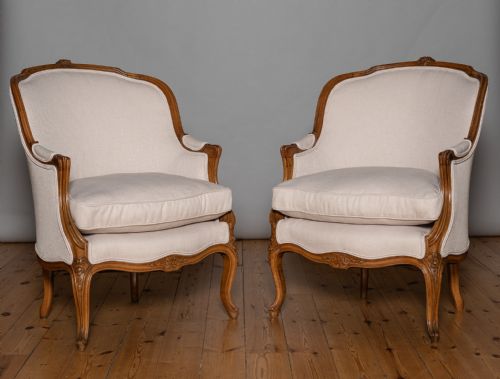
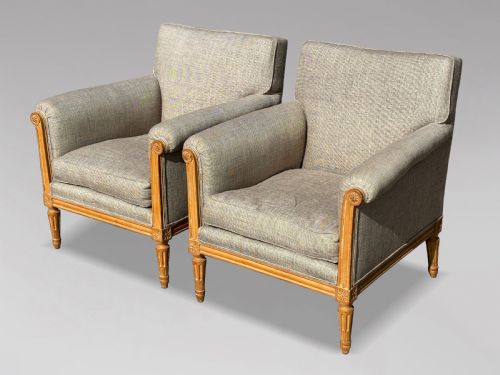


Pair of French Bergeres
A pair of french bergeres offers deep, enclosing seating defined by substantial upholstered arms and a low seat, suited to traditional drawing rooms and libraries.
Pair of French Bergeres
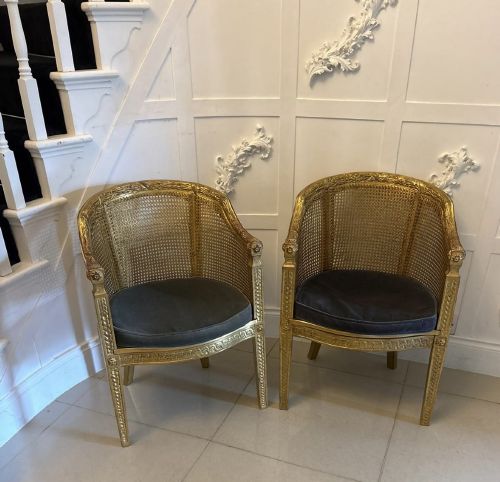
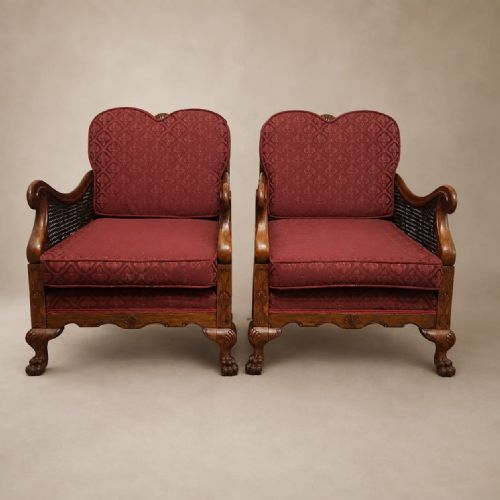
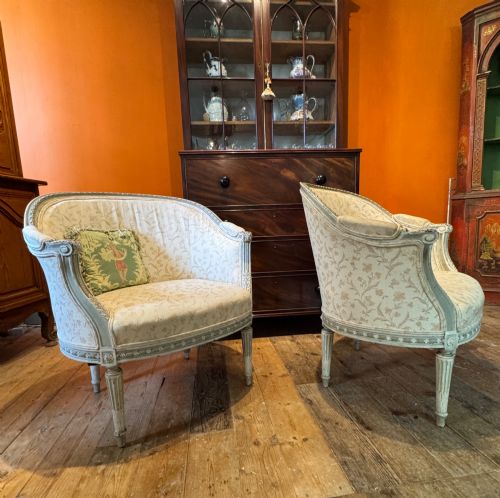
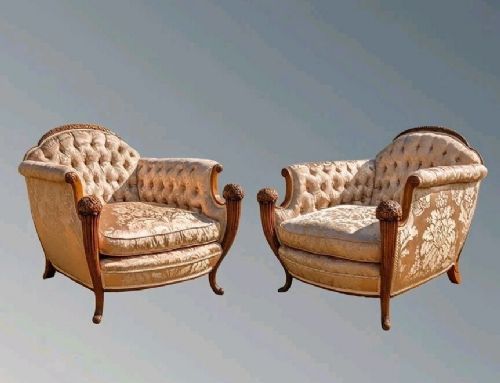
A pair of french bergeres consists of matching deep-set armchairs designed for relaxation, frequently appearing in forms such as tub chairs, winged armchairs, and library chairs. These seats draw upon historical design vocabulary, most notably Louis XV style, Louis XVI style, and French Empire aesthetics.
The versions most commonly encountered on this page date from the nineteenth and early twentieth centuries, spanning periods from eighteen eighty through to nineteen twenty. They arrive shaped by regional revivals and traditional salon seating requirements.
Makers and craftsmen produced these armchairs in matching pairs to furnish formal rooms, utilising overarching styles that range from carved walnut and painted frames to gilded surfaces.
Distinctions in quality
Quality rests upon the crispness of the timber carving and the integrity of the structural frame, where hand-carved walnut or gilded surfaces demonstrate superior craftsmanship compared to simpler moulded alternatives. The depth of the joinery and the selection of primary timbers dictate the longevity of the seating.
The refinement of the secondary materials, such as finely woven cane panels or specialist textiles including pure silk and velvet upholstery, separates standard production from exceptional examples. Original painted or gilded surfaces that retain their historical character further elevate the standing of a pair.
Pair of French Bergeres Retail Price Guide 2026
Typical asking prices for pair of french bergeres among the pieces listed under this phrase on Sellingantiques today, from the lower quarter to the upper quarter. They describe what is for sale here now, not the wider market.
Some nineteenth-century salon chairs arrive sporting cheerful silk parrot designs upon their upholstery, ready for an audience.
The Pair of French Bergeres Glossary
- Bergere
- An enclosed upholstered armchair with closed sides, typically featuring a low seat and an upholstered back panel. This form originated in France during the eighteenth century.
- Fauteuil
- An open-framed armchair with upholstered back and arm pads, exposing the wooden structure around the arms and legs. It shares stylistic origins with the bergere.
- Giltwood
- Timber treated with gold leaf or gilding preparation to create a lustrous metallic surface. This finish appears on formal nineteenth-century salon furniture.
- Cane
- Plant material woven into open mesh patterns to form panels for chair backs and sides. It provides lightweight ventilation alongside structural support.
- Louis XV Style
- A design tradition characterised by asymmetrical curves, cabriole legs, and naturalistic floral carving. It inspired numerous nineteenth and twentieth-century revivals.
Pair of French Bergeres: Frequently Asked Questions
What is a bergere chair?
A bergere is a traditional enclosed armchair featuring solid upholstered sides and a loose seat cushion. These chairs are designed for comfort and relaxed sitting.
They emerged in France and are frequently found paired for use in formal living spaces, libraries, and sitting rooms.
How do I identify Louis XV style?
Louis XV style is identified by curved lines, cabriole legs, and organic floral carvings. The aesthetic avoids straight lines in favour of flowing contours.
Twentieth-century and nineteenth-century interpretations often replicate these characteristic sweeping shapes on walnut and painted frames.
Are these chairs comfortable for daily use?
These armchairs are built with deep seats and enclosing upholstered backs designed specifically for extended lounging. Many examples feature generous proportions and supportive armrests.
Upholstery varies from traditional fabric and velvet to cane panels, allowing for different levels of cushioning.
How should I clean cane panels?
Cane panels require gentle cleaning with a damp cloth to remove dust from the woven interstices. Excessive moisture should be avoided to prevent the natural material from becoming brittle.
Maintaining moderate humidity in the room helps preserve the flexibility of the cane over time.