

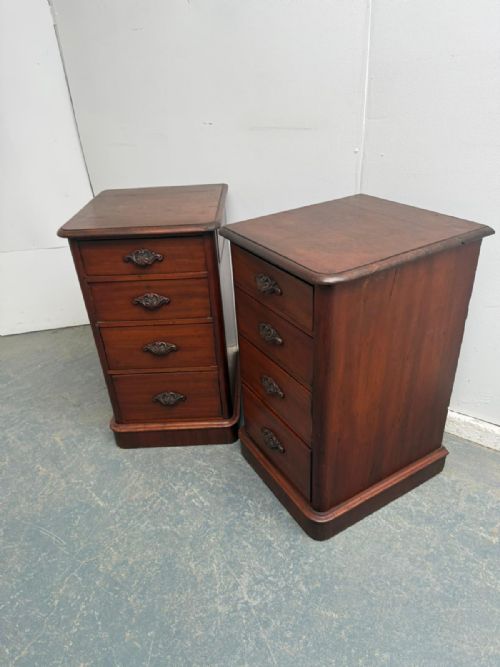


Pair Narrow Bedside Lockers
These pair narrow bedside lockers bring genuine period character to a bedroom while offering useful bedside storage in a compact footprint.
Pair Narrow Bedside Lockers
A search for pair narrow bedside lockers brings up small bedside cabinets, tables, and chests dating from the Georgian, Victorian, and Edwardian eras, as well as the 1920s and 1930s. These pieces serve as practical bedside storage where floor space is limited.
The versions most commonly met on this page include mahogany and walnut chests featuring multiple drawers or enclosed cupboard spaces, spanning styles from Victorian and late Victorian to Art Deco and Louis XV Revival.
Makers such as James Shoolbred appear among the pieces, alongside campaign styles and tall antique configurations designed to fit snugly beside higher bed frames.
Materials and construction methods
Cabinet makers utilised dense hardwoods including mahogany, walnut, burr walnut, and rosewood, often pairing them with brass handles and fittings.
Construction techniques range from traditional multi-drawer chest joinery to specialised campaign designs intended for portability.
James Shoolbred once supplied furnishings to half of London, ensuring your bedside locker shares lineage with grand Victorian drawing rooms.
Assessing quality in period bedside storage
Quality rests in the choice of timber figure, such as burr walnut or figured mahogany, and the crispness of the drawer dovetailing and brass mounts.
Alterations or adaptations, such as chests modified from larger pieces or cabinets adapted to suit modern heights, distinguish untouched examples from later adjustments.
James Shoolbred
The Pair Narrow Bedside Lockers Glossary
- Campaign bedside cabinets
- Portable furniture originally made for military officers, typically featuring recessed brass handles and corner brackets.
- Pot cupboard
- A traditional nineteenth-century term for a small bedside cabinet featuring an internal shelf intended originally to house a chamber pot.
- Burr walnut
- A highly prized wood veneer showing intricate, swirling grain patterns formed from tree growths, frequently utilised on high-status Victorian and Edwardian furniture.
- Dovetail joint
- A traditional interlocking woodworking joint used to secure drawer corners, valued for its exceptional tensile strength and durability.
Pair Narrow Bedside Lockers: Frequently Asked Questions
What periods do these bedside cabinets date from?
The pieces span several decades, ranging from Georgian and Victorian eras through to the 1920s and 1930s Art Deco period.
Each era brings distinct timber choices and decorative details, from classic mahogany Georgian pieces to figured walnut Victorian chests.
How were these lockers used historically?
These small cabinets served as bedside storage for personal items, nightwear, and in earlier periods, a chamber pot.
Their compact proportions allowed them to sit neatly beside the bed while keeping necessities concealed behind cupboard doors or within drawers.
Are matching pairs common for antique bedside cabinets?
Matching pairs from the nineteenth and early twentieth centuries are harder to source because many bedside pieces were made as single items.
When a pair survives together, it usually represents either an original matched commission or a carefully assembled partnership from the period.
How do I care for antique mahogany and walnut?
Polishing the timber occasionally with a quality beeswax helps maintain the natural moisture and rich lustre of the wood.
Keep the cabinets away from direct heat sources and strong sunlight to prevent the veneer from drying out or fading.