




Pair French Vitrines
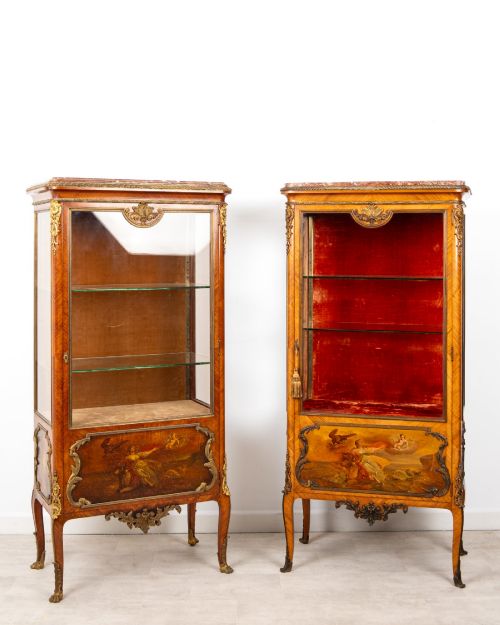
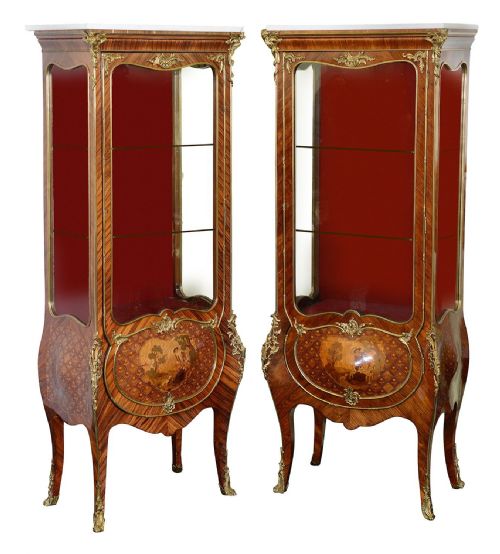
Pair french vitrines bring formal nineteenth century display into a room, offering glass panels and gilt mounts to house precious objects.
Pair French Vitrines
These pair french vitrines are formal display furniture designed to showcase treasured objects behind glass. Buyers searching this phrase encounter nineteenth century pieces, including Victorian examples and items from around eighteen eighty.
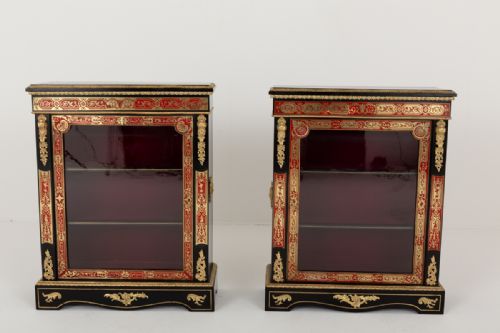
Origins and styles lean heavily towards continental revivalism, with Napoleon third, Louis fifteenth, and Louis sixteenth influences dominating. Makers and styles such as Boulle work and Vernis Martin appear frequently across the listings.
How they were made
Construction relies on timber carcases veneered in kingwood, mahogany, walnut, and satinwood, often complemented by ebonised wood. Brass and tortoiseshell form intricate Boulle inlay across many surfaces, whilst marble provides heavy tops for stability and contrast.
Ormolu mounts cast in bronze provide ornate borders and feet, accentuating curves derived from Rococo and French revival designs. Glass panels are fitted into doors and sides to permit light into the interior shelving.
Listings feature nineteenth century periods alongside specific years like eighteen fifty, eighteen sixty, eighteen eighty, and nineteen twenty.
What varies in quality
The refinement of the ormolu mounts dictates much of the visual success, where sharp chiselling and heavy gilding separate standard work from exceptional pieces. Finely hand painted panels in the manner of Vernis Martin require high artistic skill compared to simpler veneered surfaces.
The precision of the Boulle inlay, combining brass and tortoiseshell without gaps, marks the hand of a skilled cabinet maker. Timber selection also plays a role, with figured kingwood and dense mahogany providing greater depth than plain secondary woods.
Gouffel·Paul Somani
The Pair French Vitrines Glossary
- Vitrines
- Glass fronted display cabinets designed to protect and exhibit porcelain, silver, and curiosities. They stand on legs or pier bases depending on the specific nineteenth century fashion.
- Ormolu
- Gilt bronze mounts applied to furniture edges and corners. The technique involves mercury gilding on cast bronze to achieve a bright golden finish.
- Boulle
- Marquetry technique utilising brass and tortoiseshell developed by André Charles Boulle. It creates contrasting metallic and dark patterns across cabinet doors and panels.
- Vernis Martin
- Simulated Japanese lacquerwork developed in eighteenth century France. The technique uses multiple coats of varnish to create translucent painted panels.
- Pier Cabinets
- Narrow cabinets built to fit wall spaces between windows or doors. They often feature single glass doors and marble tops.
Pair French Vitrines: Frequently Asked Questions
What are pair french vitrines used for?
These cabinets serve to display collections of porcelain, glass, and small decorative items away from dust. The glass panels on multiple sides allow natural light to illuminate the objects from different angles.
Placed in drawing rooms or formal reception spaces, matching pairs create symmetry within interior decoration. They combine storage with visual exhibition in a traditional manner.
How do you clean ormolu mounts?
Ormolu mounts require gentle dusting with a soft dry brush to remove particles from recessed cast details. Moisture and harsh metal polishes strip the original fire gilding from the bronze surface.
Professional conservation cleaning is necessary if tarnish obscures the underlying gold tone. Regular maintenance simply involves protecting the metal from humidity and handling.
Can vitrines hold heavy porcelain?
Internal glass or wooden shelves are generally designed for lighter decorative objects rather than heavy dinner services. The weight capacity depends on the thickness of the original glass and the strength of the shelf supports.
Distributing weight evenly across the centre prevents stress on antique timber framing. Heavier cabinet bases can support larger ceramic pieces on the lower wooden tiers.
How to tell nineteenth century pieces apart?
Nineteenth century pieces often draw inspiration from earlier periods like Louis fifteenth and Louis sixteenth. Construction methods, such as hand cut dovetails and timber seasoning, help distinguish authentic Victorian and Napoleon third items from later reproductions.
The use of genuine tortoiseshell, hand chased ormolu, and period specific locking mechanisms further aids in dating the cabinetry accurately.