

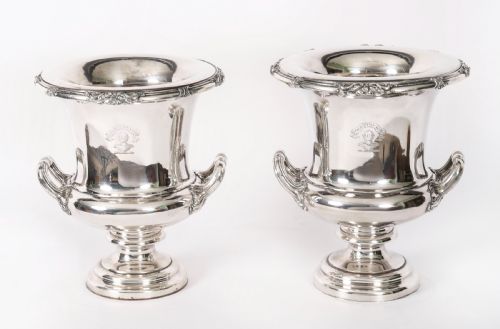
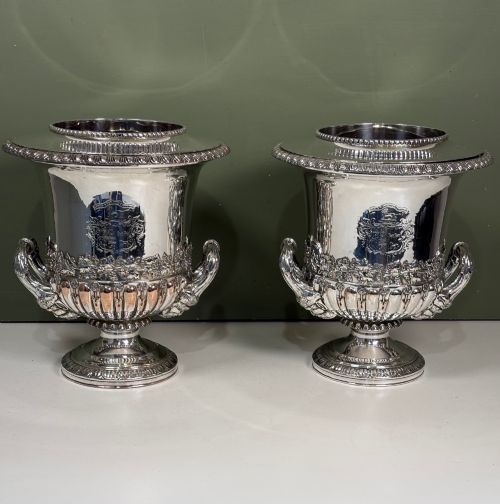


Pair Champagne Buckets
Pair champagne buckets bring symmetry and polish to any table, offering substantial capacity for chilling multiple bottles in style.
Pair Champagne Buckets
When you search for pair champagne buckets, you are looking at matched vessels designed specifically to hold ice and bottles for chilling. These matching sets serve dining rooms and drawing rooms with equal grace.
The versions you meet on this page span several centuries, appearing in forms such as wine coolers, ice pails, and floor standing Champagne coolers. They originate from periods including the Georgian, Regency, Victorian, and Art Deco eras.
Makers and manufacturers utilised various forms, from campana designs in Old Sheffield plate to porcelain bodies and modern metal structures. Each pair demonstrates the distinctive aesthetic of its respective period, whether Rococo Revival curves or clean 1930s lines.
How they were made
The construction of these vessels relies heavily on silver plate, copper, metal, and base metal, alongside porcelain and enamel. Old Sheffield plate employs a fused layer of silver over a copper core, visible at seams or wear points.
Manufacturers also utilised gold leaf and porcelain casting, particularly in Regency examples from factories such as Flight, Barr & Barr. Metalworking techniques included casting, plating, and applied decorative mounts.
Pair Champagne Buckets Retail Price Guide 2026
Typical asking prices for pair champagne buckets among the pieces listed under this phrase on Sellingantiques today, from the lower quarter to the upper quarter. They describe what is for sale here now, not the wider market.
Listings feature materials spanning silver plate, copper, porcelain, enamel, and gold leaf across the 18th, 19th, and 20th centuries.
What varies in quality
Quality in these vessels rests upon the crispness of chased or cast ornamentation, such as handles, rims, and heraldic mounts. Heavier gauge metals and thicker silver plating indicate higher grade manufacture.
The integrity of construction, the balance of the campana or cylindrical form, and the retention of original liners or inserts distinguish superior examples from standard production pieces.
WMF·Flight Barr And Barr·Christofle·Hawksworth Eyre And Co·Ercuis·Mappin And Webb·Elkington
The Pair Champagne Buckets Glossary
- Old Sheffield plate
- A composite material formed by fusing a thin sheet of silver to a thicker copper base. This technique predates modern electroplating.
- Campana design
- A vase shape resembling an inverted bell, frequently utilised for classical wine coolers and ice pails. This profile became popular during the Regency and Georgian periods.
- Silver plate
- A thin layer of silver applied to a base metal such as copper or Britannia metal. Various methods were employed across the nineteenth and twentieth centuries.
- Ice pail
- A vessel designed to hold ice cubes or blocks for chilling glasses or bottles at the dining table. These often feature lids and sturdy handles.
- Wine cooler
- A large vessel intended to chill bottles in ice and water before or during a meal. They frequently appear in matching pairs across the eighteenth and nineteenth centuries.
Pair Champagne Buckets: Frequently Asked Questions
How were pair champagne buckets used historically?
These vessels stood on sideboards or dedicated stands during formal dinners, filled with ice to keep wine and champagne bottles chilled for guests.
Servants replenished the ice and transferred the bottles to the table as needed during the meal.
Can I use antique buckets for modern bottles?
Most standard champagne and wine bottles fit comfortably into these historical coolers, though larger modern novelty bottles may require checking dimensions.
They function just as effectively today for entertaining as they did in past centuries.
How do I care for silver plated coolers?
Regular gentle cleaning with a soft cloth and proprietary silver polish maintains the shine of plated surfaces without removing the underlying metal.
Avoid abrasive sponges or harsh chemicals that can damage old plating or applied details.
How do I distinguish Regency from Art Deco coolers?
Regency coolers favour classical motifs like campana shapes, acanthus leaves, and heavy cast handles derived from antiquity. Art Deco pieces from the 1930s embrace geometric lines, smooth metal surfaces, and floor-standing frames.