



Painted Wooden Candlesticks
These painted wooden candlesticks bring instant colour and warmth to a room, offering the charm of hand-finished surfaces.
Painted Wooden Candlesticks
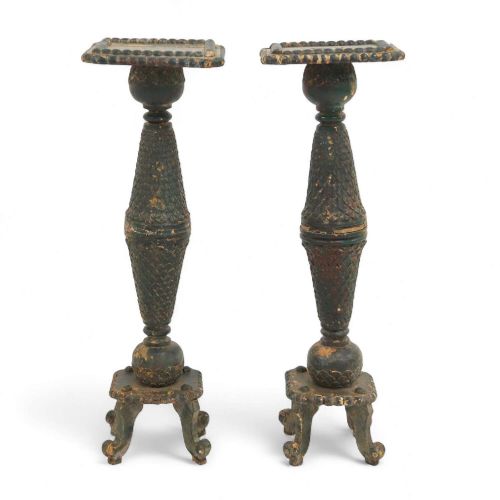
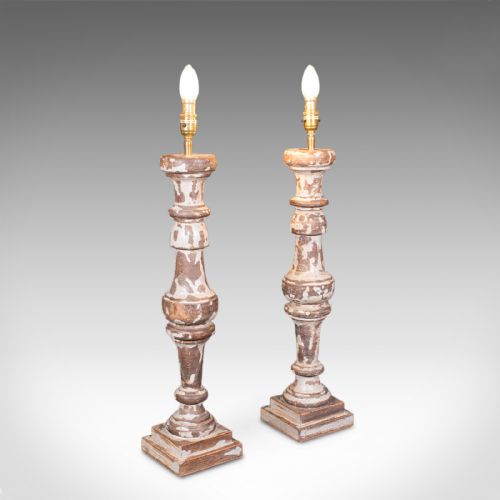
When you search for painted wooden candlesticks, you are looking at functional candle holders and lamp bases shaped from timber and finished with decorative painted surfaces. The pieces seen on this page span the nineteenth century, the Victorian era, and the early twentieth century, taking forms such as standard lamps, table lamps, torchières, and pricket sticks.
You are most likely to meet pairs of decorative candle holders and converted lamps, often originating from English, French, Italian, or Kashmiri workshops. Their styles range from French neoclassical and Italian baroque to Anglo-Indian and country designs, reflecting diverse regional tastes in domestic lighting.
How they were made
Maker's hands shaped these objects from wood, frequently applying gesso to smooth the surface before adding paint, gold leaf, or lacquer. Many examples combine carved wooden bodies with brass fittings or marbleized details to create rich decorative effects.
Surfaces received hand-painted finishes, ranging from original green paint and cream Kashmiri patterns to gilt and marbleized treatments. These traditional techniques ensured each piece gained a unique texture and depth over decades of use.
Painted Wooden Candlesticks Retail Price Guide 2026
Typical asking prices for painted wooden candlesticks among the pieces listed under this phrase on Sellingantiques today, from the lower quarter to the upper quarter. They describe what is for sale here now, not the wider market.
Some nineteenth-century candle holders spent a quiet retirement as electric standard lamps before finding their way here.
What varies in quality
The distinction between ordinary and superior pieces rests on the handling of the painted surface and the crispness of the timber carving. Original paintwork that retains its depth and character holds far more appeal than later, unsympathetic repainting.
Proportion and decorative detail also set examples apart, with finer pieces displaying balanced classical forms or intricate regional ornamentation. The integration of gilding, gesso work, and turned wood elements reveals the maker's skill and ambition.
The Painted Wooden Candlesticks Glossary
- Torchiere
- A tall stand or candlestick designed to hold a light source. These often feature decorative turned wooden columns.
- Pricket stick
- A candlestick fitted with a central metal spike that holds the candle in place. This form appears frequently in ecclesiastical and formal contexts.
- Gesso
- A plaster mixture applied to wood as a base for paint or gold leaf. It creates a smooth, receptive surface for fine decoration.
- Giltwood
- Timber that has been decorated with gold leaf or gold paint. It adds reflective warmth to candlesticks and lamp bases.
- Standard lamp
- A tall floor lamp designed to stand directly on the floor. Several period examples utilise converted wooden columns.
Painted Wooden Candlesticks: Frequently Asked Questions
How do I wire a painted wooden candlestick?
Many period pieces arrive already converted into table or standard lamps with discreet internal wiring. If you need to add a fitting, consult a professional electrician to ensure the wooden structure remains undamaged.
Choose a flex colour that complements the original paintwork or gilding, and use a shade that balances the height of the wooden column.
How should I clean painted wooden candlesticks?
Dust the surface gently with a soft, dry cloth to protect fragile paintwork and delicate gesso layers. Avoid using water, abrasive cleaners, or modern chemical polishes which can strip historic finishes.
Keep them away from direct sunlight and strong heat sources to prevent the wood from splitting and the paint from flaking.
Are these pieces usually sold in pairs?
The selection includes many matching pairs, which prove particularly popular for mantelpieces, sideboards, and architectural placement. Single pieces also appear frequently, often chosen as statement table lamps.
Matching pairs provide symmetry in interior schemes, while individual pieces offer flexibility for smaller spaces.
How can I tell the period of a painted candlestick?
Examine the timber species, the style of the turning, and the layering of the paint or gesso. Nineteenth-century pieces often display hand-mixed pigments and wear patterns that reveal the underlying wood.
Compare the decorative motifs, such as neoclassical urns or Kashmiri floral patterns, against known regional traditions from the Victorian era and early twentieth century.