
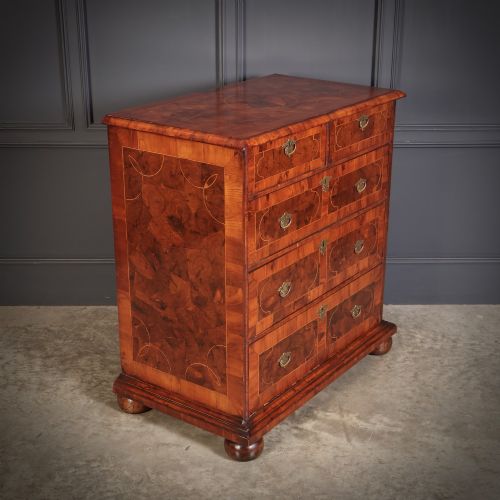
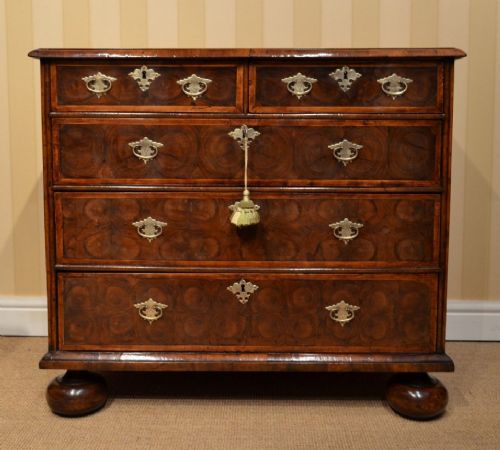
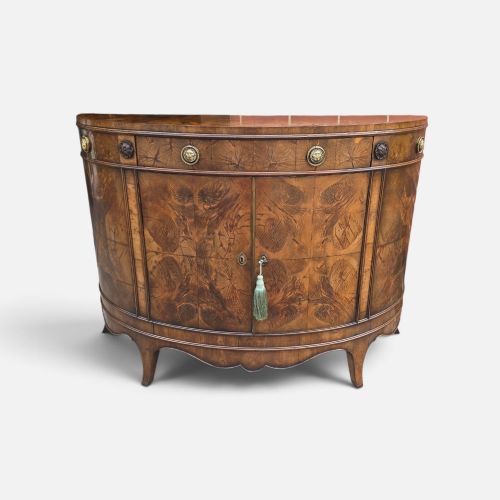
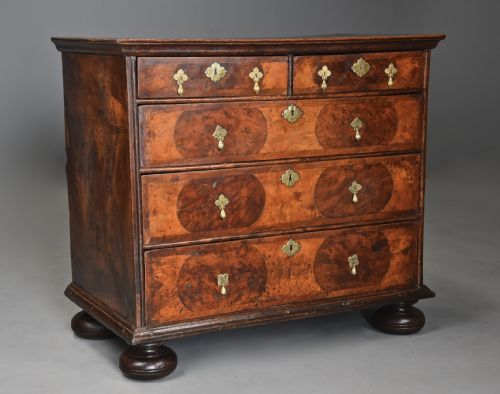

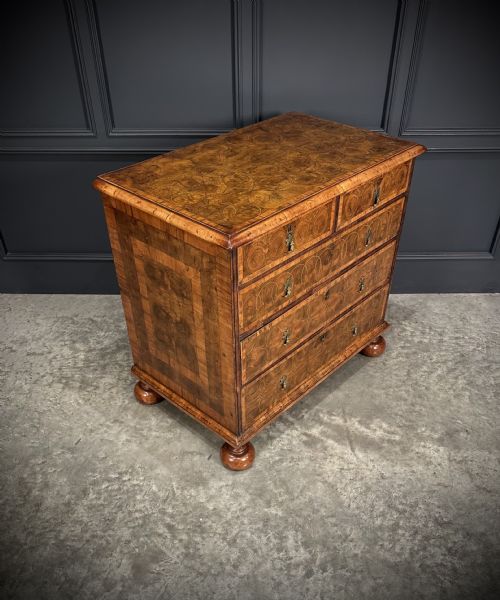


Oyster Veneered Furniture
Oyster veneered furniture brings together cross-sections of timber to create mesmerising circular patterns across seventeenth-century and revival surfaces.
Oyster Veneered Furniture
When you search for oyster veneered furniture, you encounter sophisticated case pieces primarily dating from the seventeenth century, alongside early twentieth-century revivals. The selection focuses heavily on chests of drawers, chests on stand, cabinets on stand, and side tables.
The most common forms on this page are seventeenth-century chests of drawers and cabinets, often aligned with the William and Mary period. You also meet side tables and later revival interpretations from the early twentieth century.
Makers and joiners of the seventeenth century utilised these intricate wooden discs to adorn the drawer fronts and primary surfaces of walnut, oak, and laburnum carcases. The resulting pieces range from compact chests to grand cabinets raised on stands.
How they were made
Craftsmen made oyster veneer by slicing small branches or roots diagonally to produce circular and oval cross-sections, revealing concentric growth rings. These thin discs were then arranged closely together across the surface of a carcase.
Cabinet makers combined the oyster veneer with woods such as walnut, laburnum, olive wood, and yew, frequently incorporating boxwood, holly, and maple for stringing or inlay work. Brass hardware, including drop handles and escutcheons, completed the construction.
Listings feature seventeenth-century origins alongside twentieth-century revivals, utilising woods such as walnut, laburnum, olive wood, and yew.
What varies in quality
Quality rests upon the uniformity of the cutting and the tightness of the arrangement across the ground timber. Finer examples display meticulous matching of the wooden rings to form harmonious geometric patterns without awkward gaps.
The choice of secondary woods and the richness of the primary timber dictate the distinction between standard and exceptional pieces. Period authenticity, such as seventeenth-century construction methods versus twentieth-century revival work, also defines the tier of the piece.
The Oyster Veneered Furniture Glossary
- Oyster veneer
- A method of cutting branches or small trunks transversely to create small, oval or round pieces of wood showing growth rings. This technique was highly fashionable in late seventeenth-century English cabinet making.
- Chest on stand
- A case piece consisting of an upper section of drawers resting upon a separate support frame with legs. These forms elevate the storage component and often feature elaborate underframing.
- Cabinet on stand
- An enclosed storage cabinet raised on a distinct supporting stand. Seventeenth-century examples often use contrasting veneers and intricate hinges.
- Marquetry
- The art of forming decorative patterns by fitting together small pieces of wood veneer. It frequently accompanies oyster veneered surfaces on high-status pieces.
- Stringing
- Thin inlay lines of a contrasting wood used to outline panels and drawers. In seventeenth-century pieces, lighter woods like boxwood or holly provide sharp definition.
Oyster Veneered Furniture: Frequently Asked Questions
What is oyster veneer?
Oyster veneer consists of small, thin discs of wood sliced across the branch rather than along the grain. This reveals concentric rings that resemble oyster shells.
Cabinet makers arranged these roundels closely together to create intricate patterns on seventeenth-century surfaces.
How do I date oyster veneered furniture?
Dating relies on the construction methods, secondary timbers, and overall form of the carcase. Seventeenth-century pieces typically exhibit distinct joinery and timber choices compared to early twentieth-century revivals.
Examining the drawer linings and backboards helps distinguish original period work from later revival interpretations.
Where should I place a side table?
These side tables work well in hallways, living rooms, or studies where their patterned surfaces can be appreciated. Their compact proportions allow them to fit into narrower spaces.
Keep them away from direct heat sources and strong sunlight to protect the delicate cross-grained veneers.
How do I care for these surfaces?
Maintain the wood with appropriate traditional waxes and keep humidity levels stable in the room. Avoid using modern liquid polishes that might seep into the grain.
Gentle dusting with a soft cloth preserves the natural sheen of the walnut, laburnum, or olive wood.