

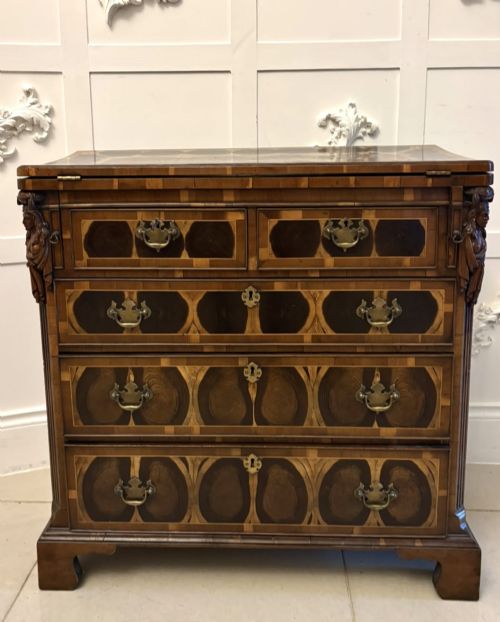
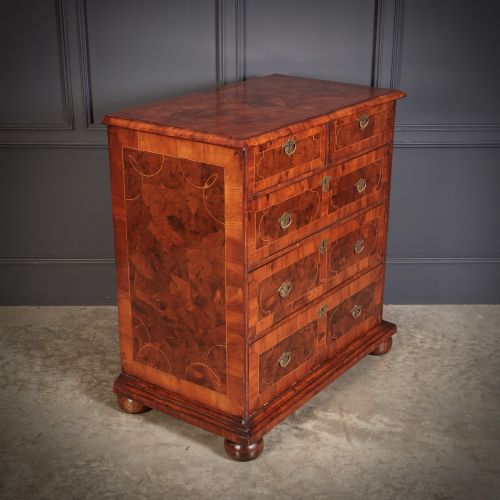


Oyster Laburnum Veneered Chest
An oyster laburnum veneered chest combines rich concentric timber circles with the austere form of seventeenth century case furniture.
Oyster Laburnum Veneered Chest
An oyster laburnum veneered chest is a piece of case furniture covered in circular timber discs sliced obliquely from small branches. These pieces primarily date from the seventeenth century, specifically the William and Mary period, alongside later revivals from the twentieth century.
The chests of drawers form the majority of what appears on this page, accompanied by variations such as chests on stands, small collectors boxes, and tea chests. Buyers most frequently encounter walnut and laburnum constructions reflecting the cabinet-making standards of the seventeen hundreds.
Makers utilised contrasting timbers like boxwood, yew-wood, and olivewood to frame the main oyster work. These geometric patterns transform plain storage furniture into decorative surfaces that showcase late seventeenth century craftsmanship.
Materials and Construction
Cabinet makers produced oyster veneer by cross-cutting small branches of laburnum or walnut at an angle to expose the concentric growth rings. These thin discs were then laid down across the carcase timber in elaborate geometric arrangements.
Oak and general timber served as the sturdy primary carcase materials to support the heavy drawer fronts and stands. Brass hardware, including drop handles and escutcheons, was fitted to complete the seventeenth century and Georgian forms.
Oyster Laburnum Veneered Chest Retail Price Guide 2026
Typical asking prices for oyster laburnum veneered chest among the pieces listed under this phrase on Sellingantiques today, from the lower quarter to the upper quarter. They describe what is for sale here now, not the wider market.
Listings feature sevententh century, eighteenth century, and 1920s periods alongside materials including laburnum, walnut, oak, and brass.
Assessing Quality
The precision of the veneer matching largely determines the visual quality of an oyster laburnum veneered chest. Finer examples display tightly packed circular cuts with minimal gaps, whereas lesser pieces show uneven slicing and heavier filler usage.
The choice of secondary woods and stringing details also separates standard production from superior work. Walnut and laburnum combinations enhanced with boxwood inlay reflect a higher grade of seventeenth century execution.
The Oyster Laburnum Veneered Chest Glossary
- Oyster veneer
- Thin circular slices of wood cut obliquely from small branches to resemble the shell of an oyster. This technique became popular during the late seventeenth century for its decorative patterning.
- William and Mary
- A stylistic period spanning the late seventeenth and early turn of the century, characterised by rich veneers and distinct case furniture forms. Pieces from this era often feature geometric marquetry and laburnum surfaces.
- Cross banding
- A border of veneer laid so that the grain runs at right angles to the main surface. It frames the central oyster panels on drawers and tabletops.
- Chest on stand
- A form where a set of drawers sits upon a raised frame with legs rather than resting directly on the floor. These elevated pieces often showcase elaborate base turnings.
Oyster Laburnum Veneered Chest: Frequently Asked Questions
What is an oyster veneer?
Oyster veneer consists of small circular or oval slices of wood cut across the branch at an angle. This method displays the natural growth rings in decorative patterns.
Cabinet makers used these sections to cover entire drawer fronts and surfaces during the late seventeenth century.
How do I date a laburnum chest?
Dating relies on construction methods, timber choices, and hardware styles. Seventeenth century examples typically feature oak carcases and hand-cut dovetails.
Twentieth century revival pieces often show machine tooling or different secondary woods beneath the laburnum surface.
Were these chests used for clothes?
Chest of drawers formats served primarily for storing textiles, linens, and personal valuables. Smaller variations like tea chests and collectors boxes held specialised goods.
The domestic role remained focused on secure storage within bedchambers and parlours.
How do I care for oyster veneer?
Keep the wood away from direct sunlight and sudden temperature changes to prevent the thin circular veneers from lifting. Regular dusting with a dry cloth maintains the polished surface.
Avoid excessive moisture or modern polishes that can seep into the grain joints.