
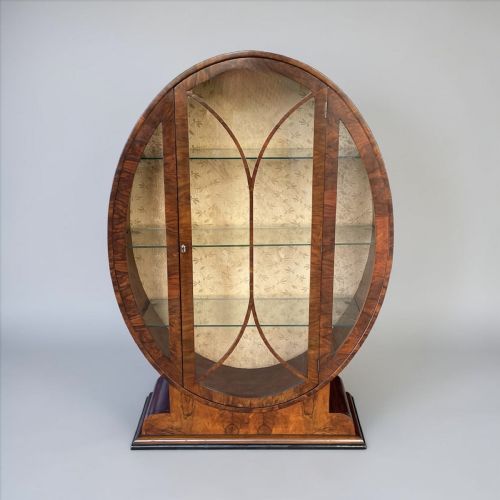


Oval Glass Display Case
An oval glass display case houses precious objects behind curved panes, offering a complete three-hundred-and-sixty-degree view for any serious collector.
Oval Glass Display Case
An oval glass display case brings together pieces designed to showcase delicate items, ranging from botanical specimens and taxidermy to carriage clocks and bijouterie. These enclosures appear in forms such as display cabinets, tabletop domes, free-standing vitrines, and specialised bijouterie tables with glazed tops.
The versions most commonly met across these listings span the Victorian and Edwardian eras, alongside French Louis XVI style pieces and mid-century Art Deco examples. Makers utilised curved glass panes set into wooden frameworks to protect contents while maintaining full visibility from every angle.
Origins stretch across English workshops and French cabinets, incorporating architectural details like bow ends and marquetry inlays. Whether housing a clock or a diorama, the defining characteristic remains the curved or oval perimeter of the transparent housing.
Construction and materials
Makers constructed the structural frames using timber species such as mahogany, walnut, figured walnut, pine, and wood finished with gilded details or vernis martin techniques. Ormolu mounts and fabric linings, including velvet, frequently added decorative contrast to the interior display areas.
Glass production required precise blowing or forming to achieve the smooth, curved profiles needed for domes and bow ends without distortion. Artisans then fitted these transparent panes into rebated wooden or metal channels to secure the delicate enclosures.
Listings feature periods from the nineteenth century through the 1930s, utilising materials including walnut, mahogany, glass, fabric, and ormolu.
Assessing quality in construction
Quality rests upon the precision of the timber joinery and the clarity of the curved glass panes, where finer examples display seamless joints and distortion-free transparency. The integration of decorative elements like marquetry inlay, ormolu mounts, and fitted velvet interiors distinguishes standard utility items from high-status cabinet work.
The sophistication of the opening mechanism and the stability of free-standing or table-top frames further separate superior pieces from simpler ones. Superior execution shows in the crispness of carved details and the careful matching of wood veneers across curved surfaces.
The Oval Glass Display Case Glossary
- Vitrine
- A glass-fronted cabinet designed for displaying fine objects or porcelain. These freestanding or table-top pieces protect contents from dust while maximising visibility.
- Bijouterie table
- A shallow glass-topped table created specifically for displaying small valuables, jewellery, or medals. The glazed lid lifts or opens to allow access to the velvet-lined interior.
- Ormolu
- Gilded bronze ornamentation applied to furniture and decorative objects during the eighteenth and nineteenth centuries. This technique adds metallic highlights to wood and glass structures.
- Vernis Martin
- A type of simulated Japanese lacquer developed in France, known for its translucent and polished finish. It frequently appears on decorative cabinets and vitrines.
- Diorama dome
- A glass cover protecting a three-dimensional scene, often featuring taxidermy, botanical arrangements, or intricate models. These enclosures preserve fragile organic displays from environmental damage.
Oval Glass Display Case: Frequently Asked Questions
What fits inside an oval glass display case?
These enclosures accommodate delicate items that require protection from dust while remaining fully visible. Collectors typically place carriage clocks, taxidermy, botanical specimens, and small valuable trinkets inside them.
The shape suits objects requiring a 360-degree view without harsh angles interrupting the sightline. Miniature dioramas and pocket watches also sit comfortably beneath these rounded glass covers.
How do I clean the glass?
Maintenance requires gentle handling, particularly with antique glass domes and delicate wooden frames. Use a soft, lint-free cloth and a mild glass cleaner applied to the cloth rather than sprayed directly onto the surface.
Keep moisture away from wooden veneers, ormolu mounts, and internal fabric linings like velvet. Regular dusting with a dry feather brush prevents grime buildup without risking moisture damage to the surrounding structure.
Are these cases freestanding?
The configuration varies depending on the specific form of the piece. Some examples stand on their own as full cabinets or vitrines, while others function as table-top domes or specialised bijouterie tables.
Domes typically rest upon wooden bases designed to anchor the glass securely. Free-standing cabinets and tables provide permanent floor-standing display solutions for larger rooms.
How do I identify Victorian pieces?
Victorian examples often employ dense timbers such as figured walnut and mahogany, frequently accompanied by heavy glass domes used for clocks or taxidermy. These pieces reflect the period's interest in collecting and displaying natural history or scientific instruments.
Construction methods from this era rely on traditional joinery techniques and hand-finished wooden bases. Stylistic cues include straightforward utility frames alongside more ornate display cabinets.