

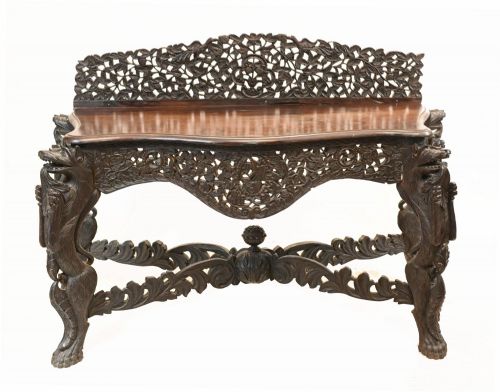


Ornate Sofa Table
An ornate sofa table combines intricate carving and substantial timber to anchor a room.
Ornate Sofa Table
An ornate sofa table encompasses console tables, centre tables, and side tables that display decorative carving, gilding, or marble tops. These pieces originate from the nineteenth and early twentieth centuries, spanning periods such as 1880, 1860, 1900, 1930, 1890, 1910, and 1920.
The versions most frequently met on this page are nineteenth-century carved console and centre tables from French, Anglo-Indian, and Burmese origins. They range from French Rococo style and Louis XVI style to Anglo-Burmese and Art Deco designs.
Makers and craftsmen utilised diverse stylistic traditions, resulting in forms with marble tops, giltwood, or scroll carvings. Each piece reflects the aesthetic preferences of its specific period, from Victorian and Gothic influences to later twentieth-century interpretations.
How they were made
These tables were constructed using a variety of hardwoods including rosewood, teak, walnut, and Brazilian mahogany, paired with structural timber and gesso. Artisans shaped these materials through extensive hand carving to achieve scrollwork and detailed ornamentation.
Surfaces were frequently finished with paint, giltwood frames, or fitted marble tops. The integration of stone tops with carved wooden bases required precise joinery to support the weight of the marble.
Ornate Sofa Table Retail Price Guide 2026
Typical asking prices for ornate sofa table among the pieces listed under this phrase on Sellingantiques today, from the lower quarter to the upper quarter. They describe what is for sale here now, not the wider market.
Some nineteenth-century makers evidently believed that if a table did not have at least one scroll, it simply wasn't trying hard enough.
What varies in quality
Quality in an ornate sofa table is determined by the depth and crispness of the carving across the wooden frame or giltwood elements. Tables with sharply defined scrollwork and intricate detailing demonstrate superior craftsmanship compared to simpler, softer chisel work.
The selection and fitting of materials also dictate the standard of the piece, particularly the thickness and figuring of marble tops and the quality of the rosewood, teak, or mahogany used in the base structure.
The Ornate Sofa Table Glossary
- Console table
- A table designed to stand against a wall, often supported by brackets or console legs rather than four conventional posts.
- Centre table
- A freestanding table intended to be viewed from all sides, traditionally placed in the middle of a room.
- Giltwood
- Wood that has been coated with gold leaf or a gold-coloured metallic finish, common in decorative French furniture.
- Rosewood
- A dense, heavily figured tropical hardwood prized for its rich colour and durability in nineteenth-century cabinetmaking.
- Marble top
- A solid stone slab fitted to the upper surface of a table, providing a smooth and cool working or display area.
Ornate Sofa Table: Frequently Asked Questions
What is an ornate sofa table used for?
These tables served primarily as decorative and functional furniture in nineteenth-century reception rooms and parlours. Console versions stood against walls to display ornaments, while centre tables occupied the middle of rooms.
Today, they function as statement pieces in hallways or living areas, providing surface space for lamps, books, or decorative objects while adding period character to an interior.
How do I identify French Rococo style?
French Rococo style tables feature asymmetrical scrollwork, C-scrolls, and naturalistic motifs such as foliage and floral carvings. The woodwork often exhibits curved lines and elaborate ornamentation.
These designs emerged from earlier European decorative traditions and emphasise lightness of movement in their carved wooden frames.
What distinguishes Anglo-Indian furniture?
Anglo-Indian pieces combine traditional British furniture forms with intricate indigenous Indian carving techniques. They frequently utilise dense timbers like rosewood.
The decoration often displays deep relief carving depicting floral and geometric patterns, reflecting the exchange of design ideas during the nineteenth century.
How should I care for a marble top table?
Marble surfaces require gentle cleaning with a damp cloth and mild soap to avoid damaging the polished stone. Acidic substances should be kept away from the top to prevent etching.
The wooden base benefits from regular dusting and occasional polishing appropriate for hardwood or giltwood finishes.
Can I place a centre table in the middle of a room?
Centre tables are specifically constructed to be freestanding, with finished detail on all sides of the base and frame. They work well away from walls where they can be appreciated from multiple angles.
Ensure there is sufficient clearance around the piece for movement within the room.