

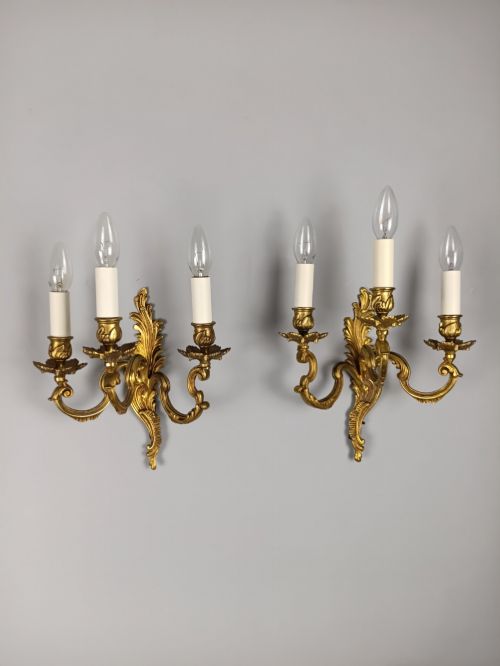
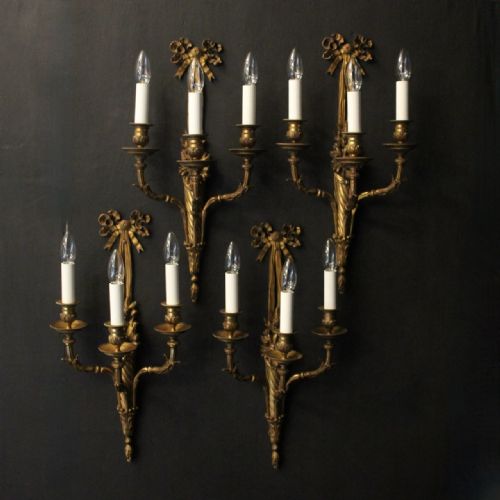


Ormolu Three Arm Sconces
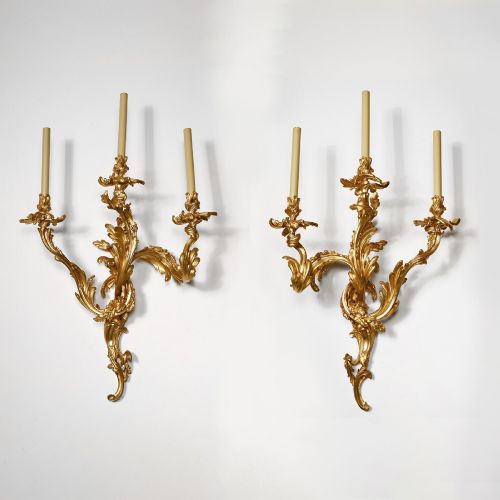
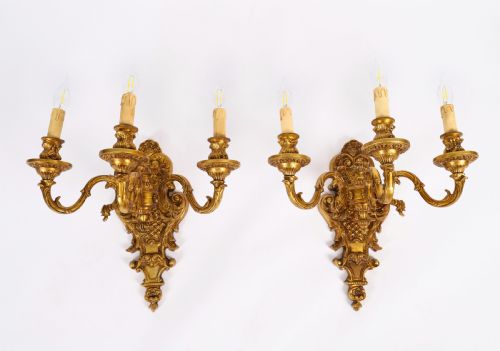
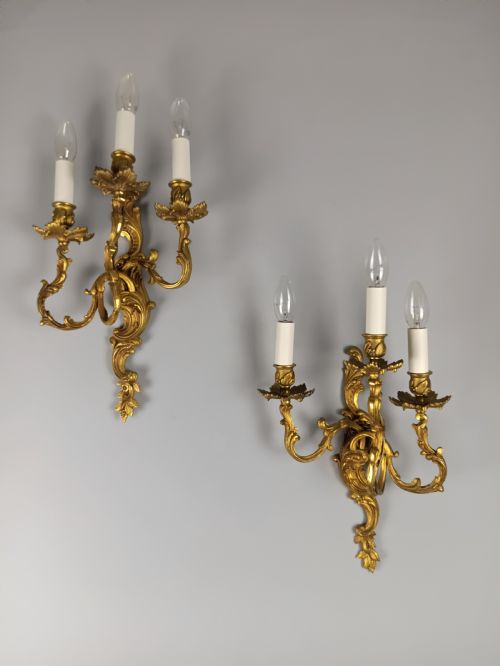
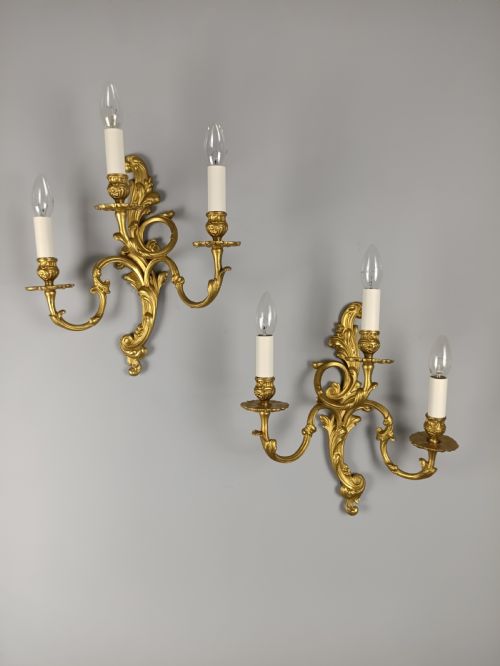
Ormolu three arm sconces bring brilliant French wall lighting into a room, cast in bronze and brass with rich historical styling.
Ormolu Three Arm Sconces
When you search for ormolu three arm sconces, you encounter decorative French wall lights designed to hold three candles or bulbs. These fixtures mount directly to a wall, projecting outward with three distinct branches to cast warm illumination across a space.
The pieces listed here lean heavily toward French origins, spanning the Victorian era through the early decades of the twentieth century. You will find matched pairs and sets reflecting elaborate historical revivals rather than plain utilitarian fittings.
Stylistically, the selection draws on Rococo, Louis XIV, and Louis XVI designs. These forms rely on asymmetrical curves, scrolling foliage, and classical symmetry to create visual weight on a wall.
How they were made
The primary construction relies on metal casting, predominantly utilising bronze, brass, and gilt metals. Molten metal was poured into moulds to form the heavy backplates, drip pans, and branching arms that define each sconce.
Surface finishes involve applying a gold tone over the base metal, achieved through traditional ormolu gilding or durable metal gilding. This imparts a luminous golden sheen that catches ambient light in a room.
Ormolu Three Arm Sconces Retail Price Guide 2026
Typical asking prices for ormolu three arm sconces among the pieces listed under this phrase on Sellingantiques today, from the lower quarter to the upper quarter. They describe what is for sale here now, not the wider market.
The materials recorded across the selection range from heavy cast bronze and ormolu to lighter gilded brass and crystal glass accents.
What varies in quality
The distinction between tiers of quality rests upon the crispness of the metal casting and the depth of the chased detail. Finer examples exhibit sharply rendered acanthus leaves and scrolls, whereas simpler pieces show softer, smoother contours from worn moulds.
Weight and gauge also dictate the caliber of the fixture, as heavier cast bronze provides a more rigid structure than thinner stamped or cast brass. The longevity of the original gilt surface further separates standard production from superior workshop output.
The Ormolu Three Arm Sconces Glossary
- Ormolu
- A gilded bronze technique involving mercury amalgamation or modern electroplating to apply a rich gold finish to base metal. This surface treatment gives antique French lighting its characteristic golden warmth.
- Rococo
- An ornate 18th-century style marked by asymmetry, C-scrolls, and naturalistic shell or plant motifs. It experienced major revivals during the 19th century.
- Louis XVI Style
- A neoclassical design vocabulary characterised by straight architectural lines, urns, ribbons, and symmetrical proportions. It offers a more restrained alternative to heavy Rococo curves.
- Applique
- A French term frequently used interchangeably with wall sconce or wall light. It denotes a decorative lighting fixture mounted flush to a vertical surface.
Ormolu Three Arm Sconces: Frequently Asked Questions
How do I install ormolu three arm sconces?
These fixtures mount directly to wall junction boxes using standard interior wiring methods. Many antique examples have been updated with modern electrical fittings to accommodate standard bulbs safely.
Professional installation by a qualified electrician is recommended to support the weight of heavy bronze or brass bodies securely against the wall.
How should I clean gilded bronze wall lights?
Dust the metal gently with a soft, dry cloth to prevent grime accumulation on the intricate chasing and recessed scrollwork. Avoid harsh chemical cleaners or abrasive polishes that can strip away the historic gilt surface.
Water and soap should be kept to a minimum, and any moisture must be dried immediately to protect both the metal and any older internal wiring components.
Can I use candles instead of electric bulbs?
Many historical sconces were originally built for wax candles before later conversion to electricity. If the drip pans and sockets permit, non-electric use remains possible depending on the specific rewiring status of the fixture.
Care should be taken with open flames near antique metalwork and older decorative finishes to prevent soot damage or heat discoloration.
How do I date a pair of wall sconces?
Dating relies on examining the casting techniques, fastening screws, and stylistic markers characteristic of periods like the Victorian era or the early 1900s. Heavier hand-chased bronze often points to 19th-century manufacturing.
Standardised brass components and specific revival trends can help narrow down pieces produced around 1920 or 1930.