

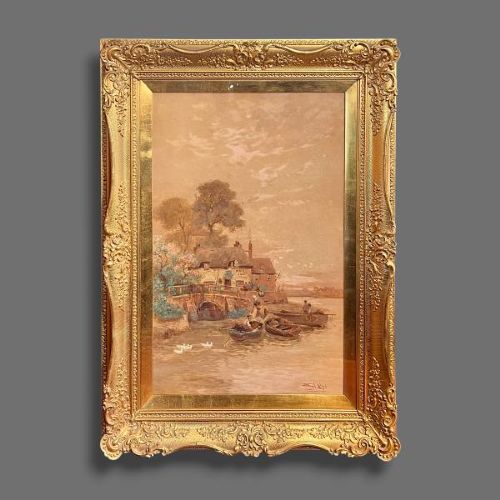


Original Water Colour Art
Original water colour art brings centuries of hand-painted character to your walls, spanning precise Victorian landscapes and mid-century modern compositions.
Original Water Colour Art
Original water colour art encompasses hand-painted works on paper created across multiple eras, ranging from Victorian and Edwardian pieces to mid-century modern compositions. When searching for original water colour art, you encounter diverse subjects including Italian scenes, alpine lakes, church views, and even animation illustrations.
The selections available typically include framed artwork and paintings executed on paper supports, often protected behind glass within wooden or giltwood frames. Pieces span distinct artistic movements, from nineteenth-century romanticism and the Victorian Dutch school to interwar realism and mid-century French styling.
Works on this page capture specific historic moments, bearing the distinct hand of named artists rather than mechanical reproduction. Buyers find both individual large-scale exhibition pieces and balanced pairs ready for hanging.
Materials and Construction
These works are executed in water colour directly upon paper supports, capturing pigment with fluid immediacy. Artists of the nineteenth and twentieth centuries utilised fine paper bases that preserve the translucent qualities characteristic of the medium.
Framing materials form an integral part of the surviving pieces, with wood, gilt wood, and gilded wood frames enclosing the paintings alongside protective glass. These traditional mountings preserve the delicate paper surfaces from atmospheric degradation over the decades.
Original Water Colour Art Retail Price Guide 2026
Typical asking prices for original water colour art among the pieces listed under this phrase on Sellingantiques today, from the lower quarter to the upper quarter. They describe what is for sale here now, not the wider market.
Listings span from the 1880s through the 1960s, utilising paper, watercolour, glass, wood, and gilt wood across various frames.
Assessing Quality and Hand
Distinction in these works rests upon the demonstrable skill of the brushwork and the sureness of the composition, separating master execution from standard amateur output. Finely painted details and atmospheric command elevate specific pieces above typical topographical records.
The significance of the artist's hand and documented attribution heavily influence the standing of an individual piece. Works carrying verified association to known nineteenth and twentieth-century painters command greater interest than anonymous examples.
Stuart Lloyd·Jan van Couver·Edith E Caswall·B. Kaufmann·Charles H Poingdestre·Walt Disney·Yves Brayer·Belisario Gioja·JS Cooper
The Original Water Colour Art Glossary
- Watercolour
- A painting method where the pigments are suspended in a water-based solution, traditionally applied to paper. This medium relies on the white of the paper showing through transparent washes of colour.
- Giltwood
- Wood that has been coated with a thin layer of gold leaf or gilt powder. This finish appears frequently on the antique frames housing nineteenth-century paintings.
- Victorian
- Pertaining to the reign of Queen Victoria, spanning the mid to late nineteenth century. Pieces from this era often display detailed naturalism or romanticism.
- Edwardian
- Relating to the reign of King Edward VII in the early twentieth century. Art from this period maintains traditional academic standards while adopting lighter palettes.
Original Water Colour Art: Frequently Asked Questions
How do I care for water colour art?
Keep water colour paintings away from direct sunlight to prevent the pigments from fading over time. Ensure they remain in rooms with stable humidity to protect the delicate paper and wooden frames.
Check that the protective glass stays sealed against dust and moisture. Professional framing using acid-free mounts safeguards the paper from chemical breakdown.
How are these paintings framed?
Most works arrive in period wooden, gilt wood, or gilded wood frames paired with glass for protection. These surrounds often reflect the aesthetic of the era in which the painting was produced.
Retaining the original framing preserves the historic integrity of the piece. Collectors often value frames that show appropriate age and matching patination.
Can I identify the period by the style?
Nineteenth-century pieces often showcase romanticism or detailed realism, while Edwardian works tend toward softer palettes. Mid-century examples introduce modernist interpretations and distinct compositional geometry.
Examining the paper type, framing construction, and artist signatures helps confirm the era. Signatures often align with documented working periods of specific painters.
What subjects appear in these works?
The subjects range widely from Italian architectural views and alpine lakes to English country churches. Artists frequently painted picturesque scenes during their travels across Europe.
Some selections include illustrative works, such as animation pieces from mid-century studios. Each subject reflects the personal observation and destination of the individual artist.