

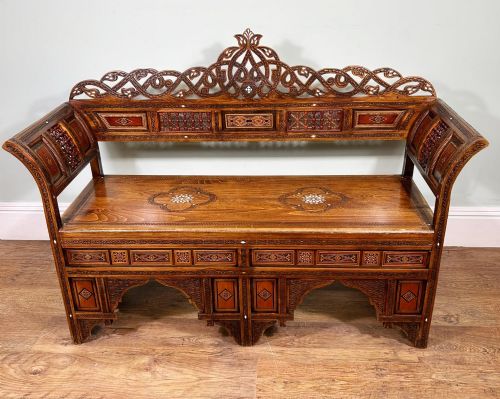


Oriental Style Bench
These oriental style bench selections bring together carved hardwoods and intricate inlaid seating from various Eastern and regional revival traditions.
Oriental Style Bench
When you search for an oriental style bench, you are looking at seating forms drawn from Chinese tradition, Moorish design and Middle Eastern craftsmanship. These pieces range from substantial hall settles and daybeds to low window seats and dressing stools.
The versions you are most likely to meet on this page date from the late nineteenth and early twentieth centuries, spanning periods such as eighteen eighty to nineteen thirty. They include carved Chinese hardwoods alongside Moorish and Syrian inlaid furniture.
Forms vary from horseshoe hall benches and daybeds to low stools and window seats, often accompanied by related dining suites or coffee tables.
How they were made
Maker techniques rely heavily on dense hardwoods such as elm, walnut and huali, shaped into traditional frames and seating structures. Carving and ebonising are utilised to define the surface decoration of Chinese Qing Dynasty and traditional pieces.
Inlaid examples incorporate contrasting materials, setting mother of pearl and bone into the wooden substrates of Damascan and Syrian furniture. Marble panels also appear as inset decorative elements within the hardwood frames.
Oriental Style Bench Retail Price Guide 2026
Typical asking prices for oriental style bench among the pieces listed under this phrase on Sellingantiques today, from the lower quarter to the upper quarter. They describe what is for sale here now, not the wider market.
Listings feature items spanning from the nineteenth century up to nineteen thirty, incorporating materials like marble, bone and mother of pearl alongside traditional hardwoods.
What varies in quality
Quality rests in the precision of the carving and the complexity of the joinery used to construct the bench. Crisp detail in dragon motifs or structural elements distinguishes finer examples from simpler production.
The execution of inlay work determines the upper tier of these pieces, particularly where mother of pearl and bone form intricate geometric or floral patterns. The choice of timber, including identified huali or huanghuali woods, elevates the standard of the piece.
Whytock and Reid
The Oriental Style Bench Glossary
- Hardwood
- Dense timber derived from broad-leaved trees, used for durable furniture construction. Examples on this page include elm, walnut and huali.
- Mother of Pearl
- The iridescent inner layer of mollusc shells, utilised for decorative inlay in Syrian and Damascan furniture. It creates striking contrast against dark wood.
- Qing Dynasty
- The final imperial dynasty of China, spanning the seventeenth to early twentieth centuries. Pieces referencing this period often display traditional carved motifs.
- Horseshoe bench
- A seating form featuring a continuous curved backrest and armrail shaped like a horseshoe. It is a traditional Chinese chair design adapted for hall seating.
Oriental Style Bench: Frequently Asked Questions
Where were oriental style benches placed in a home?
These benches were typically positioned in hallways, reception rooms or near windows as low seating. Their decorative backs and frames suited prominent placement in domestic interiors.
Larger forms like daybeds and settles served communal or resting spaces, while smaller stools functioned as moveable seating or dressing furniture.
What materials are commonly found on these benches?
Construction relies primarily on various hardwoods, including elm, walnut and specific Asian timbers like huali. These woods provide a sturdy structural foundation for detailed carving.
Decorative surfaces frequently incorporate mother of pearl, bone and marble. These contrasting materials are embedded into the wood to form geometric and pictorial patterns.
How do Chinese and Middle Eastern styles differ?
Chinese pieces often feature carved hardwood frames, ebonised finishes and distinct structural forms like horseshoe arms or daybed profiles. The decoration draws on traditional motifs such as dragons.
Middle Eastern and Moorish examples tend to emphasise surface pattern through intricate inlay work utilising bone and mother of pearl. Their forms include low window seats and Syrian furniture styles.
Can these benches be used with modern dining sets?
Hall benches and settles can be integrated into contemporary dining arrangements as alternative seating. Their dimensions often accommodate placement alongside large tables.
Care should be taken to match the height and scale of the bench to the table. Their distinct carved designs also allow them to stand alone as statement pieces.