
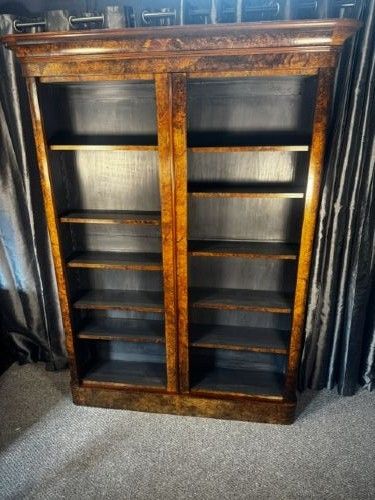


Open Front Walnut Cabinet
An open front walnut cabinet brings rich grain and accessible shelving straight into a room.
Open Front Walnut Cabinet
An open front walnut cabinet offers display space and book storage without the barrier of glass doors or solid panels. These pieces span the nineteenth century up through the nineteen-thirties, taking forms such as bookcases, credenzas, and break-fronted designs.
The selection on this page leans heavily toward nineteenth-century Victorian pieces alongside later twentieth-century interpretations. Makers drew on various historical idioms, producing items in French Provincial, Queen Anne Revival, Regency Style, Arts and Crafts, and Art Deco modes.
Buyers encounter everything from simple timber shelves to elaborate library bookcases fitted with carved friezes and barley twist columns. Some examples incorporate practical lower drawers or mirror backs behind the open compartments.
How they were made
Cabinetmakers relied on walnut and figured or burr walnut veneer laid over stable timber carcases to achieve striking decorative grain patterns. Selected surfaces often incorporated contrasting satinwood stringing or inlay work.
Structural elements frequently integrated brass hardware for adjustable shelving brackets and hinges, while glass appeared occasionally in cabinet doors or side panels of credenza forms. Carved details like friezes and turned barley twist columns required skilled hand woodworking.
Listings feature walnut and burr walnut cabinets spanning the nineteenth century through the nineteen-thirties, including bookcases and credenzas.
What varies in quality
The quality of an open front walnut cabinet rests primarily on the selection and matching of the walnut veneer across the primary elevations. Grain that flows naturally across drawer fronts and cornices indicates careful planning by the maker.
Construction depth also defines the better pieces, seen in heavier timber carcases, crisply carved wooden details rather than cast ornaments, and well-executed joinery. The refinement of secondary timbers and the precision of adjustable shelving mechanisms separate standard production from superior examples.
The Open Front Walnut Cabinet Glossary
- Burr walnut
- A veneer sliced from walnut tree growths, producing swirling knot formations and rich patterns. It was prized for luxury furniture fronts during the Victorian era.
- Break-fronted
- A furniture facade where the central section projects forward from the flanking wings. This architectural arrangement adds depth and shadow to bookcases and credenzas.
- Credenza
- A low cabinet, often featuring central open shelving flanked by cupboards or glass doors. In nineteenth-century interiors, these served both storage and display functions.
- Barley twist
- A spiral turning resembling a twisted rope, used on furniture columns and supports. It became particularly popular during revival periods referencing seventeenth-century styles.
- Frieze
- The flat or decorated horizontal band situated just beneath the top cornice of a cabinet. Carvers often embellished this area with foliage or geometric relief work.
Open Front Walnut Cabinet: Frequently Asked Questions
What is an open front walnut cabinet?
An open front walnut cabinet is a piece of case furniture featuring exposed shelving without doors, constructed primarily from walnut timber and burr veneers. These items function mainly as bookcases and credenzas for displaying books and decorative objects.
Such cabinets appear across several historical periods, ranging from mid-nineteenth-century Victorian designs to nineteen-thirties Art Deco interpretations. Their open nature provides immediate access to contents while showcasing rich wood grains.
How do I date an open walnut cabinet?
Dating relies on observing construction methods, timber choices, and stylistic revival cues visible across the piece. Nineteenth-century examples often display heavy Victorian massing or carved barley twist columns, whereas nineteen-thirties pieces show cleaner lines influenced by Art Deco or Arts and Crafts ideals.
Secondary woods, brass hardware styles, and the presence of veneer versus solid timber also help narrow down the decade of manufacture. Comparing decorative motifs like French Provincial or Queen Anne Revival details against known period markers clarifies the age.
Where should I place a walnut bookcase?
A walnut bookcase suits studies, living rooms, and libraries where its warm brown tones and figured grain can complement existing furnishings. Because these cabinets lack protective doors, placing them away from direct sunlight prevents the walnut veneer from fading over time.
Sufficient clearance in front of the unit allows easy access to the adjustable shelves and any lower drawers. Pairing them with period seating or placing them against neutral walls highlights their architectural forms.
How do I care for walnut veneer?
Maintaining walnut veneer involves dusting regularly with a soft, dry cloth and avoiding silicone-based polishes that build up residue. Keeping the furniture away from direct heat sources and sudden humidity shifts prevents the thin veneer from lifting or cracking.
Occasional applications of appropriate furniture wax help nourish the timber surface and maintain a soft sheen. Gentle handling ensures the decorative grain remains protected for daily use.