
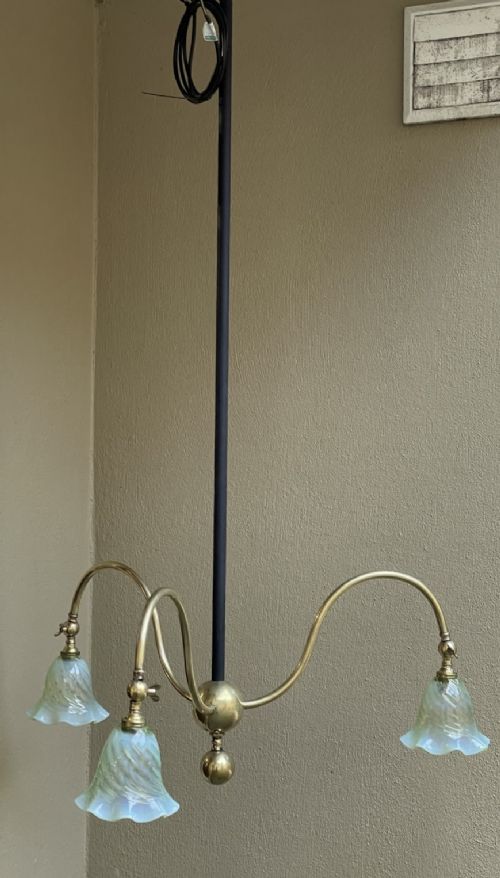
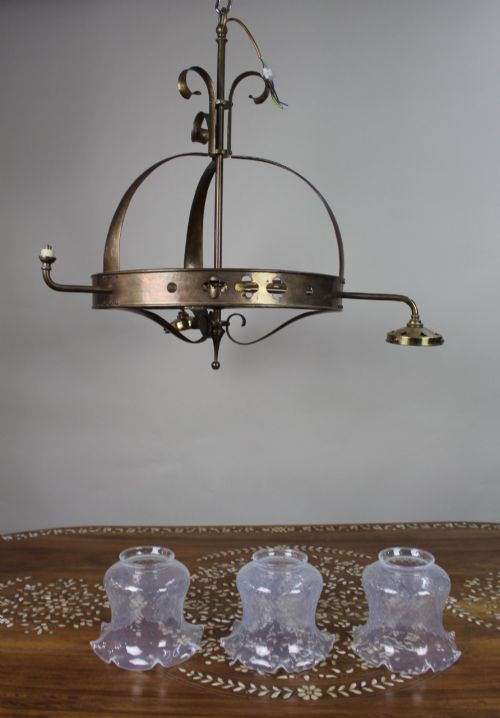


Opalescent Light Shade
An opalescent light shade diffuses a soft, milky glow, bringing period character and gentle illumination to a room.
Opalescent Light Shade
When you search for an opalescent light shade, you are looking at domestic lighting glassware designed to soften and scatter light. These pieces appear in forms such as ceiling pendants, bowls, wall lights and table lamps.
The versions you are most likely to meet on this page span the Victorian, Edwardian and mid twentieth century periods. They cross styles from Arts and Crafts and Gothic Revival to Art Nouveau and Art Deco.
Many are mounted in brass, copper or chrome fitments, whilst others survive as standalone glass shades ready for hanging. They range from simple utilitarian domes to substantial decorative bowls.
How they were made
Makers fashioned these shades using specialised glassblowing and moulding techniques, incorporating mineral additives to achieve the characteristic milky or pearlescent opacity. This treatment scatters the light evenly without harsh glare.
Metalwork components such as brass, copper and patinated bronze were cast, spun or hand beaten to house and suspend the glass. Fixtures often combined fabric cords and metal galleries to secure the shades safely.
Periods represented span the nineteenth century, Victorian, Edwardian, nineteen-hundred, nineteen-ten, nineteen-thirty and nineteen-forty.
What varies in quality
Quality in these pieces lies in the depth and complexity of the glass coloration and the fineness of the moulding. Superior examples display a rich play of pearlescent tones when lit, rather than a flat, uniform opacity.
The standard of associated metalwork also distinguishes better pieces, with heavy cast brass, hand finished copper and robust gallery mounts marking out superior production over simpler stamped metal fittings.
Sabino·Lalique·P Maynadier·Hinks·Messenger
The Opalescent Light Shade Glossary
- Opalescent glass
- Glassware that exhibits a milky, translucent quality with shifting tones, often appearing bluish in transmitted light and warm amber in reflected light.
- Arts and Crafts
- A design movement valuing hand craftsmanship and honest materials, frequently seen in hammered copper and brass fittings paired with simple glass forms.
- Art Nouveau
- A style characterised by flowing, organic lines and natural motifs, heavily represented in early twentieth century lighting design.
- Art Deco
- A later twentieth century style embracing geometric shapes, streamlined forms and machine age metals such as chrome.
- Gallery
- The metal ring or collar used to hold a glass lampshade in place beneath a ceiling fitting or pendant.
Opalescent Light Shade: Frequently Asked Questions
What is an opalescent light shade?
An opalescent light shade is a decorative glass diffuser designed to soften electric or oil illumination. The glass contains agents that scatter light, creating a gentle and even glow.
These shades appear across various historic styles, from Victorian oil lamps to Art Deco ceiling pendants.
How do I hang a vintage shade?
Vintage glass shades typically require a compatible metal gallery or fitter to secure them safely to a ceiling pendant cord. The rim of the glass slots into the gallery screws.
It is advisable to check the diameter of the fitter neck matches your existing ceiling rose and wiring.
Can I use modern bulbs with old shades?
Modern LED bulbs work well inside historical shades because they generate less heat than older incandescent types. This protects the original glass and metal from thermal stress.
Selecting a warm white bulb helps replicate the softer ambience these fittings originally provided.
How do I date an opalescent shade?
Dating relies on the style of the glass moulding, the supporting metal hardware, and construction methods. Arts and Crafts examples often feature hand worked copper, whilst Art Deco pieces display geometric symmetry.
Matching the shade to related period light fittings helps narrow down the decade of manufacture.