


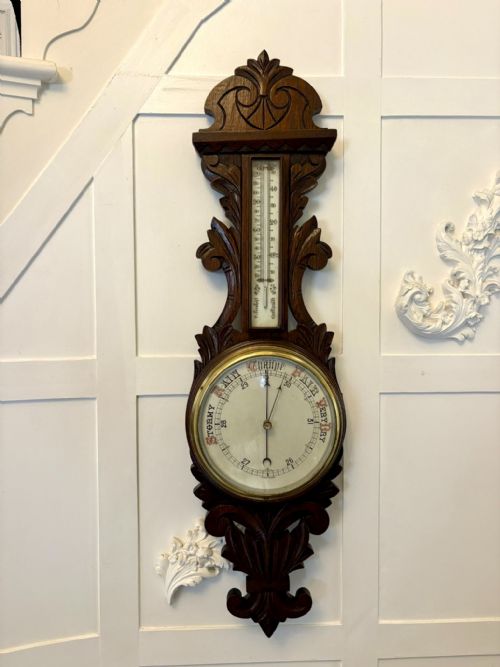


Oak Wood Barometer
An oak wood barometer measures atmospheric pressure while bringing rich Victorian grain and crisp carved detail directly onto the wall.
Oak Wood Barometer
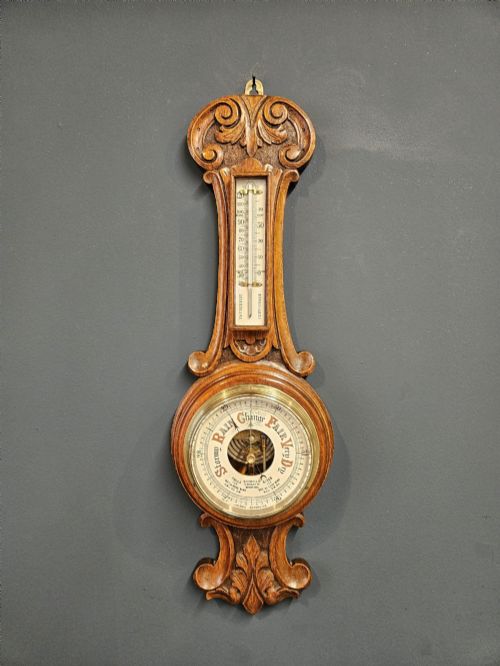
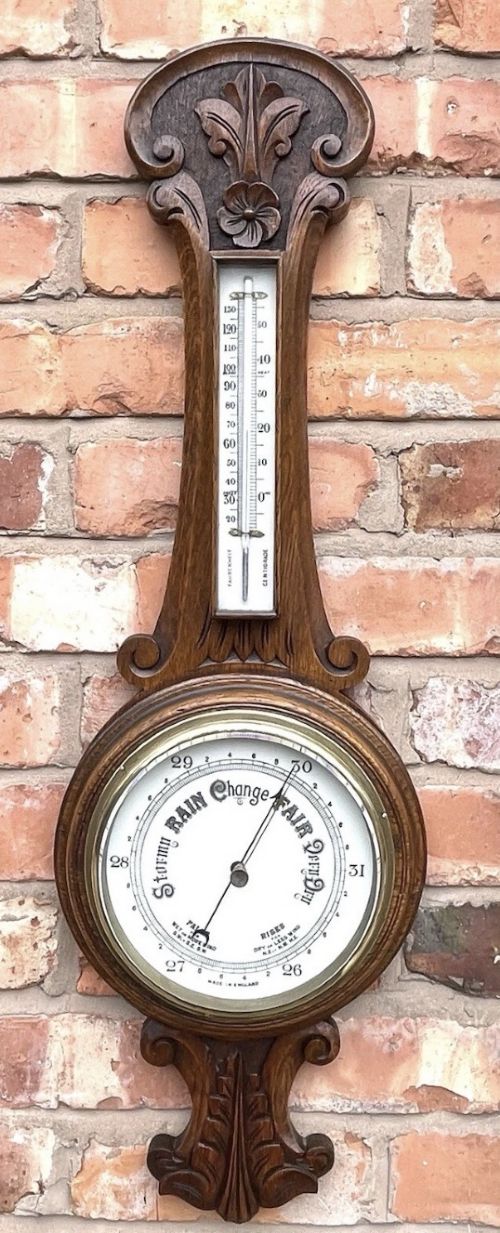
An oak wood barometer combines practical meteorology with domestic decoration, most frequently appearing on this page in the classic banjo format from the Victorian era. These wall-hanging instruments combine dials, thermometers, and sometimes clock movements within sturdy timber surrounds.
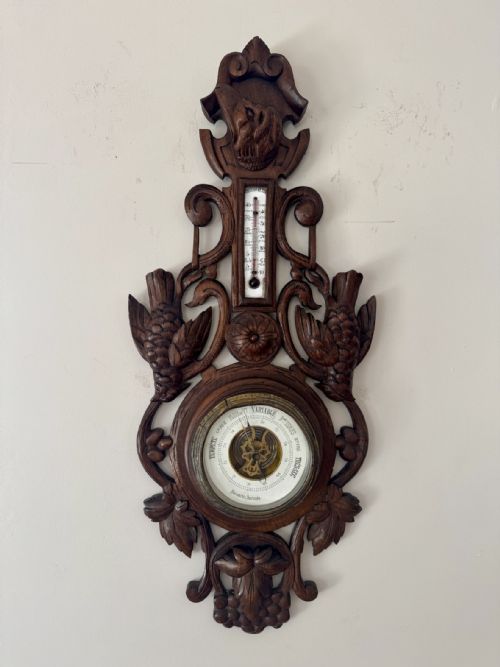
The selection ranges from robust nineteenth-century wheel barometers and stick barometers to intricately carved Black Forest examples and Edwardian interpretations. Wall barometers of this scale serve as both functional weather indicators and prominent focal points in a room.
Materials and construction
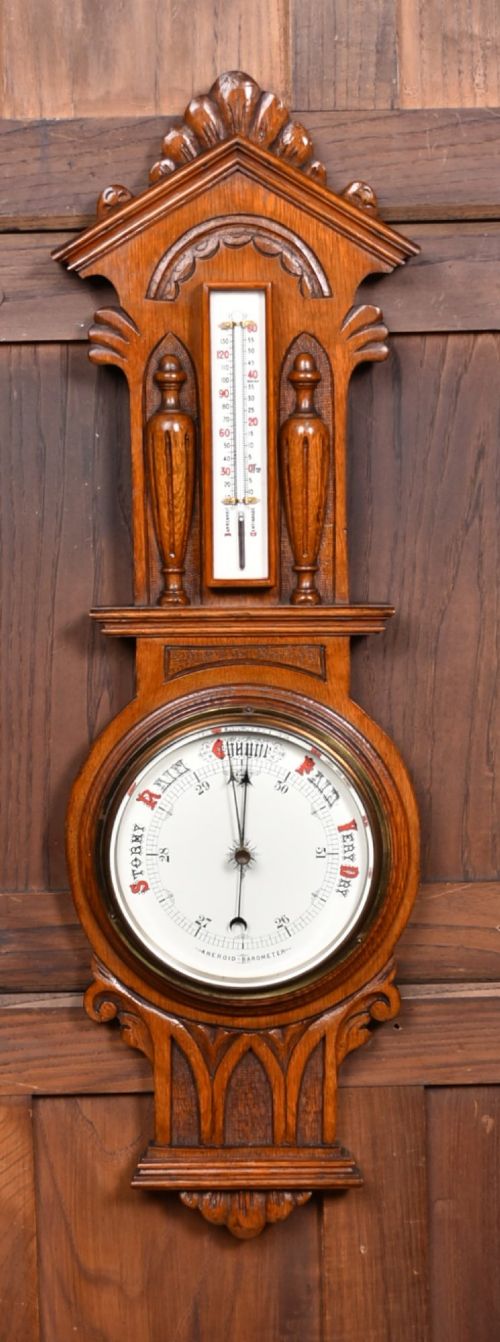
Solid oak provides the primary structural housing, often shaped into banjo contours, rectangular stick cases, or elaborate frames featuring carved foliage and animal motifs. Cabinetmakers shaped and polished the timber to highlight the natural medullary rays and grain patterns of the wood.
Internal mechanisms rely on brass fittings, glass bezels, and mercury-filled tubes or aneroid chambers. Dials fashioned from white porcelain or ceramic display crisp black graduations, while bone scales and thermometers add secondary functional detail.
Oak Wood Barometer Retail Price Guide 2026
Typical asking prices for oak wood barometer among the pieces listed under this phrase on Sellingantiques today, from the lower quarter to the upper quarter. They describe what is for sale here now, not the wider market.
Assessing quality and execution
Depth and crispness of the carving distinguish finer specimens from standard production models, particularly in Black Forest or Gothic Revival examples where hand-chiseled foliage defines the silhouette. The presence of specialised maker signatures on the dial adds historical weight and confirms workshop provenance.
The integration of multiple functions, such as combined clock movements or skeletonised mechanisms, elevates the sophistication of the piece. Preservation of the original glass, brass bezels, and undamaged porcelain dials preserves both visual appeal and mechanical integrity.
Negretti & Zambra·W Watson & Sons·Maple & Co·James Pitkin London
The Oak Wood Barometer Glossary
- Aneroid barometer
- An instrument that measures atmospheric pressure using a flexible metal box rather than liquid mercury. Changes in pressure cause the sealed capsule to expand or contract, moving a pointer across the dial.
- Banjo barometer
- A wall barometer shaped like a stringed instrument, featuring a circular dial at the top and an elongated stem that frequently houses a thermometer or hygrometer.
- Stick barometer
- A tall, vertical barometer that uses a mercury-filled glass tube and a visible scale to measure atmospheric pressure directly against a metric or imperial column.
- Skeletonised movement
- A clock or barometer mechanism with cut-away plates that reveal the internal gears and working parts through the dial face.
- Wheel barometer
- A mercurial barometer connected to a pulley and weight system that turns a visible pointer around a large circular dial, often paired with a spirit thermometer.
Oak Wood Barometer: Frequently Asked Questions
How do these barometers work?
These instruments measure shifting atmospheric pressure to indicate impending changes in local weather patterns. Mercurial versions use a column of liquid, while aneroid mechanisms rely on a sealed internal metal chamber.
As pressure rises or falls, the internal expansion or contraction moves the external pointer across the graduated dial face. This provides a direct reading of conditions ranging from stormy to very dry.
Where should I hang my barometer?
Choose an interior wall that avoids direct sunlight, intense heat sources, and damp conditions to protect the historic timber case. Stable indoor environments prevent the oak from warping and keep the delicate internal linkages functioning properly.
Ensure the wall fixing is secure, as these timber and glass instruments carry significant weight. Hanging the piece at eye level allows easy reading of the dial and thermometer.
How do I date an oak barometer?
Examine the style of the case, the typography on the dial, and any maker signatures recorded on the instrument. Victorian pieces often display heavy Victorian carving or Gothic Revival motifs, while Edwardian examples show lighter proportions.
Mechanical details also provide clues, such as the shift toward aneroid movements in the latter half of the nineteenth century. Patents or exhibition inscriptions on the brass register plates can narrow the timeline further.
What is the difference between banjo and stick barometers?
Banjo barometers feature an expanded circular head combined with a long lower trunk, creating a decorative silhouette well suited to domestic wall spaces. Stick barometers present a narrow, vertical profile that displays the mercury tube directly against a calibrated scale.
While stick instruments focus on precise scientific measurement, banjo variants prioritize decorative woodwork alongside meteorological utility.