

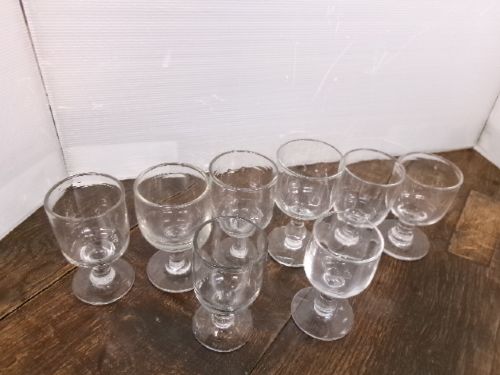




Nineteenth Century Stemware
Nineteenth century stemware encompasses hand-blown glass drinking vessels shaped for wine, champagne and spirits during the Georgian, Regency and Victorian eras.
Nineteenth Century Stemware
Nineteenth century stemware comprises functional drinking vessels produced across the Georgian, Regency and Victorian periods, taking forms such as rummers, wine glasses and champagne coupes. These pieces reflect the shifting social habits of the nineteenth century, moving from heavy tavern rummers to delicate dessert wine glasses.
The most common examples on this page are wine glasses and rummers produced in sets, often featuring coloured glass or wheel-engraved motifs. Buyers encounter both small table glasses and larger ceremonial goblets originating from English and Bohemian workshops.
How nineteenth century stemware was made
These items rely on lead crystal and blown glass manipulated by skilled glassblowers to form bowls, stems and feet. Artisans utilised lead glass for its weight and clarity, which allowed the material to hold deep wheel-engraving without fracturing.
Makers applied surface ornamentation such as gilding and colour overlays, exemplified by cranberry and aqua green glass. Techniques combined free-blowing with mould-blowing and subsequent hand-engraving of botanical or topographical scenes.
Nineteenth Century Stemware Retail Price Guide 2026
Typical asking prices for nineteenth century stemware among the pieces listed under this phrase on Sellingantiques today, from the lower quarter to the upper quarter. They describe what is for sale here now, not the wider market.
Some Victorian drinkers required glasses specifically proportioned for dessert wine, proving that historic dining involved distinct vessels for every course.
What varies in quality in nineteenth century stemware
Quality depends upon the depth and precision of the hand-engraving, the purity of the lead crystal, and the crispness of applied gilding. Superior pieces display finely detailed motifs like convolvulus flowers rather than shallow or blurred surface marks.
Consistency within a set marks out finer production, particularly in harlequin sets or matched pairs where rim heights and colour saturation align. The weight of the metal and the resonance of the glass further distinguish standard utility glass from exhibition pieces.
The Nineteenth Century Stemware Glossary
- Lead crystal
- Glass containing lead oxide, which increases the weight, refractive index and brilliance of the vessel. This material allowed nineteenth century makers to cut deeper facets.
- Rummer
- A capacious drinking glass on a short stem, popular in the Georgian and Regency periods for ale, wine or punch. These sturdy pieces often featured engraved bridges, ships or initials.
- Champagne coupe
- A shallow, broad-bowled stemmed glass designed for sparkling wine. Victorian examples frequently utilised colour overlays and delicate wheel-engraving.
- Gilding
- The application of a thin layer of gold leaf or gold paint to glass surfaces. This decoration was typically fired in a kiln to bond with the metal.
Nineteenth Century Stemware: Frequently Asked Questions
What is nineteenth century stemware?
Nineteenth century stemware refers to drinking glasses produced between eighteen hundred and nineteen hundred, encompassing Georgian, Regency and Victorian styles.
These pieces include rummers, wine glasses and champagne coupes made from lead glass or coloured crystal.
How do I identify a rummer?
A rummer is characterised by a heavy, bucket-shaped or round bowl set upon a relatively short, thick stem and a broad foot. They were built for substantial daily use in homes and taverns.
Many examples feature engraved decoration related to local landmarks or agricultural themes.
What makes coloured glass valuable?
Coloured glass derives its tone from metallic oxides added during the melting process, such as cranberry or aqua green. The uniformity of the colour and the success of overlay techniques determine the skill involved in production.
Makers often cut through the outer layer of colour to reveal clear lead crystal beneath.