

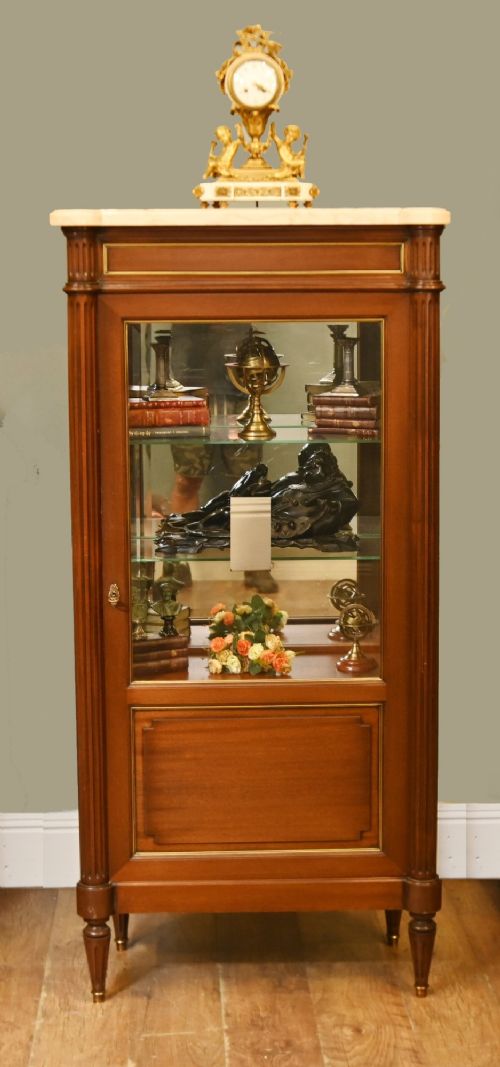
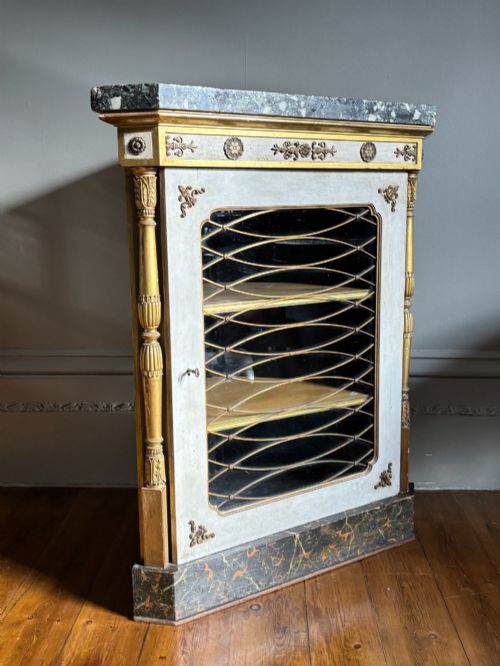


Neoclassical Display Case
A neoclassical display case brings architectural clarity to your room while keeping treasured objects safe behind glass.
Neoclassical Display Case
A neoclassical display case draws on classical motifs like symmetry, columns, and refined proportions to house your objects. These pieces span the Victorian, Edwardian, and late nineteenth-century periods, capturing revivalist movements such as Sheraton Revival, Louis XVI, and Adam style.
You will encounter various formats on this page, including towering vertical vitrines, corner cabinets designed to utilise awkward angles, and broad side cabinets. They frequently employ mahogany and satinwood, punctuated by brass mounts and glass panels.
The aesthetic looks back to ancient Greece and Rome through French Directoire and British Regency lenses. Such pieces balance structural strength with decorative lightness, making them versatile furniture for modern and traditional interiors alike.
How they were made
Cabinet makers utilised dense timbers such as mahogany and satinwood as the primary carcase materials, often employing careful veneers and string inlay to achieve crisp linear patterns. These woods provided both durability and a fine grain suited to polished finishes.
Glazing techniques allowed large expanses of glass to be secured within slender timber bars or brass framing, creating unobstructed views of the interior shelves. Giltwood accents and painted wood surfaces added decorative contrast without compromising the architectural lines.
Neoclassical Display Case Retail Price Guide 2026
Typical asking prices for neoclassical display case among the pieces listed under this phrase on Sellingantiques today, from the lower quarter to the upper quarter. They describe what is for sale here now, not the wider market.
What varies in quality
The standard of timber selection and inlay precision sets the finer examples apart from simpler workshop output. Cabinet makers who took extra care with satinwood banding and symmetrical grain patterns achieved a visual depth that ordinary construction lacks.
Hardware and mount quality also signal the tier of the piece, with crisply cast brass mounts and well-fitted glass doors demonstrating superior craftsmanship. The architectural proportions feel more resolved on cabinets where every classical detail is properly scaled.
James Hicks·C Hindley and Sons
The Neoclassical Display Case Glossary
- Satinwood
- A lustrous, yellowish timber prized for its fine grain and ability to take a high polish. It was a favourite for decorative cabinet work during the Sheraton Revival.
- Directoire style
- A transitional French design period bridging Louis XVI and Empire styles, marked by restrained classical ornamentation and geometric purity. It favours clean architectural lines over excessive carving.
- Breakfront
- A cabinet whose central section projects forward from the flanking wings. This creates visual rhythm and depth across the front elevation.
Neoclassical Display Case: Frequently Asked Questions
What is a neoclassical display case?
A neoclassical display case is a glazed cabinet influenced by the classical architecture and design principles of ancient Greece and Rome. These pieces typically feature symmetrical lines, refined timber veneers, and decorative elements like columns or classical brass mounts.
They were built to showcase valuable porcelain, silver, or personal collections while protecting them from dust. The form evolved through various revival periods during the nineteenth and early twentieth centuries.
Where should I place a corner cabinet?
A corner cabinet fits neatly into empty room junctions, turning overlooked angles into focal points for display. They work particularly well in dining rooms or drawing rooms to house collection pieces without crowding the floor space.
Ensure the door has enough clearance to swing open fully without hitting adjacent furniture or architectural mouldings.
How do I care for satinwood?
Satinwood benefits from gentle dusting with a soft, dry cloth and should be kept away from direct sunlight to preserve its warm tone. Avoid silicone-based polishes, which can build up and dull the fine grain over time.
Maintaining stable room humidity prevents the timber and underlying veneers from drying out or splitting.
How do I distinguish Sheraton Revival from Adam style?
Sheraton Revival pieces often showcase lighter timbers like satinwood, delicate string inlay, and tapered legs inspired by late eighteenth-century furniture designs. Adam style tends to reflect a more robust architectural influence with classical swags, urns, and heavier symmetry.
Examining the decorative motifs and the overall weight of the timber will usually reveal which classical designer inspired the piece.