

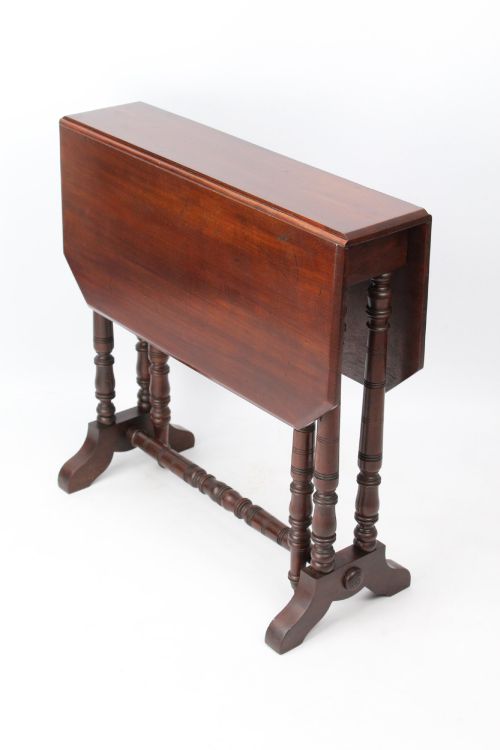


Narrow Gateleg Table
A narrow gateleg table offers compact utility with hinged leaves, suiting period homes and modern spaces alike.
Narrow Gateleg Table
A narrow gateleg table is primarily represented here by Sutherland tables, alongside oak drop-leaf dining tables and spider-leg pembroke tables. These space-saving items date from the Victorian, Edwardian, and early twentieth-century periods.
The form relies on drop leaves supported by pivoting legs, allowing the table to fold flat when floor space is at a premium. They function variously as occasional tables, tea tables, and small dining tables.
Victorian and Edwardian examples dominate the selection, built in proportions suited to smaller rooms and narrower corridors. Oak and mahogany appear most frequently as the primary woods.
How they were made
Cabinetmakers utilised solid timbers and veneers, combining mahogany, oak, and walnut with decorative elements such as satinwood inlay and brass fittings. Ebonised finishes and burr walnut surfaces also appear across the selection.
The hinged leaf mechanism requires precise joinery to ensure the drop leaves align smoothly with the fixed centre top when raised. Slender gate legs pivot outward on wooden hinges or brass pivots to bear the weight of the extended leaves.
Narrow Gateleg Table Retail Price Guide 2026
Typical asking prices for narrow gateleg table among the pieces listed under this phrase on Sellingantiques today, from the lower quarter to the upper quarter. They describe what is for sale here now, not the wider market.
The selection spans from Victorian and Edwardian pieces up to the 1930s, constructed predominantly in mahogany, oak, and walnut.
What varies in quality
The refinement of the timber selection dictates the overall standard, moving from plain utility oak to figured mahogany and burr walnut with intricate satinwood crossbanding. Subtle details such as canted corners and delicate spider-leg turnings distinguish finer pieces from standard production.
Structural integrity in the hinge action and the stability of the pivoting gate legs determine the daily usability of the table. Original brass hardware and well-fitted leaves indicate higher standards of period craftsmanship.
The Narrow Gateleg Table Glossary
- Sutherland table
- A narrow form of drop-leaf table featuring exceptionally slender legs and leaves that drop almost to the floor. It was patented in the nineteenth century and remains popular for its minimal footprint.
- Gateleg table
- A table with one or more hinged leaves supported by legs that swing out like a gate. This design provides a large surface area when open and a compact profile when folded.
- Drop leaf
- A hinged section of a table top that folds down to save space. These leaves allow the piece to alternate between a narrow console or occasional table and a larger dining surface.
- Crossbanding
- A border of veneer laid around the edge of a table top with the grain running perpendicular to the centre. This decorative technique frames the primary timber and demonstrates detailed cabinet work.
- Canted corner
- A corner that has been bevelled or cut off at an angle rather than left square. This shaping softens the outline of the table top.
Narrow Gateleg Table: Frequently Asked Questions
How do I identify a Sutherland table?
A Sutherland table is recognised by its particularly narrow centre fixed top and deep drop leaves that hang nearly vertical when folded. The legs are slender and set close to the hinge.
When opened, the pivoting gate legs swing out deeply to support the long leaves, distinguishing it from standard drop-leaf dining tables.
Where should I place a narrow drop-leaf table?
These tables suit hallways, landings, and small sitting rooms where floor space is limited. With both leaves down, they function as slim side or occasional tables against a wall.
Raising one or both leaves transforms the piece into a tea table or a small dining surface for a couple of people.
What is the difference between oak and mahogany versions?
Oak examples generally date to the Arts and Crafts period or the early twentieth century, presenting a heavier, more rustic appearance. They suit traditional cottage interiors.
Mahogany and walnut versions lean towards the Victorian and Edwardian eras, often featuring finer polished surfaces, inlay work, and slender turned legs.
How do I care for the polished wood surface?
Keep the wood away from direct sunlight and heat sources to prevent the polish and veneers from drying out or cracking. Use coasters and placemats to protect the finish from moisture and heat.
Dust regularly with a dry cloth and occasionally apply a suitable wax to maintain the lustre of the mahogany, walnut, or oak.