

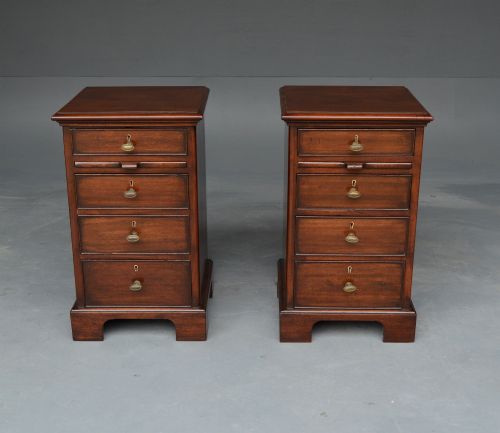
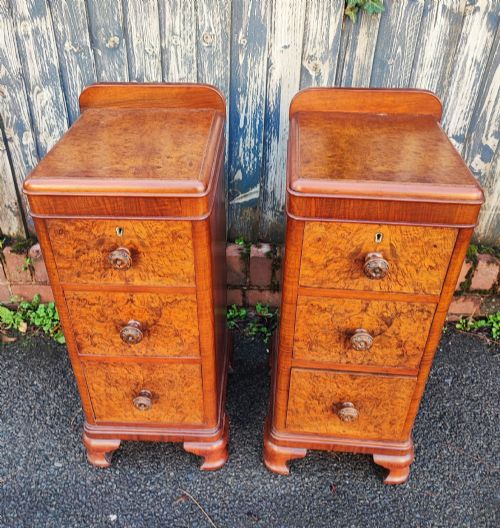
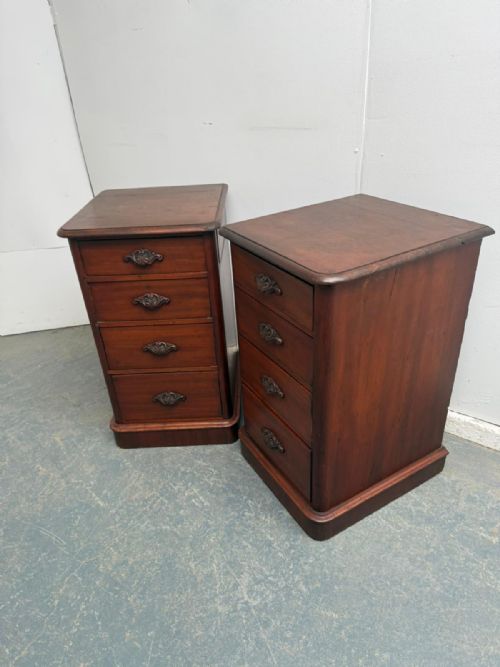


Narrow Bedside Lockers
These narrow bedside lockers are compact bedroom pieces built to keep necessities close at hand without crowding the floor.
Narrow Bedside Lockers
When you search for narrow bedside lockers, you encounter compact bedside chests, cabinets, and tables designed for smaller spaces. These pieces emerge from periods spanning the Georgian era through the Victorian period, and onward into the nineteen-twenties and nineteen-thirties.
The versions you are most likely to meet on this page include mahogany, walnut, and burr walnut examples, alongside oak, rosewood, and metal variations. Formats range from simple pot cupboards to small chests fitted with multiple drawers.
Many are presented as pairs, offering symmetrical storage flanking a bed. Styles stretch from restrained Victorian and Georgian designs to Louis XV Revival, Art Deco, and Victorian Campaign aesthetics.
How they were made
Cabinet makers utilised dense hardwoods such as mahogany and walnut, frequently selecting figured burr walnut veneers for visual depth. Brass hardware appears on campaign variations and drawer pulls, adding structural corners and functional handles.
Construction techniques include multi-drawer arrangements and door enclosures, such as pot cupboards designed to house chamber pots. Waxed finishes protect the timber while preserving the grain patterns characteristic of nineteenth and early twentieth-century workshops.
Narrow Bedside Lockers Retail Price Guide 2026
Typical asking prices for narrow bedside lockers among the pieces listed under this phrase on Sellingantiques today, from the lower quarter to the upper quarter. They describe what is for sale here now, not the wider market.
Materials recorded across these listings include mahogany, walnut, burr walnut, oak, rosewood, brass, and metal.
What varies in quality
Quality rests in the selection of timber figures, such as highly figured burr walnut against plain wood, and the crispness of cabinet joints. Proportions matter significantly in narrow furniture, where balanced height and depth dictate visual harmony.
Original hardware, uniform drawer construction, and matching pairs elevate certain pieces above standard utility cabinets. Adaptations, such as altered heights or modified interiors, distinguish standard workshop output from untouched examples.
James Shoolbred
The Narrow Bedside Lockers Glossary
- Pot cupboard
- A small bedside cabinet originally designed to house a chamber pot behind a single door. These practical units evolved into general bedside storage as plumbing moved indoors.
- Campaign bedside cabinets
- Portable furniture built with brass corners and inset handles for military transport. These pieces prioritize sturdy construction and space-saving dimensions.
- Burr walnut
- Timber sliced from walnut tree growths, prized for swirling grain patterns. Cabinet makers utilised this veneer to create decorative focal points on drawer fronts and top surfaces.
- Louis XV Revival
- A decorative style mimicking eighteenth-century French curves and ornamentation. Pieces in this aesthetic feature flowing lines and ornate brass mounts.
Narrow Bedside Lockers: Frequently Asked Questions
What are narrow bedside lockers?
These pieces are compact bedroom storage units, including cabinets, chests, and tables, built to occupy minimal floor space.
They serve to hold bedside items and often feature cupboards or small drawers for private storage.
How were these lockers used?
Historically, bedside cabinets functioned as nightstands to hold lighting, books, and chamber pots.
Today, they serve the same practical purpose while adding period character to bedroom interiors.
Are they sold in pairs?
Many listings feature matching pairs designed to sit symmetrically on either side of a double bed.
Singular pieces also appear for tighter bedroom layouts or eclectic styling.
How do I identify the period?
Period identification relies on timber choices, construction methods, and stylistic cues such as Georgian proportions or Art Deco geometry.
Drawer dovetails and hardware styles further clarify whether a piece is Victorian, Edwardian, or later.