



Morris Style Chair
A morris style chair brings functional Arts and Crafts design into your home with adjustable backs, sturdy frames, and traditional rush or upholstered seating.
Morris Style Chair
When you search for a morris style chair, you encounter a distinct tradition of seating rooted in nineteenth-century domestic reform and the Arts and Crafts movement. These armchairs and side chairs bridge the gap between utilitarian purpose and honest craftsmanship, often featuring adjustable reclining mechanisms or characteristic spindle backs. You are most likely to meet oak and ebonised wood versions produced from the Victorian era through the early twentieth century.
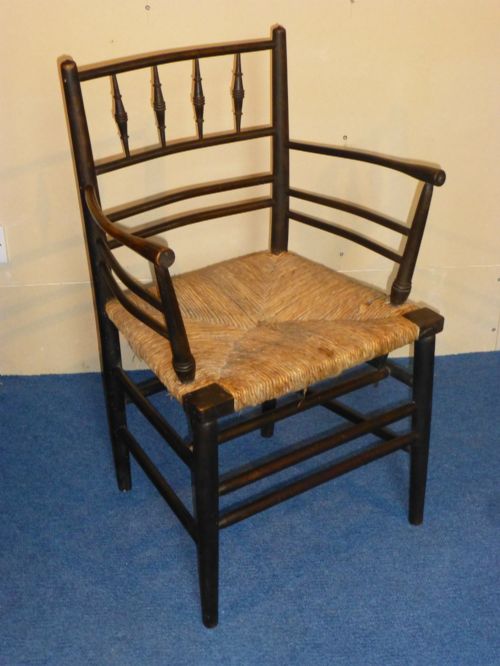
The designs draw heavily upon historical precedents reinterpreted by makers associated with Morris and Co., including Philip Webb and furniture makers inspired by his workshop. Pieces range from low armchairs and fireside chairs with rush seats to larger upholstered wingbacks covered in iconic patterned fabrics. Whether you encounter a humble stained beech Sussex chair or a robust oak reclining armchair, the form prioritises comfort and structural clarity.
How they were made
Makers utilised solid timbers such as oak, beech, ash, and ebonised wood to build the robust frames that define these seats. Turning lathes shaped spindles and bobbin details, while craftsmen employed traditional joinery techniques to ensure lasting stability without metal fasteners. Rush seating was twisted by hand and woven tightly into patterns across the seat frames.
Upholstered variants combined webbed foundations and traditional stuffing with characteristic patterned textiles such as linen and printed cotton. Brass adjustments on reclining models allowed users to alter the angle of the backrest through a simple hinged bar or rack system. These material choices reflect a dedication to durability and tactile natural textures.
Listings feature oak, beech, and ebonised wood frames paired with rush seating, linen, and printed cotton fabrics across the nineteenth and early twentieth centuries.
What varies in quality
The distinction between standard examples and exceptional pieces often lies in the pedigree of the workshop and the integrity of the materials. Chairs bearing specific attribution to prominent firms or notable designers command greater interest due to their documented provenance and refined proportions. Finer execution shows in the precision of the turnings, the tightness of the rush weaving, and the quality of the timber selection.
Condition and originality also dictate standing within the market, particularly regarding retained original upholstery fabric and untarnished frame finishes. Pieces that retain their adjustable brass mechanisms in full working order demonstrate superior survival through decades of domestic use. Subtle details, such as ebonising quality or the weight of the solid oak frame, separate everyday production from workshop masterworks.
Morris and Co·Philip Webb·Howard and Sons·Heals of London·Liberty
The Morris Style Chair Glossary
- Sussex chair
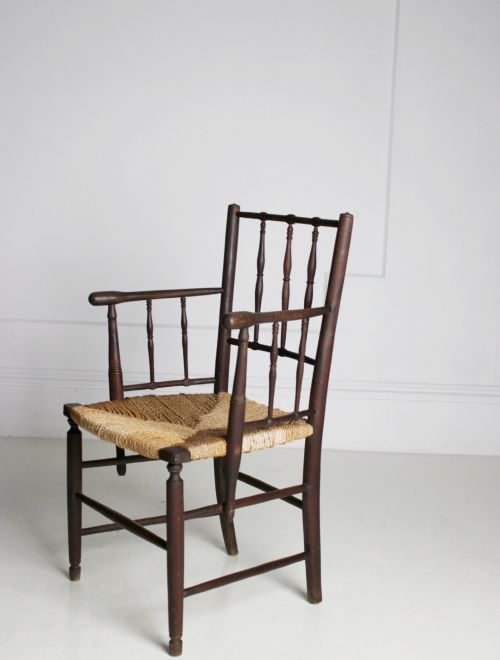
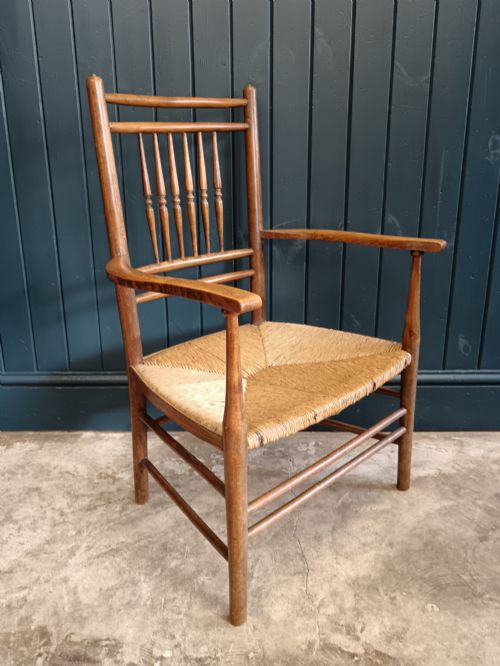
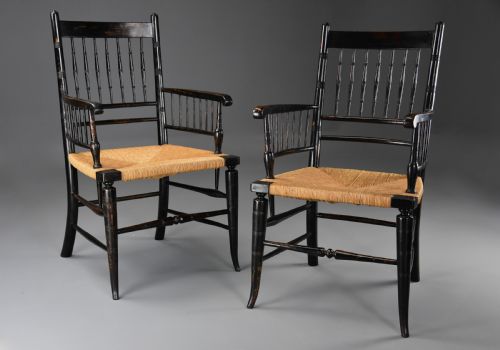
- A nineteenth-century vernacular chair design utilising turned spindles and rush seats, popularised by Morris and Co. These lightweight chairs were adapted from traditional Sussex cottage seating.
- Reclining armchair
- A seating form equipped with an adjustable backrest mechanism, often controlled by a pivoted wooden rod resting against brass pegs. This innovation allowed domestic relaxation long before modern mechanical furniture.
- Rush seat
- A seating surface woven from dried marsh rushes twisted into cords and patterned across a wooden frame. This natural material provides a resilient and breathable platform.
- Bobbin turning
- A woodturning technique that produces a series of rounded, spool-like shapes along the length of a furniture leg or spindle. It became a hallmark of decorative framing during the Victorian period.
- Ebonised wood
- Timber treated with chemical stains or dark finishes to simulate the appearance of solid ebony. This technique was frequently applied to fruitwood or beech frames.
Morris Style Chair: Frequently Asked Questions
What is a morris style chair?
A morris style chair is a nineteenth or early twentieth-century armchair characterised by honest construction, exposed wooden framing, and often an adjustable reclining back. Many examples draw inspiration from designs associated with William Morris and his circle.
These pieces typically utilise oak, beech, or ebonised wood, paired with rush seating or traditional upholstery. They represent a shift toward functional, handcrafted domestic furniture during the Arts and Crafts era.
How do I identify a Sussex chair?
A Sussex chair is identified by its lightweight turned spindle back, slender frame, and woven rush seat. The design stems from traditional cottage seating adopted by nineteenth-century manufacturers.
Original examples often feature ebonised wood finishes and maker stamps or attribution to workshops associated with Philip Webb. They function well as occasional seating or fireside chairs.
How do reclining mechanisms work?
Reclining mechanisms on antique chairs usually rely on a hinged backrest controlled by a wooden rod resting against a series of brass pegs or notches. Users lift and shift the rod to alter the recline angle manually.
This simple mechanical setup allows the user to adjust the chair for reading or resting. The brass fittings add a subtle metallic contrast to the exposed timber frame.
Where should I place one?
These armchairs suit studies, living rooms, and bedrooms where their tactile wooden textures and traditional upholstery can be appreciated. Their compact scale compared to bulky modern upholstery makes them versatile for smaller spaces.
Pairing a rush-seated armchair with a reading lamp or placing an upholstered wingback beside a fireplace highlights their historical character. They integrate smoothly into both traditional period rooms and eclectic modern interiors.