
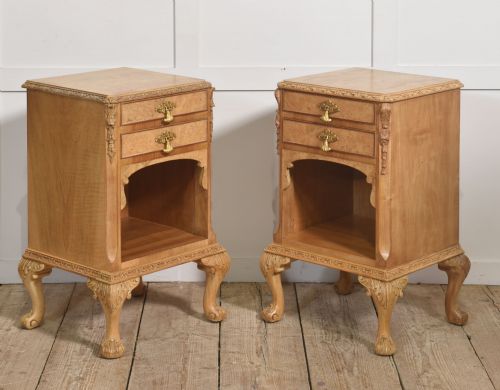
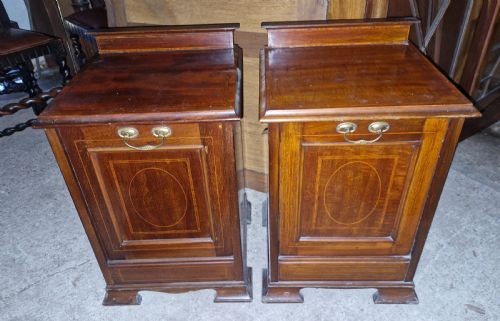


Matched Pair Nightstands
Matched pair nightstands are bedside companions designed to flank a bed in unison, offering practical surface space and concealed storage.
Matched Pair Nightstands
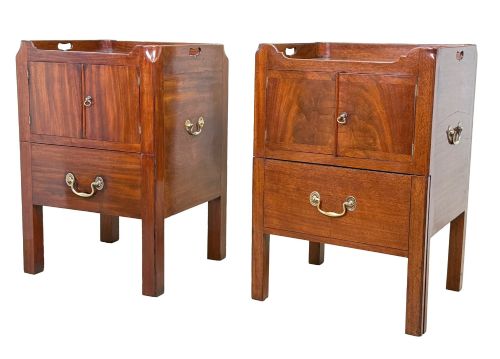
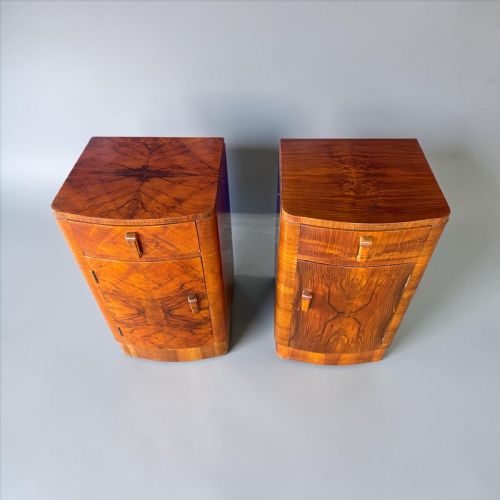
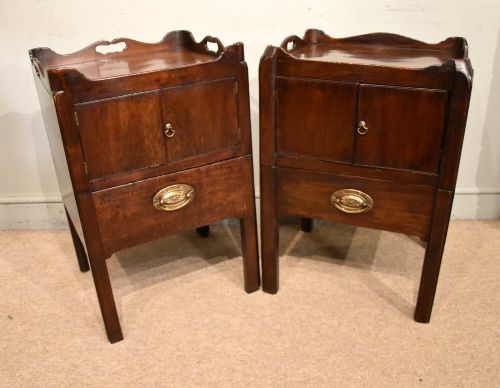
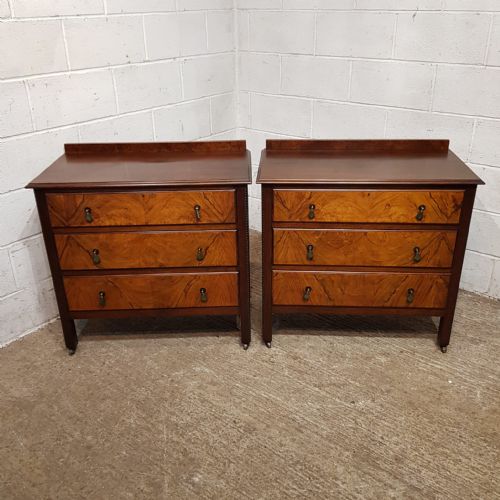
When you search for matched pair nightstands, you encounter bedside cabinets, tables, and small chests dating from the eighteenth century to the mid-twentieth century. The selection leans heavily towards Art Deco walnut examples alongside Victorian mahogany cabinets and earlier Georgian pieces.
Forms vary from cylindrical cupboards and drum shapes to small chests of drawers and architectural washstands adapted for modern use. The pieces bridge the gap between utility and decorative harmony beside the bed.
Most entries originate from distinct historical revivals or periods, including Georgian Revival, Sheraton Revival, and French Chateau styles. Buyers find both open tables and enclosed cupboards designed to keep nighttime necessities out of sight.
How they were made
Cabinetmakers utilised solid timbers such as mahogany, oak, and walnut, frequently applying decorative veneers like burr walnut, burr elm, and blonde maple to prominent surfaces. Inlaid stringing and contrasting woods decorate the faces of later Edwardian and revival pieces.
Construction methods range from traditional dovetail joints in drawer construction to curved laminated panels seen in Art Deco drum cabinets. Brass fittings appear on handles, hinges, and gallery rails across multiple eras.
Listings span from the 18th century through the Victorian era to Art Deco creations in walnut, mahogany, and maple.
What varies in quality
The distinction between standard production and exceptional work rests on the selection of timber figures and the precision of the matching veneer across both cabinets. Grain continuity on a matched pair demonstrates superior craftsmanship.
Hardware integrity, the seamless movement of drawers, and the fidelity of historical style revivals dictate the standing of an individual pair within the broader market.
Gillows
The Matched Pair Nightstands Glossary
- Matched pair
- Two pieces created together or selected specifically for their identical dimensions, materials, and design to sit symmetrically. They provide balance to a bedroom layout.
- Burr walnut
- A prized wood harvested from the warted growths on walnut trees, yielding intricate swirling grain patterns. It decorates the door panels and tops of luxury cabinets.
- Washstand
- A historical piece of bedroom furniture designed for washing utensils, frequently converted into a bedside cabinet due to its convenient proportions and enclosed lower storage.
- Inlay
- A technique where pieces of contrasting wood or brass are fitted into depressions in the base wood to form decorative patterns. It defines Sheraton Revival and Edwardian styles.
- Drum table
- A circular cabinet or table featuring a deep cylindrical body, popular during the Art Deco period for its clean geometric silhouette.
Matched Pair Nightstands: Frequently Asked Questions
How do I match nightstands with my bed?
Consider the height of the mattress relative to the tabletop surface to ensure comfortable reach during the night. Matching the timber tone or stylistic period helps maintain visual harmony in the room.
Pairs featuring neutral woods like mahogany or walnut adapt easily to diverse headboard materials and bedroom colour schemes.
Are these cabinets purely decorative?
Most pieces combine a surface top for lamps and books with enclosed cupboards or drawers underneath. This internal storage keeps personal items neatly hidden.
Some variants offer open shelving or shoe storage compartments depending on their original functional purpose.
How do I tell Art Deco pairs apart from Victorian ones?
Art Deco nightstands display streamlined geometry, smooth drum shapes, and light exotic veneers such as blonde maple or burr elm. Victorian examples rely on heavier mahogany construction, panelled doors, and cylindrical proportions.
Revival styles often incorporate earlier decorative motifs onto nineteenth or twentieth-century carcases.
Can I use washstands as nightstands?
Nineteenth-century washstands share similar heights and proportions with dedicated bedside cabinets. Their enclosed cupboards accommodate modern bedside storage needs effectively.
Architectural forms from the early nineteenth century bring unusual character and robust surfaces to the bedside.