
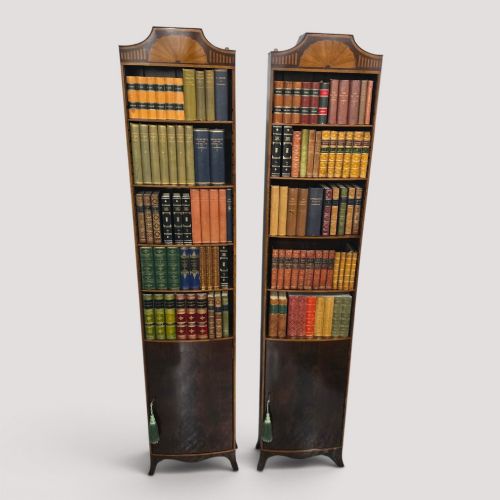
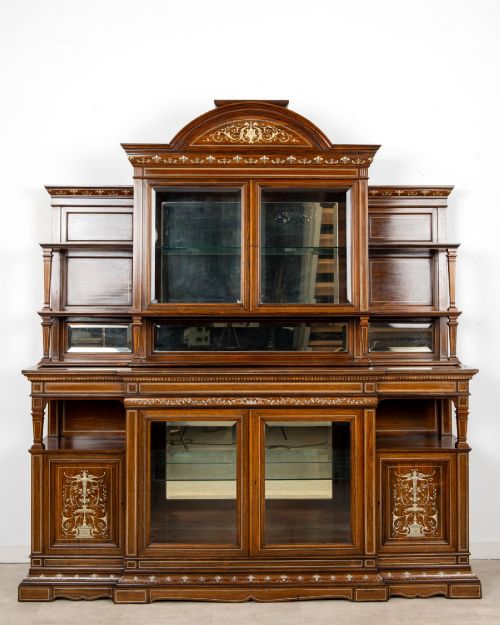
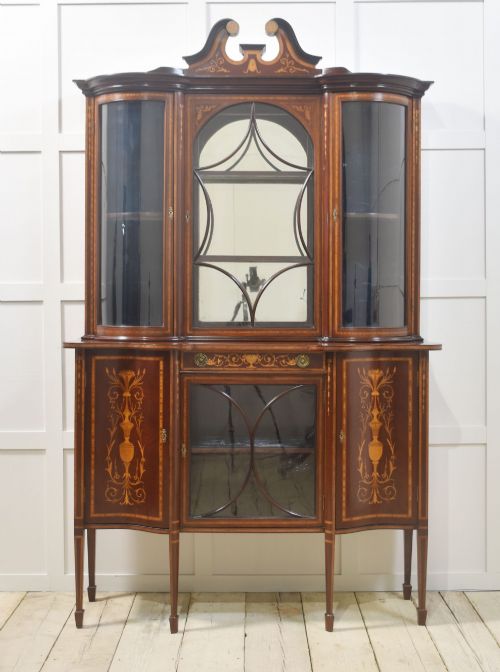
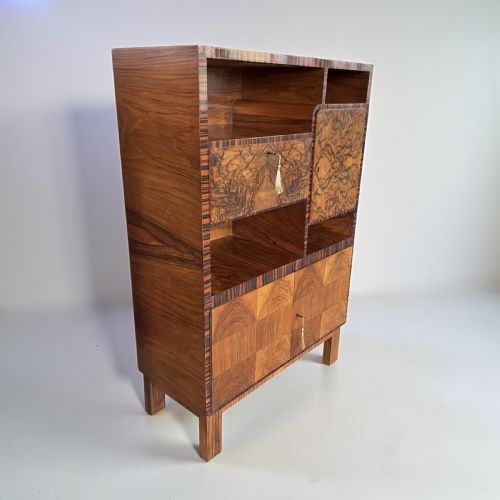


Marquetry Wood Bookcase Stand
These marquetry wood bookcase stand examples are refined display pieces that combine patterned veneers with practical shelving and cabinet storage.
Marquetry Wood Bookcase Stand
A marquetry wood bookcase stand brings together decorative wood inlay and functional storage across forms like display cabinets, corner units, and revolving bookcases. The selection draws on Edwardian, Victorian, Art Nouveau, and 18th Century origins, reflecting diverse historical revivals.
Most items you encounter are Edwardian and 19th Century mahogany, satinwood, or walnut cabinets featuring delicate fruitwood inlay or glass panels. These pieces served to showcase treasured volumes and ornaments in formal rooms.
Formats range from serpentine display cabinets and bow front cupboards to revolving bookcases and music cabinets. Each variation offers distinct ways to house books and display decorative objects within a room.
Materials and construction
Cabinet makers utilised foundational woods like mahogany, walnut, satinwood, and rosewood to construct the primary bodies and shelving units. These sturdy timbers provided reliable support for glass doors, brass mounts, and internal shelving.
Surface decoration relies on precise marquetry and fruitwood inlay, creating intricate geometric or floral patterns across the panels. Glazed doors and mirror backs were frequently integrated to enhance light distribution within the display sections.
Even music and books shared fine company in cabinets designed to keep both bound volumes and sheet collections neatly displayed.
Judging the execution
Quality rests in the precision of the marquetry and the choice of primary timber, where finely figured mahogany or satinwood elevates the piece. The crispness of the fruitwood inlay and the integration of brass hardware distinguish more ambitious workshop output.
Proportion and cabinetwork integrity dictate the standing of a piece, from serpentine or bow front profiles to well-engineered revolving mechanisms. Finer examples maintain structural harmony alongside meticulous surface detail.
Collinson & Lock·Edwards & Roberts·Shapland & Petter
The Marquetry Wood Bookcase Stand Glossary
- Marquetry
- Decorative veneer work arranged in pictorial or geometric patterns on a wooden ground. This technique employs various contrasting timber types to create detailed surface designs.
- Serpentine
- A curved line that bends convexly in the centre and concavely at the sides. This contour is frequently seen on the fronts of higher-quality cabinets.
- Satinwood
- A lustrous, hard timber with a yellowish colour, often used for fine veneer and inlay. It became especially popular during the Sheraton Revival period.
- Revolving bookcase
- A freestanding bookcase designed to turn on a central axis for easy book access. These units combine practical shelving with compact footprints.
Marquetry Wood Bookcase Stand: Frequently Asked Questions
How do I care for inlaid wood cabinets?
Keep the furniture away from direct sunlight and steady heat sources to protect the delicate fruitwood inlay and timber finishes.
Apply a traditional wax polish periodically to maintain the lustre of the wood without building up heavy residues.
Where were these cabinets placed originally?
They typically stood in formal drawing rooms, libraries, or parlours to store prized volumes and showcase decorative porcelain or glassware.
Corner units and revolving models were chosen to maximise storage efficiency in smaller spaces.
How do I identify Edwardian examples?
Edwardian pieces often feature lighter woods like satinwood and mahogany paired with restrained marquetry and Sheraton Revival styling.
They lean towards refined elegance, frequently incorporating glazed display doors and slender proportions.