



Marquetry Book Table
These marquetry book table pieces bring together refined woodworking and practical display, offering compact storage for volumes alongside distinctive inlaid surfaces.
Marquetry Book Table
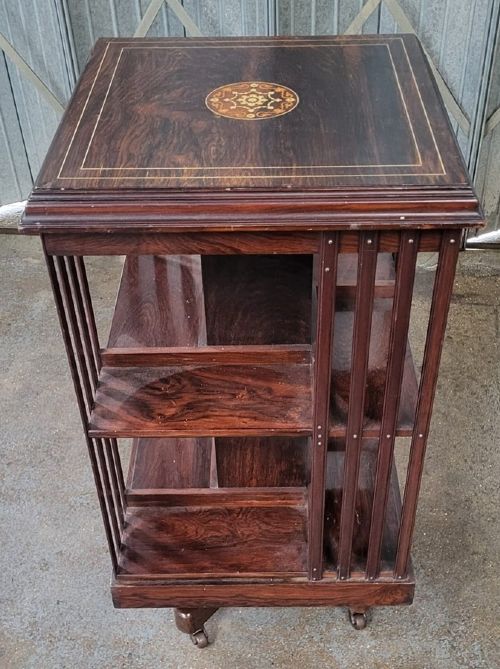
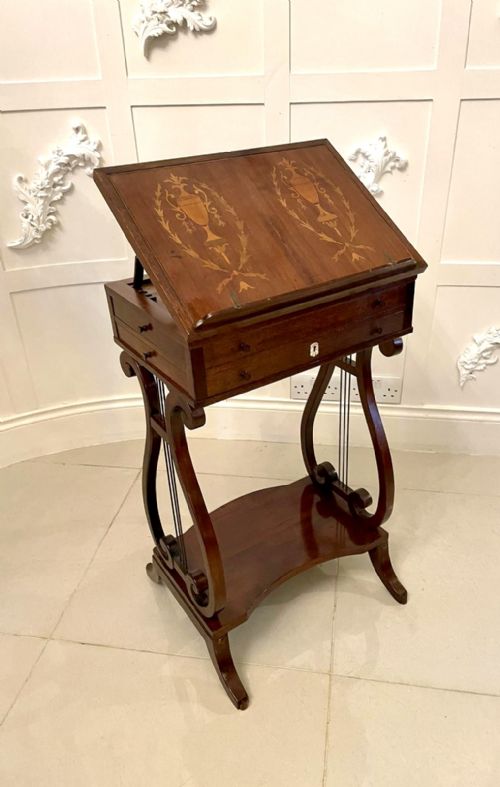
A marquetry book table combines surface decoration with functional storage, uniting small display furniture and revolving bookcases under the search phrase marquetry book table. The examples span various formats including revolving library tables, reading stands, and compact bedside tables.
Most pieces on this page originate from the Edwardian era or the nineteenth century, utilising mahogany, rosewood, and walnut as primary timbers. Formats range from rotating book drums to occasional side tables fitted with inlaid tops.
How they were made
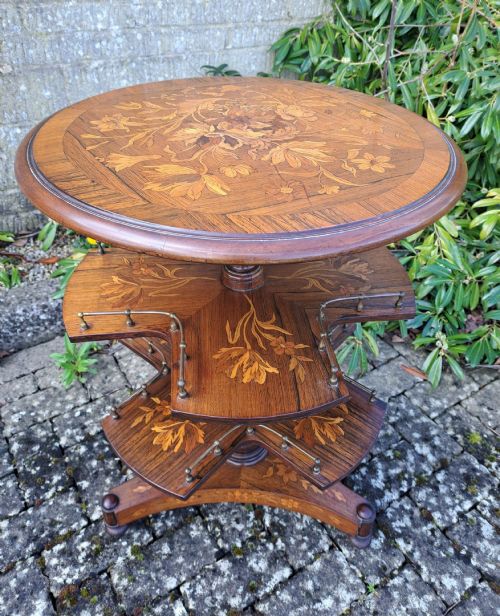
Cabinet makers utilised dense hardwoods such as mahogany and rosewood as foundational structures, applying contrasting fruitwood and satinwood veneers to create pictorial or geometric patterns on the tops. These wooden surfaces frequently combine with cast brass or ormolu mounts.
Revolving mechanisms require precise internal framing to support multiple tiers of books while turning smoothly on a central spindle. Inlaid decoration is meticulously cut and fitted piece by piece directly into the solid timber or veneer ground.
Marquetry Book Table Retail Price Guide 2026
Typical asking prices for marquetry book table among the pieces listed under this phrase on Sellingantiques today, from the lower quarter to the upper quarter. They describe what is for sale here now, not the wider market.
Listings feature revolving bookcases, reading tables, and occasional furniture constructed from mahogany, rosewood, and walnut across Edwardian and nineteenth-century periods.
What varies in quality
The distinction between standard items and exceptional examples lies in the complexity and precision of the inlay work, where multi-toned fruitwoods create depth and shadow rather than flat patterns. Superior specimens maintain tight joints in their revolving mechanisms and use higher-grade timbers.
Mounting hardware also marks the tier of a piece, with finely chased ormolu separating standard brass fittings from superior ones. The crispness of the edge definition in the parquetry or floral motifs indicates the skill of the original workshop.
The Marquetry Book Table Glossary
- Marquetry
- Decorative veneer work forming pictures or designs on furniture surfaces. It differs from parquetry by using curved and pictorial motifs rather than strict geometric grids.
- Parquetry
- Geometric wood inlay forming repeating patterns such as cubes or chequers. This technique provides a structured surface texture often seen on table tops.
- Ormolu
- Gilded bronze mounts applied to furniture for decorative accent. These metal additions frame corners and support legs on finer tables.
- Revolving
- Designed to turn on a central axis for easy access to stored items. This mechanism is common in multi-tiered book units.
- Satinwood
- A lustrous yellow-brown timber used extensively for contrasting inlay work. Its bright grain highlights delicate details within floral designs.
Marquetry Book Table: Frequently Asked Questions
What is a marquetry book table?
A marquetry book table is a piece of furniture that combines a flat or rotating surface decorated with wood inlay with storage compartments for volumes.
These pieces function as reading stands, library tables, or revolving bookcases depending on the specific nineteenth or early twentieth-century design.
How do revolving book tables work?
Revolving book tables rest upon a concealed central pivot and bearing system housed within the base. This allows the upper tiers to turn smoothly in either direction for easy selection of books.
Cabinet makers balanced the weight distribution carefully to prevent tipping during rotation.
Where were these tables used?
These tables served primarily in private libraries, studies, and drawing rooms as accessible storage for frequently read volumes.
Smaller variants also functioned as bedside cabinets or occasional stands to hold reading material within arm's reach.
How do I date a marquetry book table?
Dating relies on identifying the underlying timber, the style of the inlay work, and the mechanical construction of the base. Edwardian examples often feature lighter mahogany and refined satinwood inlay, while Georgian and nineteenth-century pieces display heavier rosewood and Dutch floral marquetry.
Hardware such as ormolu mounts also provides clear indicators of period manufacturing techniques.