
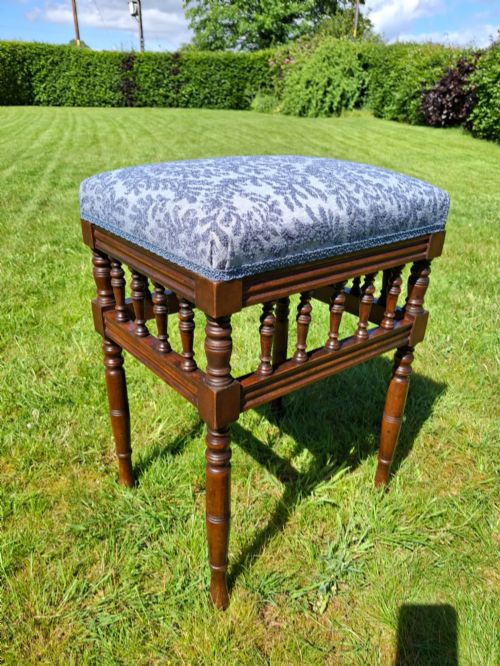


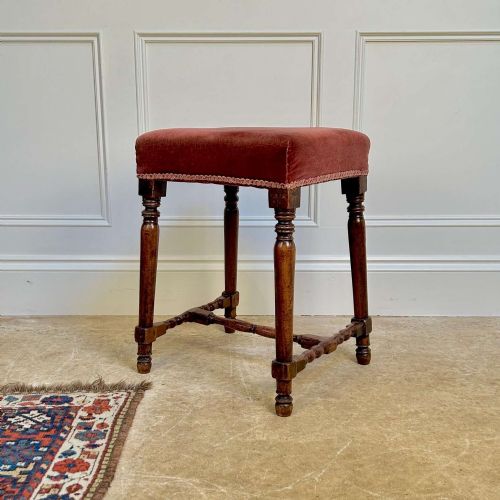


Mahogany Turned Leg Footstool
A mahogany turned leg footstool gives low seating and resting support with robust timber framing and shaped supports.
Mahogany Turned Leg Footstool
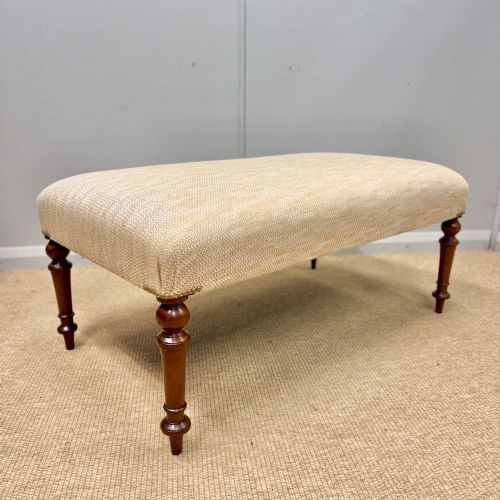
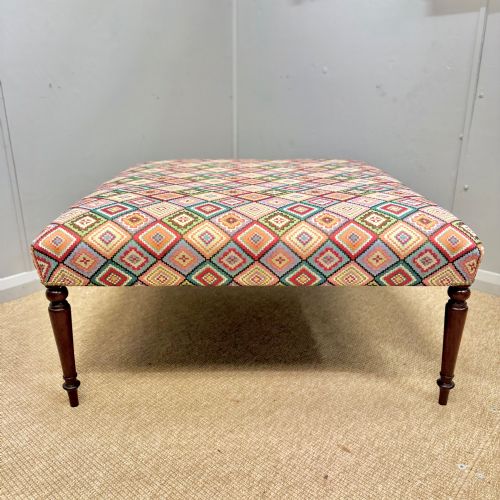
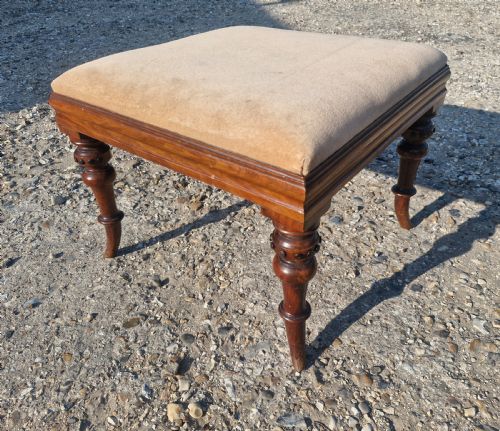
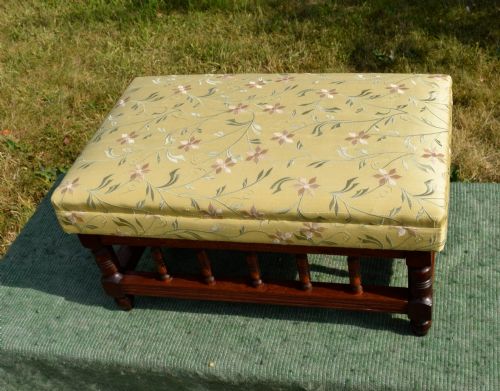
A mahogany turned leg footstool is a low timber support designed for resting the feet or sitting near firesides and dressing tables. When exploring a mahogany turned leg footstool on this page, you encounter pieces spanning the Georgian, Regency, Victorian, and Edwardian eras, including piano stools, dressing table stools, and large ottomans.
The objects take various shapes, from square and oblong frames to circular forms and long country house benches. Materials range from solid mahogany frames paired with fabric, velvet, wool, leather, and cane tops, occasionally featuring brass castors.
Materials and Construction
Makers utilised solid mahogany for the structural frames, shaping the timber into turned legs that provide stability and decorative detail. Tops were constructed with caning or webbed wooden foundations to support upholstery in leather, tapestry, kilim, velvet, and chenille.
Additional hardware such as brass castors appeared on larger examples to ease movement across heavy carpets. Joinery relied on traditional framing methods suited to bearing weight and daily domestic use.
A solitary walnut cock-fighting stool hides amongst the mahogany crowd, ready for an energetic Victorian spectator.
Defining Quality
Superior examples of a mahogany turned leg footstool display well-proportioned timber turning, crisp joinery, and substantial framing timber. Lower grades often show heavier, less refined turning and simpler secondary woods beneath the upholstery.
The choice of covering material and the precision of buttoning or hand-tacked textiles also separate standard domestic pieces from finer country house commissions.
Liberty & Co·James Shoolbred
The Mahogany Turned Leg Footstool Glossary
- Mahogany
- A durable tropical hardwood valued for its rich reddish-brown tone and strength in furniture frames. It takes a fine polish and resists warping over long periods.
- Turned leg
- A structural support shaped on a lathe to create cylindrical, fluted, or spool profiles. It is a defining feature of these stools.
- Caning
- Woven rattan or split cane used to create a permeable, decorative seat panel. It appears on square tables and stools.
- Kilim
- A flat-woven textile of wool or cotton utilised as an upholstery covering. It brings patterned colour to nineteenth-century frames.
Mahogany Turned Leg Footstool: Frequently Asked Questions
What were footstools used for?
These low seats served primarily for resting the feet while seated in armchairs or by the fire.
They also functioned as piano seating, dressing table stools, or casual perches in country house drawing rooms.
How do I date a mahogany stool?
Dating relies on the style of the turned legs, timber choice, and upholstery methods visible beneath the frame.
Georgian and Regency pieces tend to show finer proportions, while Victorian examples often feature deeper buttoning and brass castors.
Are these stools comfortable to sit on?
Many examples feature traditional sprung or webbed upholstery filled with horsehair or wool padding.
Firmness varies depending on whether the piece has been recently re-upholstered or retains its historic stuffing.
Can I use an antique footstool daily?
Solid mahogany frames provide sturdy support suitable for regular placement in living spaces and bedrooms.
Care should be taken with delicate textile covers or vintage leather surfaces to preserve their condition over time.