



Mahogany Rotating Library Caddy
A mahogany rotating library caddy is a compact desk or table accessory designed to keep reference books within arm's reach.
Mahogany Rotating Library Caddy
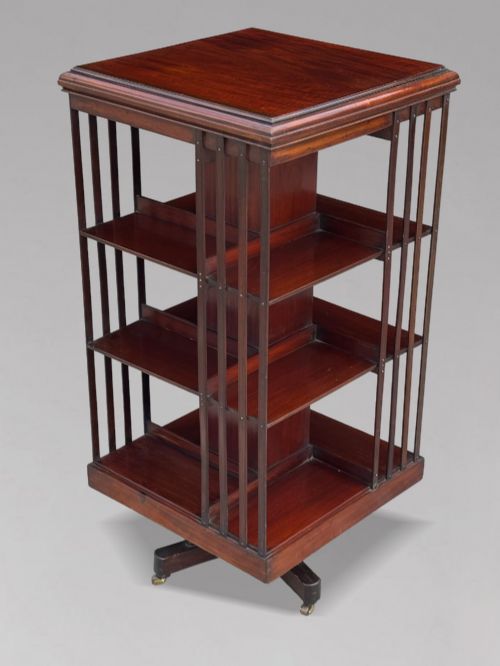
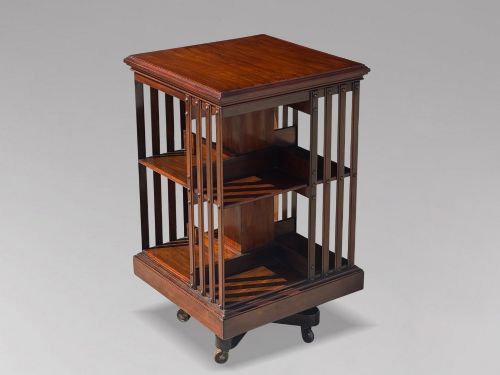
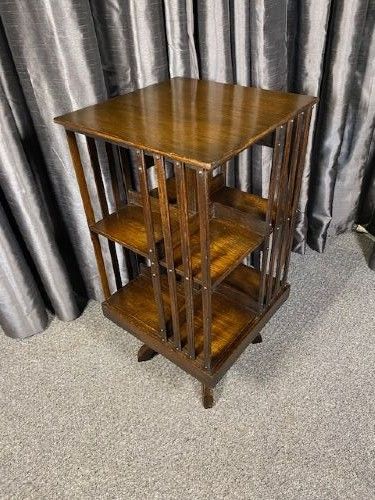
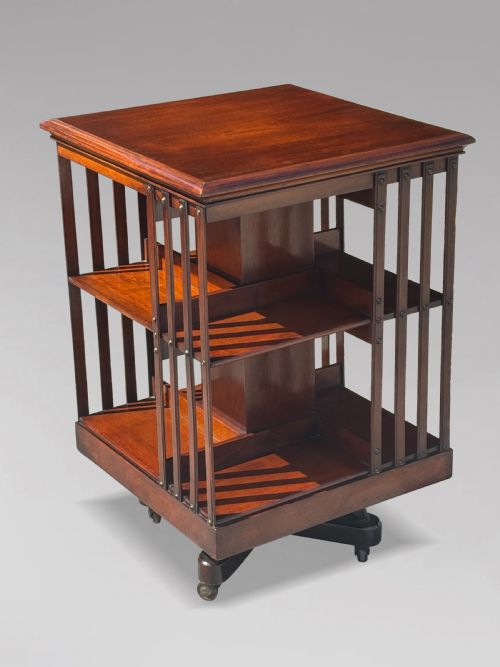
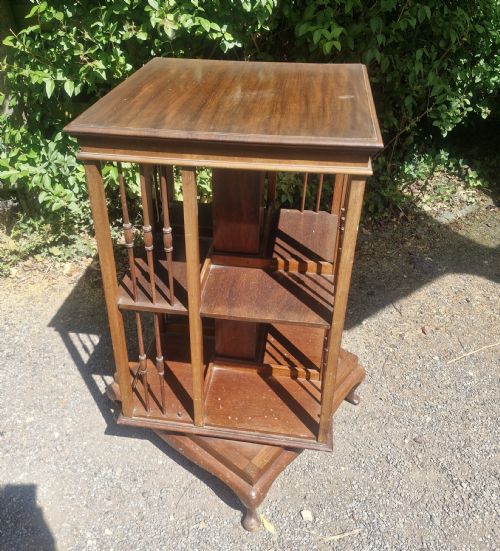
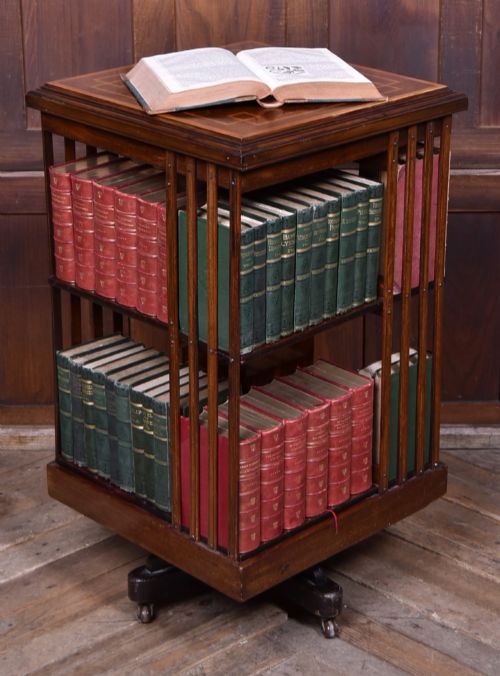
The mahogany rotating library caddy appears across this selection primarily as a revolving bookcase, designed to sit upon a table or desk for easy access to volumes. Most examples date from the Victorian and Edwardian periods, reflecting the late nineteenth and early twentieth century appetite for organised study spaces.
The form typically comprises a slatted or divided wooden body mounted on a turning mechanism, allowing the user to spin the entire unit to select a book. These pieces bridge the gap between functional office furniture and decorative desktop items.
How they were made
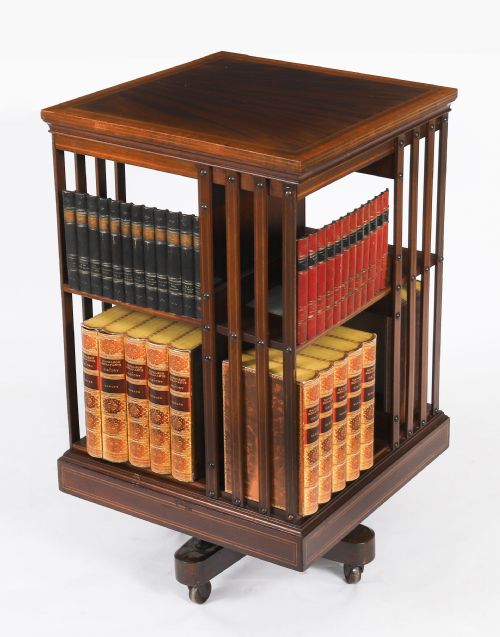
Makers constructed these pieces chiefly from solid mahogany and flame mahogany veneers, often incorporating contrasting satinwood inlay to define the panels. The revolving mechanism relies on hidden internal cast iron or brass fittings that permit smooth rotation under the weight of books.
Secondary timbers such as oak occasionally appear in the internal framework or drawer linings. Surface finishes were hand-polished to highlight the natural grain and deep red tones of the mahogany.
Mahogany Rotating Library Caddy Retail Price Guide 2026
Typical asking prices for mahogany rotating library caddy among the pieces listed under this phrase on Sellingantiques today, from the lower quarter to the upper quarter. They describe what is for sale here now, not the wider market.
Several examples incorporate satinwood inlay and distinct flame mahogany veneers across their revolving compartments.
What varies in quality
Quality in a mahogany rotating library caddy rests upon the crispness of the inlaid decoration and the choice of timber figure, such as flame mahogany veneer. Superior pieces exhibit tight, precise joinery and a revolving action that remains steady and balanced when fully loaded.
Lesser examples utilise plain mahogany boards without decorative inlay and feature simpler, lighter turning mechanisms that can feel loose or imprecise over time.
The Mahogany Rotating Library Caddy Glossary
- Mahogany
- A durable tropical hardwood prized for its reddish-brown colour and stability in furniture construction. It takes a fine polished finish.
- Revolving bookcase
- A small bookcase designed to turn on a central axis or pivot base. This allows access to multiple compartments from a single seated position.
- Satinwood inlay
- A contrasting light-coloured timber veneer set into the surface of the primary wood to create decorative borders or motifs. It adds visual detail to Edwardian and Victorian pieces.
- Edwardian
- The period of British history covering the reign of King Edward VII, noted for lighter furniture designs and revived classical styles. Pieces from this era often feature delicate inlay work.
Mahogany Rotating Library Caddy: Frequently Asked Questions
Where were these caddies used?
These pieces sat upon large library tables, partner desks, or study writing surfaces where heavy reference volumes needed to be consulted frequently throughout the day.
Their compact revolving design meant they could hold dictionaries, atlases, or legal texts within immediate reach without cluttering the main workspace.
How do I care for the timber?
Keep the mahogany away from direct heat sources and strong sunlight to prevent the timber and veneer from drying out or fading over time.
An occasional application of high-quality wax helps nourish the polished surface and preserve the deep tone of the wood.
How do I distinguish Edwardian from Victorian?
Victorian revolving bookcases generally date from the late nineteenth century and tend to be heavier in proportion with rich, dark mahogany surfaces.
Edwardian examples, made around the turn of the twentieth century, frequently incorporate lighter timber tones and delicate satinwood inlay work.
How does the turning mechanism work?
The body rests upon a concealed base fitted with metal components, often comprising cast iron or brass bearings and plates.
This hidden pivot allows the upper tier to spin freely while maintaining stability when books occupy the shelves.