



Mahogany Gentleman Press
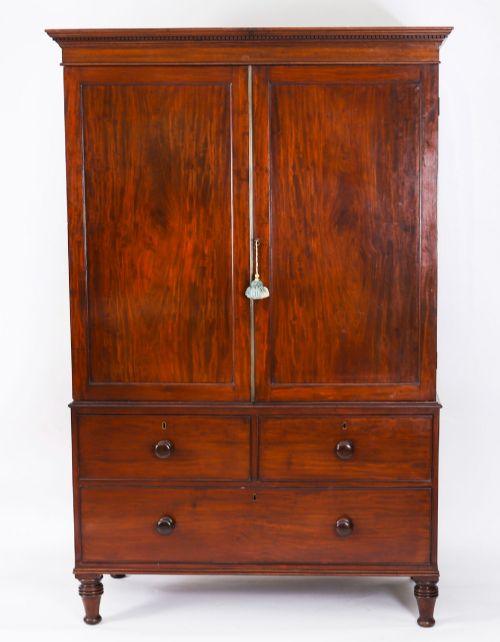
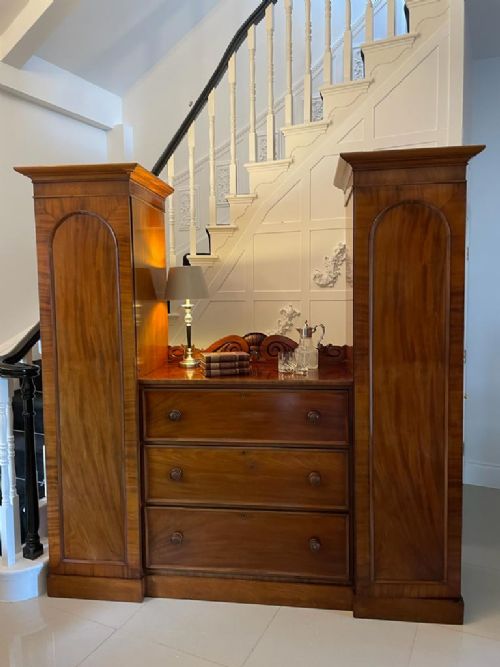
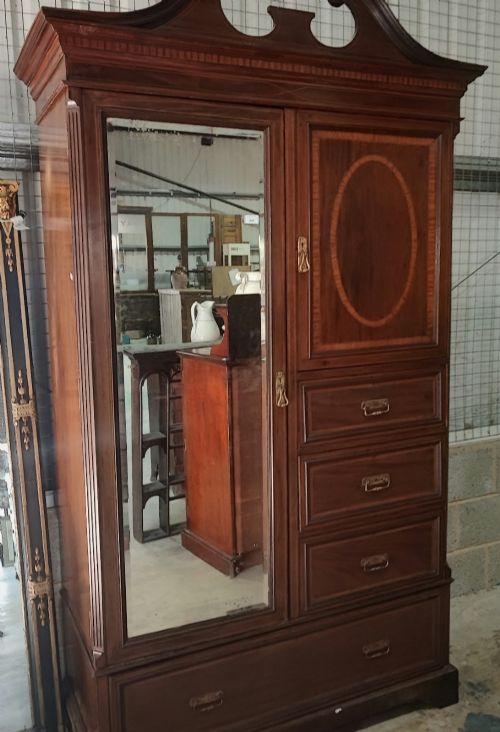
A mahogany gentleman press combines wardrobe hanging space and linen storage in a substantial timber cabinet designed for personal attire.
Mahogany Gentleman Press
A mahogany gentleman press serves as a dual-purpose storage piece for clothing, bringing together upper press compartments with internal sliding trays or hanging sections above lower drawer banks.
The pieces appearing here span from the George III and Regency eras through the Victorian, Edwardian, and William IV periods, taking forms such as linen presses, compactum wardrobes, and combination cabinets.
Buyers meet examples executed in solid timber and veneers, frequently organised with deep drawers, hanging space, and linen slides behind panelled or glazed doors.
Materials and construction methods
Cabinet makers utilised dense native and imported timbers, pairing solid structural frames with book-matched flame mahogany veneers to create rich figured surfaces on primary display facades.
Decorative detailing often involved contrasting satinwood banding, fine inlay work, and turned or bracket feet, supported by durable brass hardware on doors and drawers.
Internal components relied on traditional joinery, incorporating sliding wooden trays for folded linens and sturdy hanging rails within the upper sections.
Mahogany Gentleman Press Retail Price Guide 2026
Typical asking prices for mahogany gentleman press among the pieces listed under this phrase on Sellingantiques today, from the lower quarter to the upper quarter. They describe what is for sale here now, not the wider market.
The listings combine 18th century Georgian forms with 19th century Victorian variants, Edwardian compactums, and Regency period hanging wardrobes.
Factors that separate examples
Superior pieces display exceptional timber selection, where flame mahogany grain matches symmetrically across multiple door panels and drawer fronts.
Internal configuration and joinery precision set finer cabinets apart, particularly where sliding trays move smoothly and internal compartments retain original configuration without later alteration.
The crispness of inlay work, the weight of cast brass mounts, and the integrity of secondary timbers dictate the overall standing of an individual press.
maples & co·Edwards and Roberts·Robert Strahan of Dublin·Gillows of Lancaster
The Mahogany Gentleman Press Glossary
- Compactum wardrobe
- A multi-section fitted wardrobe combining hanging space, drawers, and shelving within a single unified cabinet structure.
- Linen press
- A tall cabinet featuring upper doors enclosing sliding trays designed for storing folded textiles, placed above a chest of drawers.
- Satinwood banding
- A decorative technique using thin strips of pale exotic timber inlaid into borders around drawer fronts or door panels.
- Breakfront
- A cabinet design where the central section projects forward from the flanking outer sections, creating architectural depth.
Mahogany Gentleman Press: Frequently Asked Questions
What is the difference between a linen press and a wardrobe?
A linen press traditionally contains internal sliding trays behind upper doors for folded garments, whereas a wardrobe focuses primarily on vertical hanging space.
Many examples bridging these categories combine both functions, offering hanging compartments alongside traditional linen slides.
How do I date a Georgian mahogany press?
Georgian pieces typically display architectural proportions, bracket feet, and solid timber construction with hand-cut dovetails on the drawer linings.
Secondary woods like oak or pine are standard inside, alongside simpler brass hardware that differs from later Victorian mechanisms.
Where should I place a gentleman press in a modern bedroom?
These large cabinets require a substantial wall with adequate clearance for opening heavy panelled doors and pulling out deep lower drawers.
Measuring ceiling height and floor space carefully ensures the piece fits comfortably without dominating the room.
Did these presses come apart for transport?
Most large period presses are modular, dismantling into a heavy cornice, upper door section, and lower chest base to allow for moving.
This knockdown construction was essential for delivering heavy timber furniture up stairwells in large townhouses.