

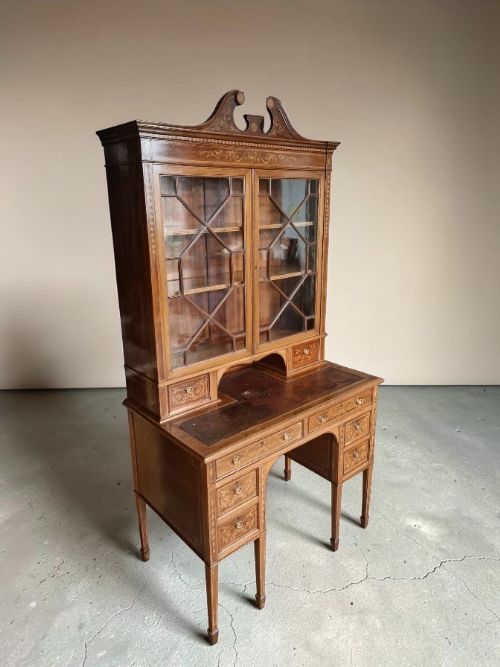
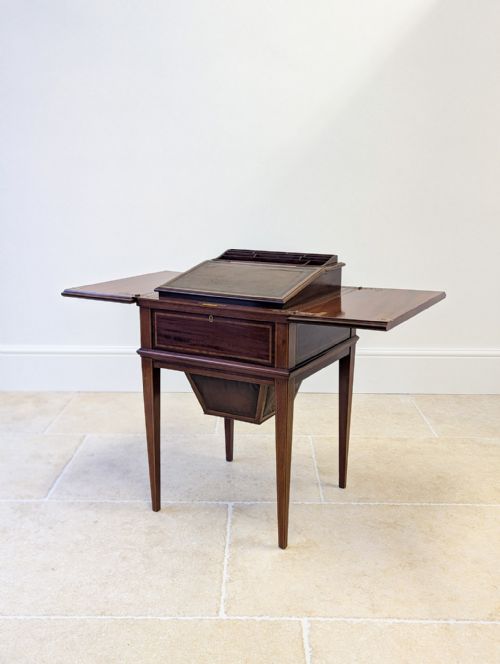
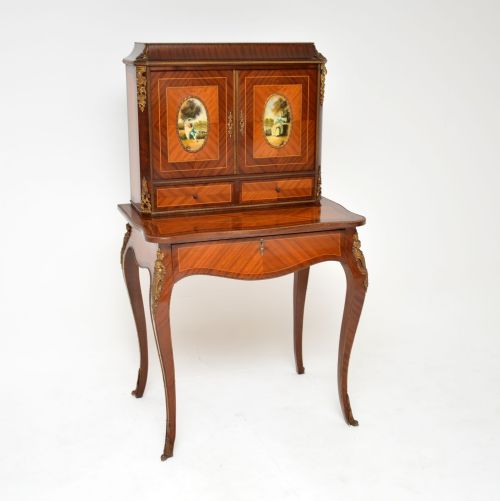
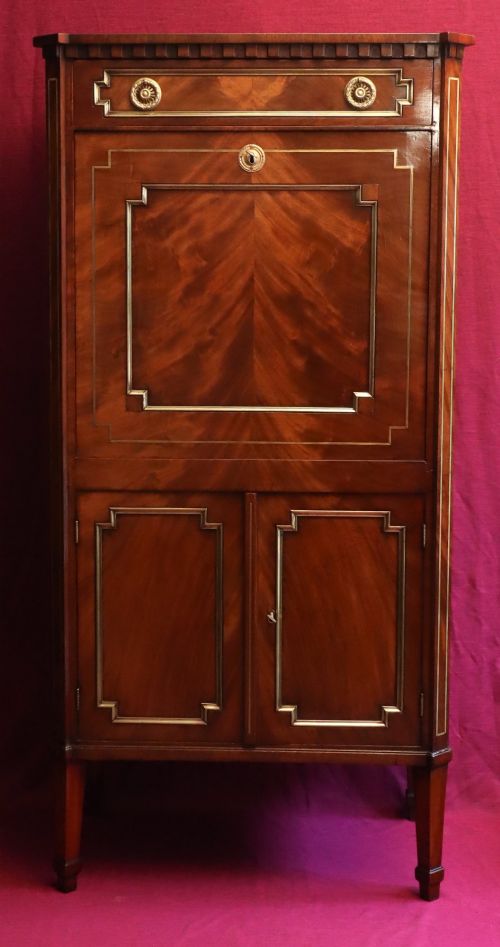

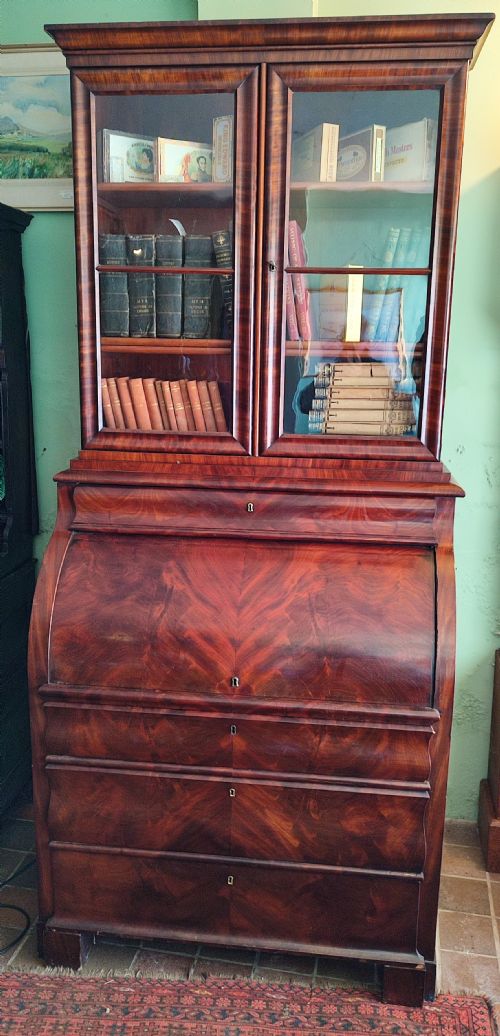


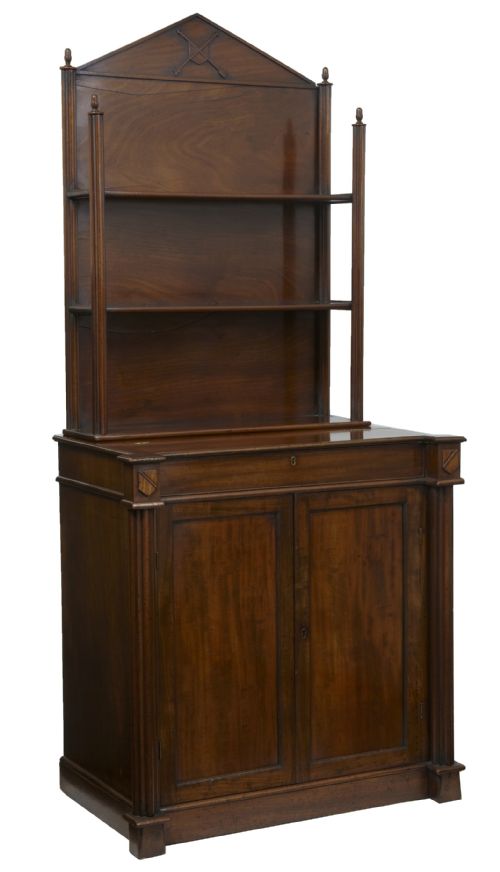
Mahogany Escritoire Cabinet
A mahogany escritoire cabinet is a fitted writing piece with a drop front, built for serious correspondence and prized for hidden compartments.
Mahogany Escritoire Cabinet
A mahogany escritoire cabinet combines a writing surface with concealed storage behind a hinged fall front or cylinder panel. When you search for a mahogany escritoire cabinet, you encounter forms spanning the eighteenth, nineteenth, and early twentieth centuries, with Georgian and Victorian examples appearing most frequently.
The selection ranges from tall upright secretaire à abattant pieces with marble tops to compact writing cabinets and bureau bookcases. French, English, and Biedermeier regional variations dominate the inventory, offering diverse proportions and internal drawer layouts.
Materials and construction
Makers utilised dense mahogany timbers, often selecting flame or figured veneers for the primary visual surfaces, supported by secondary woods in the internal carcase. Brass hardware, boxwood stringing, and occasional ormolu mounts provide structural reinforcement and decorative contrast.
The falling front requires precise joinery to bear weight when open as a desk, while internal pigeonholes and small drawers demand meticulous miniature cabinet work. Structural variations include marble tops on continental pieces and marquetry inlay on Dutch examples.
Mahogany Escritoire Cabinet Retail Price Guide 2026
Typical asking prices for mahogany escritoire cabinet among the pieces listed under this phrase on Sellingantiques today, from the lower quarter to the upper quarter. They describe what is for sale here now, not the wider market.
Listings feature mahogany, walnut, and rosewood timbers paired with marble tops, brass hardware, and boxwood stringing.
Judging quality and craftsmanship
Quality rests upon the selection of timber veneers and the crispness of internal drawer construction, where hand-cut dovetails distinguish superior workshops. The stability of the fall-front mechanism and the original integrity of locks and hinges separate exceptional examples from standard production.
Sophistication of internal architecture, such as secret compartments and finely turned small drawers, elevates a piece. Ormolu mounts and fine boxwood stringing, where present, should display sharp chasing and precise fitting rather than crude casting.
Gregory & Co. of London
The Mahogany Escritoire Cabinet Glossary
- Escritoire
- A writing cabinet featuring a fall-down front that conceals a fitted interior of small drawers and pigeonholes.
- Secretaire à abattant
- An upright desk with a vertical fall-front panel that drops down to form a writing surface, often topped with marble.
- Cylinder bureau
- A writing desk with a rotating quarter-cylinder lid that slides back to reveal the writing surface and interior fittings.
- Fall front
- A hinged writing flap that closes vertically against the cabinet face and opens horizontally for writing.
- Ormolu
- Gilt-bronze mounts applied as decorative ornamentation to the exterior of nineteenth-century French furniture.
Mahogany Escritoire Cabinet: Frequently Asked Questions
What is an escritoire?
An escritoire is a dedicated writing cabinet featuring a hinged fall front that opens to reveal a fitted interior of drawers and pigeonholes.
Designed for managing correspondence, these pieces combine concealed storage with a practical writing surface in a compact footprint.
How do I date a mahogany escritoire?
Dating relies on observing stylistic markers, construction methods, and timber choice across periods like the Georgian era and Victorian reign.
Earlier eighteenth-century pieces display solid timber framing and restrained proportions, while nineteenth-century variations often incorporate elaborate veneers and Ormolu mounts.
Where should I place an escritoire?
These cabinets suit studies, drawing rooms, or bedrooms where their vertical profile utilises wall space efficiently without dominating the room.
Ensure adequate floor clearance in front of the cabinet to allow the fall front to open fully into a writing position.
How do I care for mahogany?
Protect mahogany surfaces from direct sunlight and extreme temperature fluctuations to prevent the timber veneers from drying and lifting.
Apply traditional wax polish sparingly and buff with a soft cloth to maintain the natural lustre of the wood.