





Mahogany Dessert Trolley
A mahogany dessert trolley brings tiered wooden utility and period engineering straight to the dining room.
Mahogany Dessert Trolley
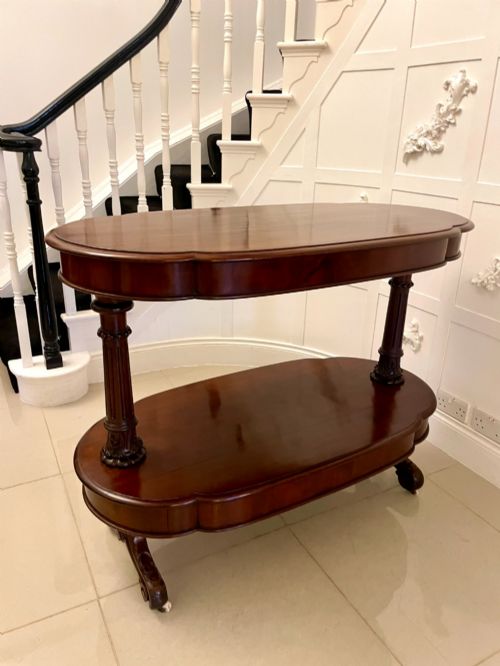
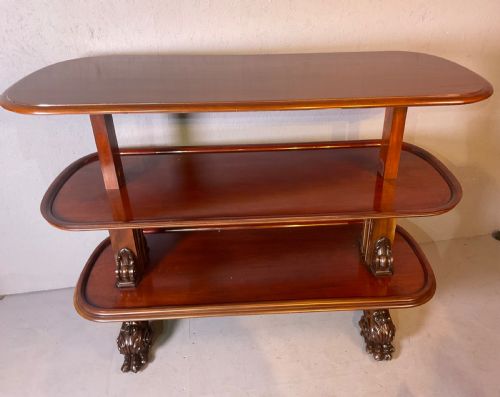
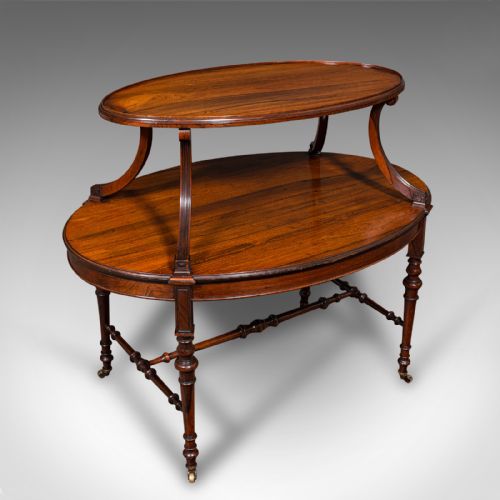
A mahogany dessert trolley serves primarily as a tiered stand or dumb waiter designed for moving food and serving ware in nineteenth century dining rooms. These pieces appear in configurations of two or three tiers, offering substantial surface area for service without crowding the main dining table. Buyers seeking a mahogany dessert trolley encounter robust nineteenth century examples, including Victorian and Regency forms.
The practical function involves staging courses or displaying tableware across multiple levels, often aided by original castors for mobility. Many items on this page function as buffets or serving tables, reflecting the versatile terminology used by period makers. Selecting the right piece means weighing whether a three tier stand or a larger metamorphic form best suits the room.
How they were made
Makers constructed these serving pieces predominantly from solid and veneered mahogany, frequently accented with brass for castors and mechanical fittings. Rosewood also appears in select examples, providing tonal contrast to the darker timber. Cabinetmakers shaped the tiered shelves with turned supports and edge mouldings, ensuring structural rigidity across multiple levels.
Engineering played a central role in complex designs, particularly in metamorphic dumb waiters that transform for different service needs. Joinery techniques from the nineteenth century relied on solid framing to support heavy loads of crockery and food. Original brass castors allow these heavy wooden structures to roll smoothly across floors.
Mahogany Dessert Trolley Retail Price Guide 2026
Typical asking prices for mahogany dessert trolley among the pieces listed under this phrase on Sellingantiques today, from the lower quarter to the upper quarter. They describe what is for sale here now, not the wider market.
Listings span the nineteenth century, featuring Victorian and Regency styles executed in mahogany, rosewood, and brass.
What varies in quality
Quality rests heavily on the sophistication of the woodwork and the originality of the structural hardware. Pieces featuring well turned columns, richly figured mahogany grain, and robust brass castors sit firmly at the upper end of the range. Simpler constructions lack the refined proportions and architectural detailing found in workshop pieces.
The presence of working mechanical elements, such as those found in metamorphic variants, dictates the level of craftsmanship involved. Superior examples maintain tight joints and smooth operation across all tiers, showing careful attention by the original cabinetmaker.
Maple & Co
The Mahogany Dessert Trolley Glossary
- Dumb waiter
- A tiered serving stand designed to hold food and dishes near a dining table without requiring servant attendance. These pieces typically feature two or three graduating shelves.
- Metamorphic
- A descriptive term for furniture that alters its form or function through mechanical hinges or pivots. These pieces adapt from compact stands into larger serving surfaces.
- Tiered stand
- A piece of furniture organised in successive horizontal levels supported by vertical columns. This design maximises vertical space for display and service.
- Castor
- A small wheel mounted to the base of furniture legs to permit easy rolling across floors. Original brass versions add both function and period detail.
- Regency
- An English design style spanning the early nineteenth century defined by classical restraint and clean architectural lines. Pieces from this period often incorporate dark timbers like mahogany.
Mahogany Dessert Trolley: Frequently Asked Questions
What is a dumb waiter?
A dumb waiter is a multi-tiered wooden stand used in dining rooms to hold dishes, serving ware, and food. It allows diners to access extra plates without needing servants present during the meal.
These pieces typically feature two or three circular or rectangular shelves supported by a central column or corner posts. They represent essential nineteenth century dining furniture.
How do I use a trolley?
You can use a tiered mahogany trolley as a mobile serving station, a drinks cart, or a display surface for decorative objects in a living room or dining space.
The original castors allow the heavy wooden structure to move easily across the floor, making it practical for modern entertaining.
How do I date these pieces?
Dating relies on identifying stylistic markers, timber characteristics, and hardware such as brass castors. Nineteenth century pieces often show specific Victorian or Regency design idioms.
Examining the construction methods and joinery beneath the tiers helps confirm the era of manufacture.
What is a metamorphic trolley?
A metamorphic trolley is a specialised piece of furniture that uses mechanical joints to change its shape or expand its surface area. These clever designs adapt to different hosting requirements.
Cabinetmakers engineered these pieces to fold or shift while maintaining the structural stability needed for heavy serving ware.