

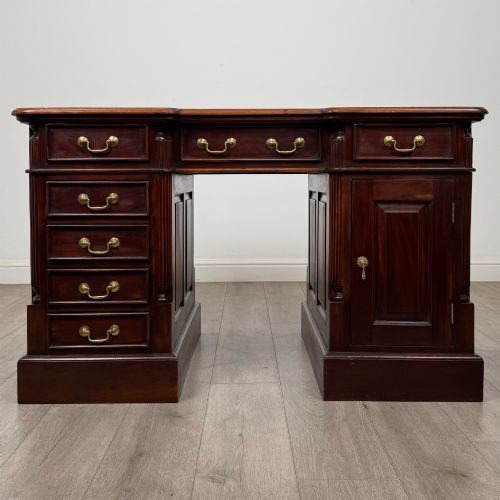
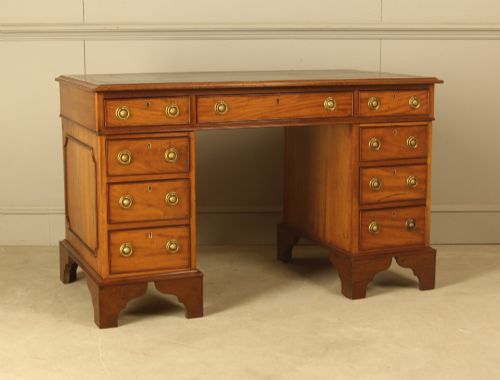


Mahogany Computer Table
These mahogany computer table options are substantial nineteenth-century and Edwardian pedestal desks that provide sturdy timber surfaces for modern workspaces.
Mahogany Computer Table
When you search for a mahogany computer table, you encounter traditional pedestal desks and writing tables dating from the eighteenth century through to the early twentieth century. The selection leans heavily toward Victorian examples alongside Edwardian and Georgian forms adapted for modern placement.
These pieces typically manifest as pedestal desks or kneehole writing tables designed with banks of drawers flanking a central recess. They offer generous timber tops that easily accommodate contemporary technology while maintaining classic period proportions.
Origins span British workshops of the Victorian and Georgian eras alongside occasional early twentieth-century examples such as American pedestal desks. Buyers find both compact side tables and substantial dual-pedestal formats tailored for daily utility.
How they were made
Cabinet makers utilised dense mahogany timber as the primary structural and visual medium, often selecting figured grain for the main top surfaces and drawer fronts. Satinwood inlay frequently appears as a contrasting decorative element on refined surfaces.
Working surfaces are commonly inset with tooled leather writing panels, providing a durable and traditional top layer. Brass hardware, including original handles and drawer pulls, completes the functional assembly of these desks.
Mahogany Computer Table Retail Price Guide 2026
Typical asking prices for mahogany computer table among the pieces listed under this phrase on Sellingantiques today, from the lower quarter to the upper quarter. They describe what is for sale here now, not the wider market.
Some nineteenth-century kneehole desks include hidden compartments behind the central recess, designed long ago for private correspondence.
What varies in quality
The distinction between standard examples and superior pieces rests on the depth of timber figure, the crispness of carved pillars, and the integrity of structural joinery. Finer desks display carefully matched mahogany veneers and balanced proportions across the pedestals.
Preservation of original brass handles and intact leather inserts elevates a piece above those altered by later replacements. The quality is further judged by the refinement of secondary woods and the precision of inlaid satinwood details.
The Mahogany Computer Table Glossary
- Pedestal desk
- A heavy freestanding desk comprising two supporting banks of small drawers with a central recess for the user. This format provides substantial storage and a large writing surface.
- Kneehole desk
- A compact desk or writing table featuring a central recessed space beneath the top for the knees, flanked by narrow drawer columns. Georgian examples often conceal a small secret drawer within this upper section.
- Satinwood inlay
- Decorative woodwork where pale satinwood is fitted flush into contrasting darker mahogany surfaces in geometric or floral motifs. This technique brightens the primary timber frame.
- Serpentine front
- A furniture front curved with a convex centre flanked by concave wings, creating a flowing wave-like contour. This shape demands high carpentry skill to execute cleanly on drawer fronts.
Mahogany Computer Table: Frequently Asked Questions
Can I fit modern computer equipment on these desks?
The generous proportions of nineteenth-century pedestal tops easily accommodate laptops, monitors, and keyboards while retaining ample writing space.
Their sturdy timber construction supports modern office equipment without compromising the historic character of the room.
How do I identify a Victorian pedestal desk?
Victorian examples typically feature dense mahogany timber, robust pedestal banks, and often incorporate original brass hardware and inset leather top panels.
They display the heavier proportions and functional utility characteristic of mid to late nineteenth-century British cabinet making.
Are the leather tops original?
Many desks retain their early or original tooled leather writing surfaces, showing patination acquired through decades of practical use.
Some pieces feature carefully replaced leather panels that respect the traditional appearance and colour tone of the period.
What is the difference between a writing table and a pedestal desk?
A writing table generally rests on four legs rather than heavy under-desk pedestals, offering a lighter visual presence in a room.
Pedestal desks provide significantly more drawer storage organised into two supporting columns beneath the main writing surface.