
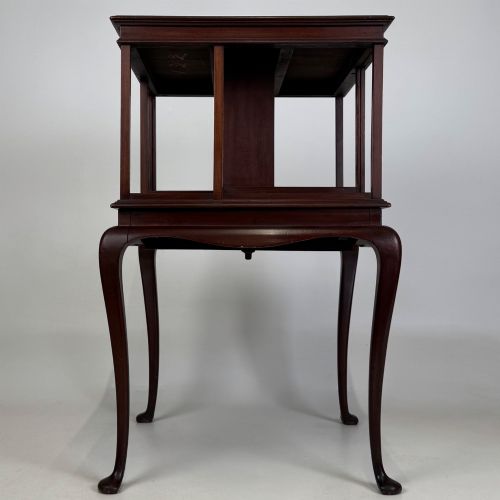
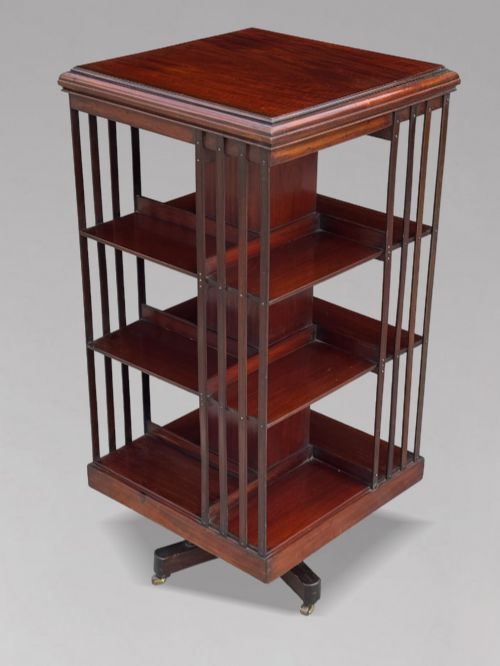
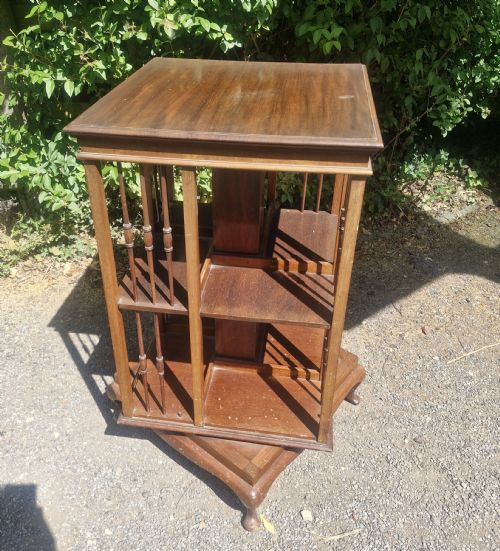
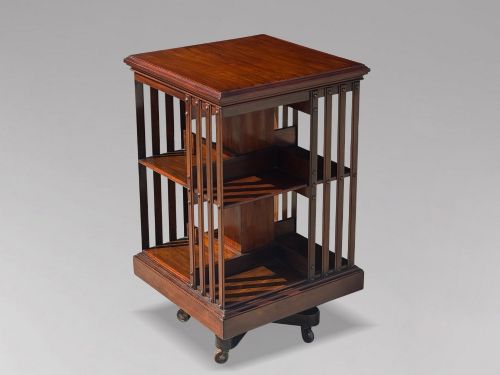
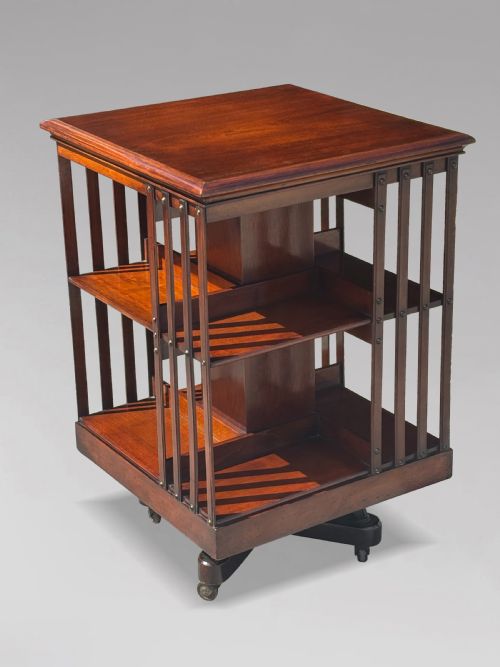
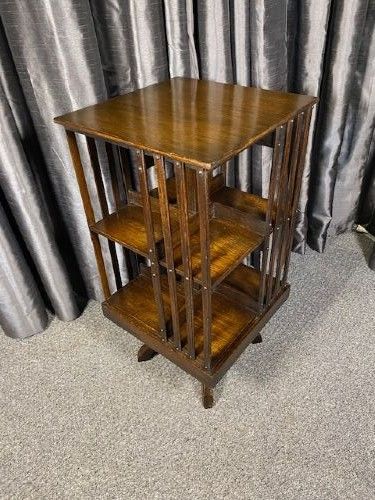
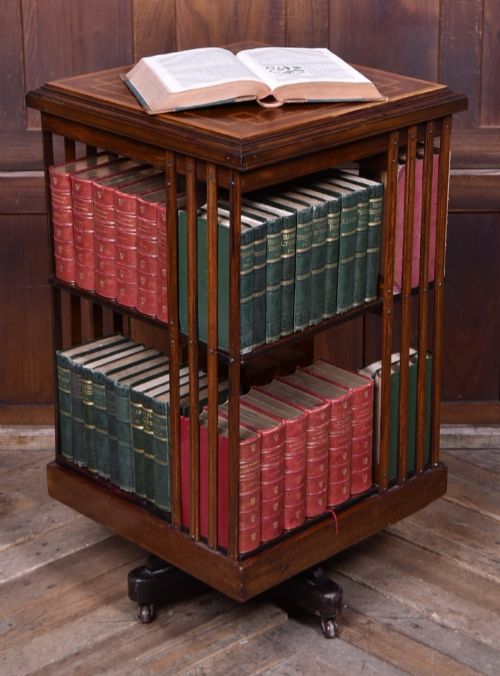


Mahogany Book Caddy Stand
A mahogany book caddy stand organises working volumes on a desk or floor with pivoting rotation and timber grain.
Mahogany Book Caddy Stand
When searching for a mahogany book caddy stand, buyers encounter functional items designed to keep reference books close at hand. The selection spans floor-standing revolving bookcases and compact desktop book troughs.
The pieces emerge predominantly from the Edwardian era and the nineteenth century, utilising rich timber for daily utility. Forms range from simple two-tier library troughs to intricate revolving stands featuring satinwood inlay.
Victorian and Edwardian workshops produced these utilitarian items for studies and libraries where space required clever organisation. Each version serves the practical need of holding texts upright and accessible.
Materials and construction
Makers relied primarily on solid and veneered mahogany, often embellished with satinwood inlay for decorative contrast. Structural stability was reinforced with internal iron or cast iron mechanisms that allowed smooth rotation.
Brass fittings appeared on desk organisers and revolving stands to add durable working points. Joinery methods matched the demands of heavy books, balancing timber weight with turning capability.
Some Victorian readers spun their bookcases so vigorously that the central pivot hummed like a small brass bee.
The spectrum of quality
Quality rests in the smoothness of the revolving action and the crispness of the timber grain. Superior examples display fine satinwood inlay and robust internal metalwork rather than plain joins.
Cabinetmakers who selected deeply figured mahogany and finished the timber with care produced pieces that survived heavy use. Lesser items relied on simpler construction and plain secondary woods.
Waring and Gillows
The Mahogany Book Caddy Stand Glossary
- Book trough
- An open-topped wooden trough designed to hold a row of books upright on a desk or table.
- Revolving bookcase
- A bookcase built upon a central pivot mechanism allowing it to spin freely for easy selection of volumes.
- Satinwood inlay
- A contrasting decorative wood inserted into the mahogany surface in geometric or floral patterns.
- Desk organiser
- A compact compartmented stand used for sorting correspondence and smaller reference books.
Mahogany Book Caddy Stand: Frequently Asked Questions
How do revolving bookcases work?
These pieces sit upon a concealed central pivot and ball-bearing mechanism hidden beneath the base. This allows the entire wooden structure to turn smoothly in either direction.
Users can access multiple shelves of heavy books from a single seated position without shifting the entire stand.
Where should I place a book trough?
Book troughs suit placement upon large executive desks, library tables, or low sideboards. They keep current reading material upright and sorted within arm's reach.
Avoid positioning timber pieces in direct sunlight or beside active heat sources to protect the mahogany polish.
How do I date an Edwardian stand?
Edwardian pieces often feature lighter framing, delicate satinwood stringing, and simpler proportions compared to heavy Victorian models. Maker labels or stamps underneath can also confirm the period.
Construction details like machine-cut screws point towards the late nineteenth or early twentieth century.
Can these stands hold heavy books?
Floor-standing revolving bookcases utilise sturdy internal iron and cast iron framing to support heavy reference volumes. Smaller desktop versions are better suited for lighter novels and notebooks.
Distributing weight evenly across opposing shelves ensures the turning mechanism continues to rotate without friction.