

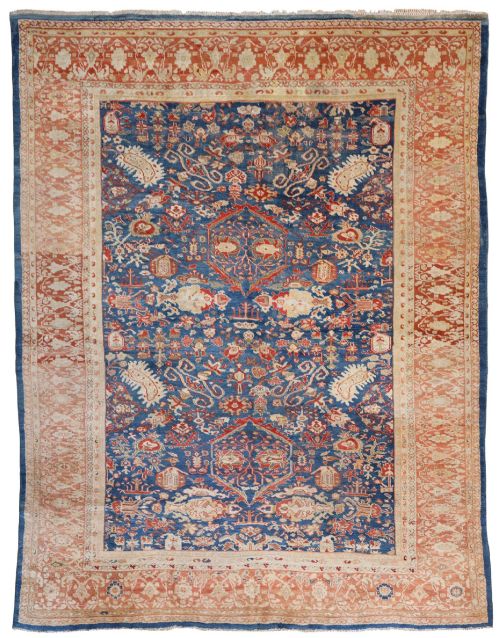

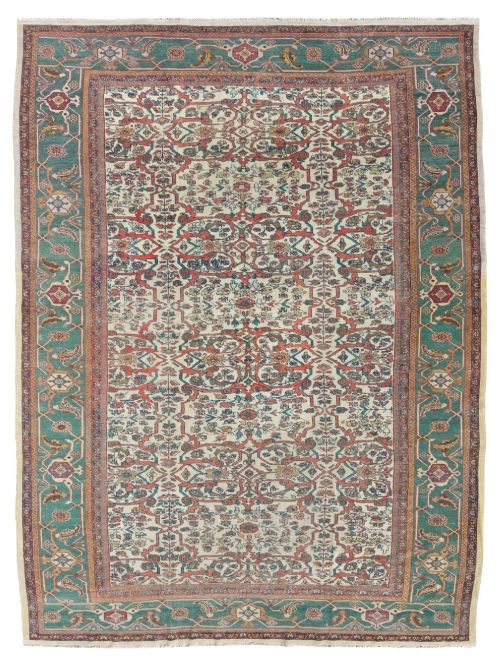
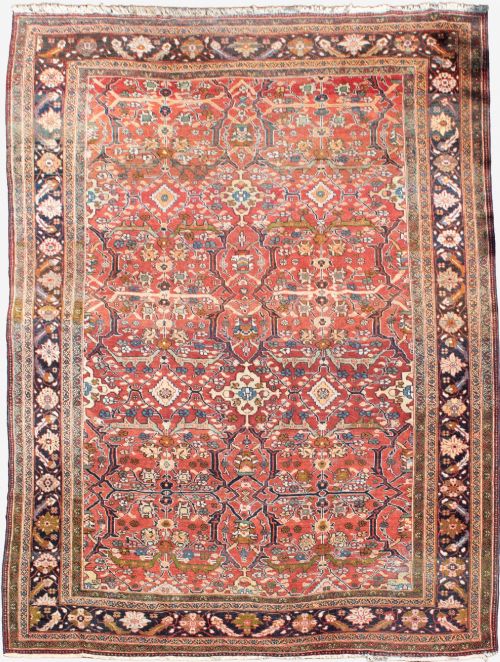


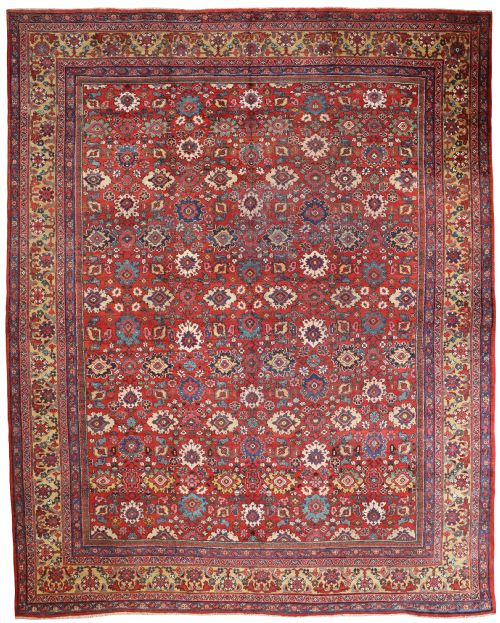


Mahal Floor Rug
A mahal floor rug brings substantial Persian character to a room, offering room-size formats and runners woven in wool and cotton.
Mahal Floor Rug
A mahal floor rug is a Persian textile originating from the 19th and early 20th centuries, spanning decades from the 1870s through to the 1930s. These floor coverings arrive in substantial room sizes, alongside runner formats, designed for large spaces.
The pieces on this page encompass traditional Persian designs, including specific variations such as Sultanabad, Ziegler, and Saroukh types. They present distinct patterns like the shrub design, the Mina Khani motif, and the Mustafi layout.
Originating from West Persia, particularly the Chahar Mahal valley region, these carpets represent a rich tradition of village and workshop weaving. Buyers encounter formats ranging from compact area rugs to grand room-size carpets exceeding four metres in length.
How they were made
The construction relies on a foundation of durable cotton supporting a dense pile of hand-spun wool. This pairing provides the structural stability required for large floor carpets while maintaining a resilient surface texture.
Weaving techniques combine traditional knotting methods with flat weave textile variations, as seen in regional jajim floor spreads. Natural dyeing traditions produce characteristic terracotta, blue, and green ground colours across the surviving examples.
Mahal Floor Rug Retail Price Guide 2026
Typical asking prices for mahal floor rug among the pieces listed under this phrase on Sellingantiques today, from the lower quarter to the upper quarter. They describe what is for sale here now, not the wider market.
Some flat-weave textiles double as wall hangings, proving that not every floor rug insists on staying on the floor.
What varies in quality
Quality rests in the clarity of the design and the integrity of the wool pile across the field. Superior examples display balanced proportions in motifs such as the Mina Khani pattern and retain deep, saturated ground colours.
The precision of the weave and the condition of the cotton foundation dictate the longevity of the carpet. Subtle variations in wool quality and dye depth separate standard village productions from finer workshop pieces.
The Mahal Floor Rug Glossary
- Mahal
- A type of Persian carpet originating from the region surrounding Sultanabad in west-central Persia, known for large-scale patterns and muted colour palettes. These rugs often feature all-over designs rather than central medallions.
- Ziegler
- A classification of commercial Persian carpets produced in the late 19th and early 20th centuries by European firms, featuring softer colours and modified traditional designs tailored for Western interiors.
- Sultanabad
- An older classification for carpets woven in the same district as Mahals, often possessing denser geometric or floral layouts and dating back to the late 19th century.
- Mina Khani
- A traditional repeating grid pattern composed of four flowers arranged around a central rosette, linked by curved vines across the field of the rug.
- Jajim
- A type of flat-woven textile produced by nomadic and village groups, utilised as a floor spread, cover, or wall hanging.
Mahal Floor Rug: Frequently Asked Questions
How do I clean a mahal floor rug?
Professional dusting and specialist low-moisture washing preserve the wool pile and cotton foundation of antique Persian carpets.
Regular gentle vacuuming without a beater bar prevents dirt accumulation in the weave between professional cleans.
Can I place a mahal floor rug in a hallway?
Runners and narrow formats are suited for corridors and high-traffic walkways, provided a quality underlay is used to prevent slipping.
Selecting a durable wool-pile runner ensures the textile withstands daily footsteps while protecting the underlying floor.
What is the difference between a mahal and a ziegler?
Ziegler carpets represent a commercial subdivision of Mahal production, commissioned by European firms to suit Western aesthetic preferences with softer palettes.
Standard Mahals often display more traditional village patterns and local colour choices, though both share regional West Persian origins.
How do I date an antique rug?
Dating relies on stylistic analysis, material examination, and structural characteristics such as knot density and dye types.
Comparing the border designs and secondary colours against established regional timelines helps narrow the decade of production.