

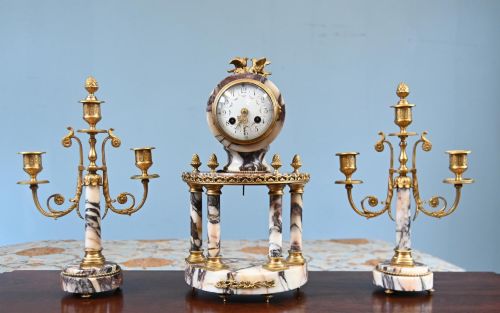


Louis XVI Portico Clock
These louis xvi portico clock pieces bring neoclassical symmetry and architectural presence into a room, favoured by collectors for their striking columns and pendulum movement.
Louis XVI Portico Clock
When you search for louis xvi portico clock, you are looking at architectural timepieces defined by side columns supporting an upper entablature, housing a central dial. These examples span the eighteenth century, the nineteenth century, and the Victorian period, reflecting both original French production and later revival tastes.
The materials visible across these offerings lean heavily towards white marble, alabaster, ormolu, and gilt bronze, creating a crisp contrast between pale stone and bright metallic mounts. Dial faces typically feature enamel numerals, protected behind glass within ornate bezels.
How they were made
The construction combines stonemasonry with precision bronze casting and fire gilding, utilising white marble or alabaster for the architectural pillars and bases. Ormolu and gilt bronze mounts were cast, chased, and applied to accent the structural corners, bezels, and pediments.
Internal movements required specialised clockmaking craft, featuring brass gear trains and escapements designed to drive pendulum swings accurately within the open portico frame. Enamel dials were fired onto copper plates, with delicate hand-painted numerals marking the hours.
Louis XVI Portico Clock Retail Price Guide 2026
Typical asking prices for louis xvi portico clock among the pieces listed under this phrase on Sellingantiques today, from the lower quarter to the upper quarter. They describe what is for sale here now, not the wider market.
Portico clocks let you watch the pendulum swing through open air, turning the steady ticking of time into moving architecture.
What varies in quality
The distinction between tiers rests upon the crispness of the bronze chasing and the depth of the fire gilding on the ormolu mounts. Finer examples display sharp architectural detailing and substantial marble weight, whereas lesser pieces feature softer cast definition and simpler brass elements.
Completeness also dictates standing, as surviving clock garnitures with matching original candelabras demonstrate higher desirability than standalone timepieces. The integration of movement maker signatures, such as AD Mougin or Japy Freres, marks a higher standard of workshop execution.
AD Mougin Paris·Japy Freres
The Louis XVI Portico Clock Glossary
- Portico clock
- A mantel timepiece designed with an architectural frame resembling a classical porch, featuring columns supporting a top entablature. This layout leaves the central pendulum visible as it swings.
- Ormolu
- Gilded bronze mounts created by applying a mixture of gold and mercury to a cast bronze base, then firing to drive off the mercury. This technique produces a rich, durable golden surface finish.
- Clock garniture
- A decorative set comprising a central clock accompanied by matching side pieces such as candelabras or urns. These sets were designed to create a balanced display across a mantelpiece.
- Enamel dial
- A clock face made by fusing powdered glass onto a metal backing plate at high temperatures. The resulting glossy white surface resists fading and provides a crisp background for painted numerals.
- Neo-Classical
- A style inspired by the art and architecture of classical antiquity, emphasising symmetry, straight lines, and restraint. It forms the stylistic foundation for Louis XVI design.
Louis XVI Portico Clock: Frequently Asked Questions
How do I maintain the movement?
These mechanical movements require professional cleaning and oiling every few years to keep the brass gear trains running smoothly. Keeping the clock level on a stable mantelpiece ensures the pendulum beats evenly without stopping.
Avoid placing the piece in direct sunlight or damp environments, which can damage the delicate enamel dial and discolour the marble or ormolu surfaces.
Where should I place a garniture set?
A complete garniture set demands a wide mantelpiece, sideboard, or console table where the central clock and matching side pieces can be arranged symmetrically. The architectural height of a portico design looks best against a plain wall or mirror that allows the silhouette to stand out.
Because these pieces are heavy due to their marble and bronze construction, ensure the supporting surface is sturdy and level.
How do I date an 18th century piece?
Eighteenth-century originals generally exhibit hand-chased bronze work with distinct wear patterns and simpler, more restrained neoclassical motifs compared to later nineteenth-century revivals. The construction of the internal movement and the quality of the marble base also offer clues to the period of manufacture.
Maker marks stamped on the backplate of the movement help narrow down the decade of production and verify the workshop of origin.
What is the difference between ormolu and brass?
Ormolu involves a layer of gold applied to cast bronze through a traditional fire-gilding process, resulting in a warm, deep metallic lustre. Brass is a yellow alloy of copper and zinc used for internal gears and sometimes for simpler exterior mounts that lack the golden depth of fire-gilded bronze.
Over time, ormolu retains a richer tone, whereas untreated brass may develop a darker patina if not polished.