


Louis XVI Bouillotte Tables
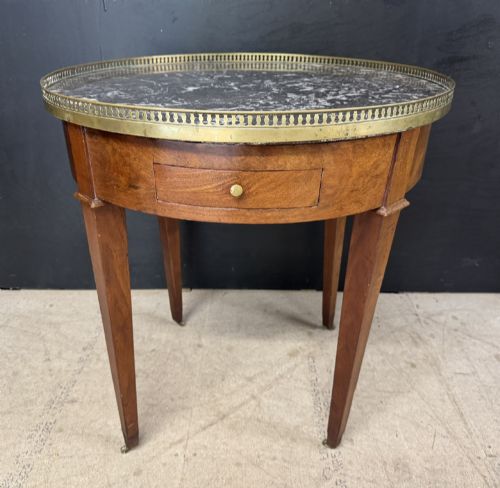
These louis xvi bouillotte tables are classic French small tables with marble tops and brass galleries, prized for placing beside a chair or sofa.
Louis XVI Bouillotte Tables
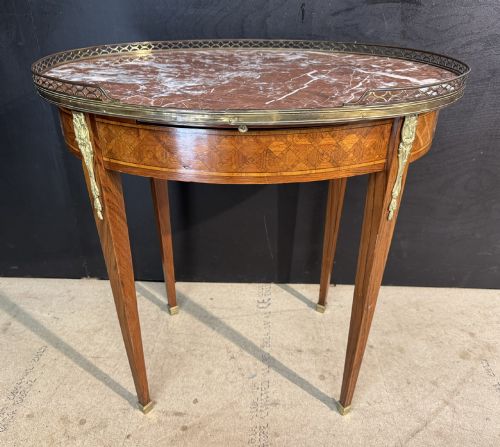
Louis xvi bouillotte tables on this page span the nineteenth century and the early twentieth century, appearing in forms such as lamp tables, side tables, centre tables, and occasional tables. These pieces commonly feature circular or oval tops surrounded by raised brass rims designed to keep small items secure.
The aesthetic draws heavily on French Louis XVI style, French Empire, and French Neoclassical traditions. Makers and designers of the period often incorporated marquetry or simpler wood veneers to create refined surfaces suited to formal drawing rooms.
Buyers will encounter circular marble topped bouillotte tables alongside pairs of small tables and occasional pieces with drawers. The proportions remain consistently neat, making them adaptable for modern rooms that require functional antique surfaces.
Materials and Construction
Cabinetmakers utilised timber frameworks of mahogany, walnut, kingwood, tulipwood, and general wood, often applying intricate marquetry patterns across the surfaces. These woods provided the structural integrity needed to support heavy stone elements.
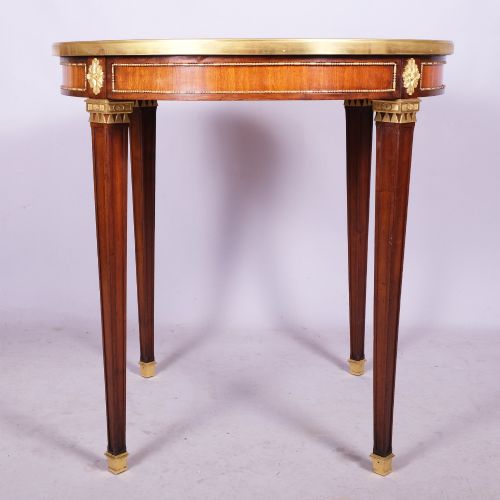
The distinctive round tops utilise inset marble slabs, which are typically encircled by brass or ormolu galleries and mounts. Ormolu cast details and brass fixtures provide the characteristic metallic contrast against the timber bases.
Card players once relied on the raised gallery of these tables to keep their stakes from rolling onto the floor during late-night wagers.
Judging Quality
Quality rests in the precision of the cabinetwork and the selection of timber veneers such as kingwood and tulipwood. Finer examples display crisp casting in the ormolu and brass mounts, alongside well-fitted marble slabs.
The integration of decorative elements like marquetry after makers such as Charles Topino distinguishes more ambitious pieces from simpler utilitarian tables. Balance in the proportions and the crispness of the turned legs further elevate the standing of a table.
Charles Topino
The Louis XVI Bouillotte Tables Glossary
- Bouillotte table
- A small French table with a raised gallery around the edge of the top. These pieces were originally designed for the card game of the same name.
- Ormolu
- Gilt bronze mounts used extensively on French furniture. The technique involves applying finely ground gold to a bronze base.
- Marquetry
- Inlaid wood veneers arranged in decorative patterns. Cabinetmakers utilised different timber colours to create pictorial or geometric designs.
- Gallery
- A raised rim of brass or metal fitted around the perimeter of a table top. This feature prevented items from sliding off.
Louis XVI Bouillotte Tables: Frequently Asked Questions
What is a bouillotte table?
A bouillotte table is a traditional French occasional table characterised by a raised gallery edge designed to keep items on the top. They are typically round or oval and often feature marble tops.
Historically associated with a card game, these tables now function well as bedside surfaces, lamp tables, or small side tables in a drawing room.
Are these tables French in origin?
The pieces listed reflect French design traditions, spanning Louis XVI style, French Empire, and French Neoclassical aesthetics. Cabinetmakers across the nineteenth and early twentieth centuries reproduced these classic forms.
Buyers find both single tables and matching pairs originating from this continental design lineage.
What materials are used in these tables?
Construction relies on timbers such as mahogany, walnut, kingwood, and tulipwood, sometimes enhanced with detailed marquetry. Tops are frequently fashioned from solid marble.
Metalwork plays a key role, with brass and ormolu used for galleries, mounts, and decorative accents around the frame.
How do I place one in a room?
Their compact scale and circular forms make these tables versatile for tight spaces or beside upholstered armchairs. The raised gallery also provides practical security for lamps or decorative objects.
They work effectively as standalone accent pieces or paired symmetrically beside a sofa or fireplace.