



Louis XV Revival Commode
A louis xv revival commode brings sweeping serpentine lines and gilt mounts into a room, offering both display and storage.
Louis XV Revival Commode
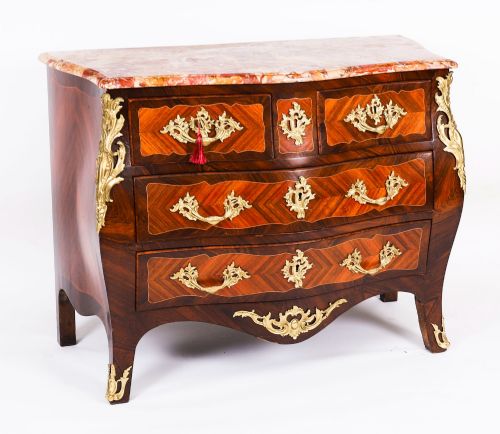
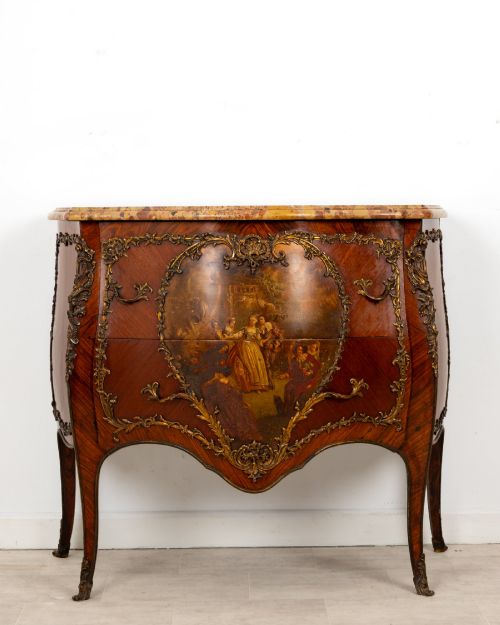
When you search for a louis xv revival commode, you encounter pieces designed in the nineteenth and early twentieth centuries that borrow heavily from French rococo forms. These items appear primarily as chests of drawers, side cabinets, and commodes alongside related dressing tables and bedside tables.
The most common examples on this page date from the nineteenth century, often featuring the characteristic serpentine or bombé shaping associated with the revival style. Makers from this era produced these works using traditional forms while adapting them to nineteenth and early twentieth-century interiors.
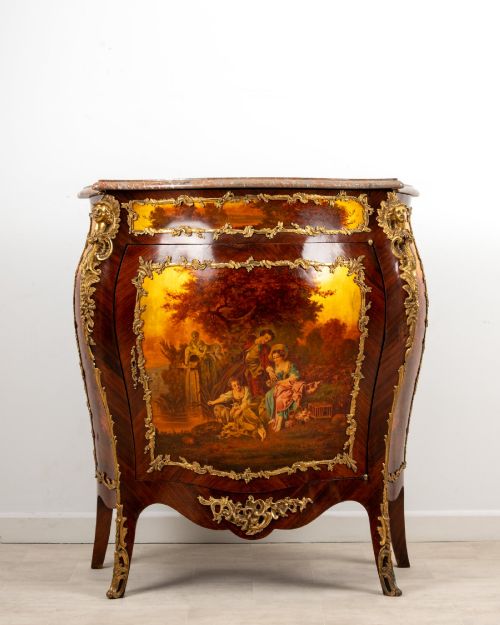
Originating largely from French workshops, these pieces manifest in variations such as side cabinets and smaller petit commodes. Each version retains the curved silhouettes and decorative mounting that define the louis xv revival aesthetic.
Markers of quality
The distinction between tiers rests upon the crispness of the gilt bronze or ormolu mounts and the depth of their chasing. Finer examples display meticulous hand-finishing on the metalwork rather than cast uniformity.
Quality also shows in the precision of the marquetry and the selection of woods such as kingwood and walnut. Heavier, more substantial marble tops fitted snugly to the curved woodwork indicate higher manufacture standards.
Louis XV Revival Commode Retail Price Guide 2026
Typical asking prices for louis xv revival commode among the pieces listed under this phrase on Sellingantiques today, from the lower quarter to the upper quarter. They describe what is for sale here now, not the wider market.
Listings span the nineteenth century up to 1920, incorporating materials such as marble, ormolu, kingwood, brass, walnut, gilt bronze, lacquer, and mahogany.
Epstein
The Louis XV Revival Commode Glossary
- Ormolu
- Gilt bronze applied as decorative mounts on furniture. It provides the bright golden highlights characteristic of rococo revival pieces.
- Bombe
- A bulging or outward-curving chest or cabinet shape. This contour requires skilled carpentry to achieve balanced proportions.
- Marquetry
- Inlaid wood veneers arranged to form decorative pictures or geometric patterns. Craftsmen use contrasting timbers to create tonal shading.
- Vernis Martin
- A type of decorative lacquer finish developed in France. It mimics Asian lacquerwork using multiple coats of varnish and painted scenes.
- Serpentine
- A furniture front or top curving inward centrally and outward at the ends. This undulating line defines much of the louis xv revival output.
Louis XV Revival Commode: Frequently Asked Questions
What is a louis xv revival commode?
A louis xv revival commode is a decorative chest of drawers or cabinet inspired by eighteenth-century French rococo design. These pieces date predominantly from the nineteenth and early twentieth centuries.
They feature curved woodwork, prominent mounts, and often marble tops, serving as both storage and decorative furniture.
How do I date a louis xv revival piece?
Dating relies on examining the construction methods, secondary woods, and the style of the gilt bronze mounts. Nineteenth-century examples often show hand-cut dovetails and heavy cast bronze details.
Twentieth-century pieces may incorporate machine-cut elements while maintaining the traditional aesthetic forms seen in earlier workshops.
Where were these commodes made?
Many of these pieces originated in French workshops, particularly in Paris, which was the centre of revival furniture production during the nineteenth century. English makers also produced similar interpretations.
Cabinetmakers across these regions utilised imported exotic timbers like kingwood and mahogany alongside traditional walnut.
How should I care for marble and ormolu?
Marble tops require gentle cleaning with mild soap and water to avoid staining from acidic liquids. A neutral sealer can protect the porous stone surface over time.
Ormolu mounts should be dusted with a soft brush, avoiding chemical cleaners that can strip the original gilding from the bronze.