

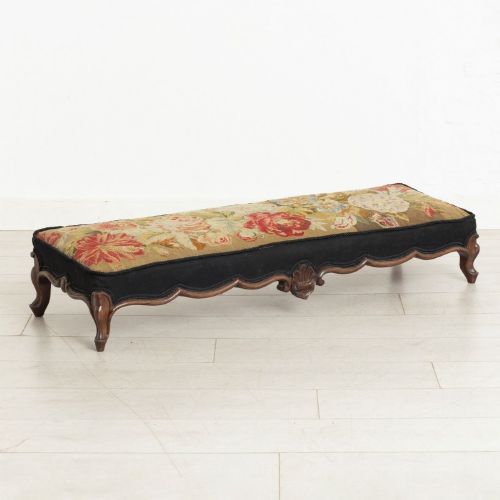


Long Low Footstool
A long low footstool offers a restful seat by the fire, built in mahogany, walnut, oak, and cane across centuries of British and continental design.
Long Low Footstool
A long low footstool provides a supportive platform for resting feet or sitting near the hearth, appearing in forms such as fender stools, carriage stools, and prayer stools. These pieces match search terms for a long low footstool through their extended proportions and low profiles.
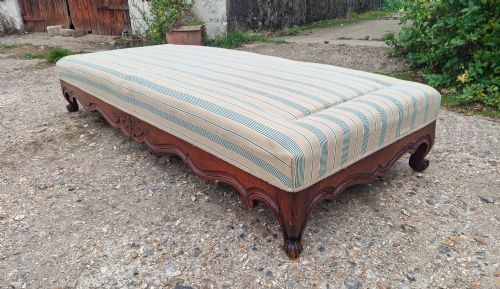
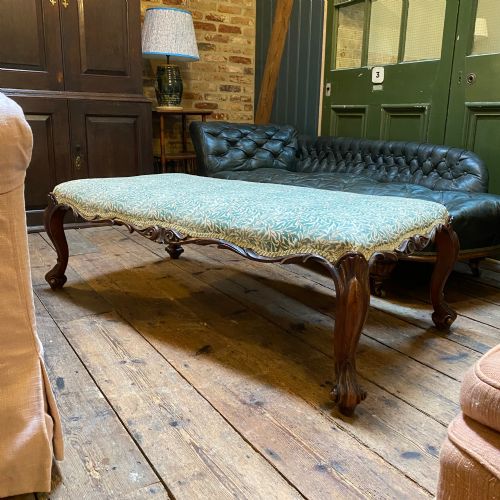
The pieces on this page span the Victorian era, the nineteenth century, the eighteenth century, and the early twentieth century. Common stylistic variations include Queen Anne, Victorian Gothic, Jacobean Revival, Carolean Revival, and French Rococo designs.
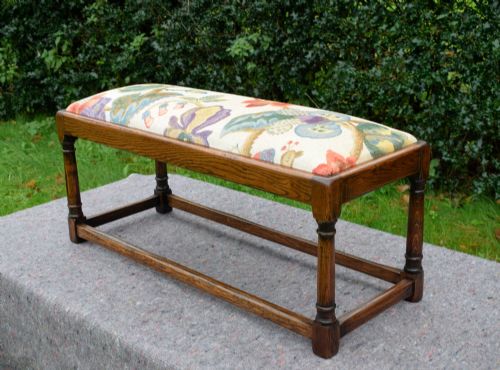
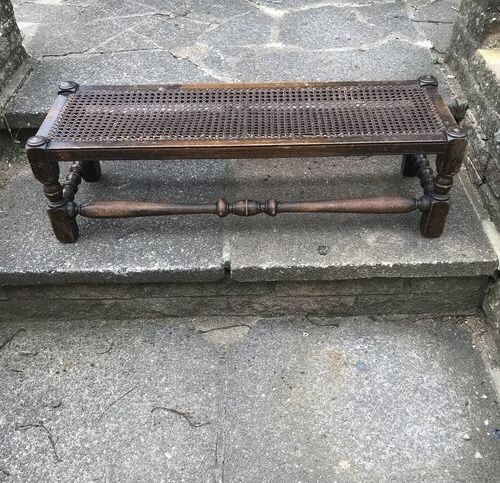
Makers utilised timber frames of mahogany, walnut, and oak, paired with seats of cane, wool, tweed, crewelwork, and other textiles. Brass details and hand-carved gilding also appear on specific continental and domestic examples.
Materials and Construction
Carpeneters built the structural frames using solid hardwoods like mahogany, walnut, and oak, often shaping the wood with turned legs, cabriole legs, or hand-carved gilt surfaces. These timbers provide the rigid skeleton necessary to support frequent domestic use.
Upholstered versions rely on traditional textiles including wool, tweed, crewelwork, and general fabric, while alternative designs incorporate woven cane seats. Brass fittings occasionally appear as structural or decorative elements on specific carriage and fender stools.
Long Low Footstool Retail Price Guide 2026
Typical asking prices for long low footstool among the pieces listed under this phrase on Sellingantiques today, from the lower quarter to the upper quarter. They describe what is for sale here now, not the wider market.
Listings feature items spanning the eighteenth century through to nineteen-twenty, constructed in mahogany, walnut, oak, and cane.
Evaluating Quality
Quality rests in the precision of the timber framing and the execution of carved details, such as cabriole legs or hand-carved gilt ornaments. Finer examples display harmonious proportions across extended lengths alongside robust joinery.
The integrity of the original upholstery materials, whether woven cane or period textiles like crewelwork and tweed, distinguishes high-grade survivals. Superior pieces retain their structural stability and original material composition without excessive replacement parts.
The Long Low Footstool Glossary
- Cabriole leg
- A furniture leg that curves outward and then tapers inward, commonly seen on Victorian and Georgian seating.
- Fender stool
- A long, narrow footstool designed to sit immediately in front of a hearth fender.
- Crewelwork
- Traditional surface embroidery using wool yarn on a plain fabric ground, often found on antique upholstery.
- Carolean Revival
- A late nineteenth-century revival style mimicking the ornate carved woodwork of the mid-seventeenth century.
Long Low Footstool: Frequently Asked Questions
What is a long low footstool?
A long low footstool is an extended, low-set piece of furniture designed for resting feet or low seating by a fireplace. These items historically served domestic spaces such as drawing rooms and carriages.
They appear in various woods and textile covers, reflecting the aesthetic preferences of periods ranging from the eighteenth century to the early twentieth century.
How were carriage stools used?
Carriage stools provided passengers with comfort and stability during long journeys in horse-drawn vehicles. Their compact yet elongated shapes suited the confined spaces of historical transport.
Over time, many of these pieces transitioned into domestic fireside use as foot rests.
How do I date a footstool?
Dating relies on examining the timber species, joinery methods, and stylistic cues such as cabriole legs or revival motifs. Victorian and Georgian pieces exhibit distinct manufacturing traits characteristic of their respective decades.
Upholstery fabrics and underlying webbing also offer clues, though textiles are frequently replaced during restoration.
Can I use an antique stool daily?
Most wooden stools retain sturdy frames built from durable hardwoods like oak, walnut, and mahogany. Regular domestic use is generally suitable provided the joints remain tight and stable.
Delicate surfaces, such as gilded frames or fragile antique cane, require more careful placement to prevent unnecessary wear.