



Line Art Print
A line art print delivers clean graphic focus to a room, offering stark visual definition through minimalist line work and historical engraving.
Line Art Print
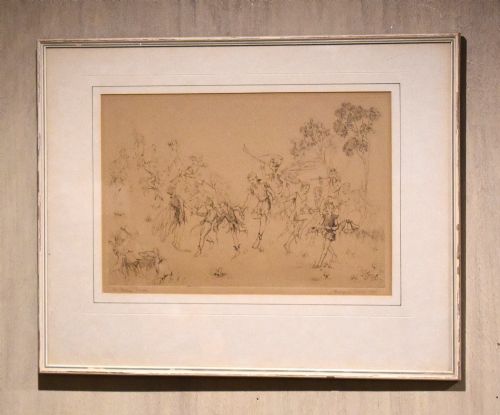
A line art print encompasses everything from 18th-century architectural engravings and classical portraits to mid-century modern lithographs and pen and ink drawings. Buyers seeking this phrase encounter a rich mix of centuries-old copperplate engravings, delicate British illustrations, and twentieth-century prints.
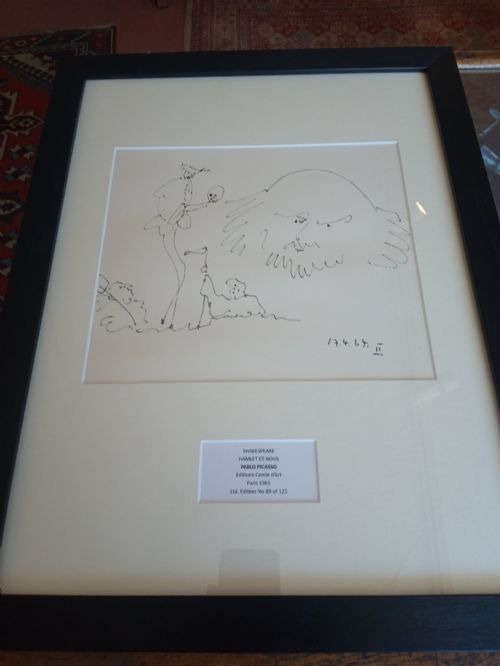
The selections available here span diverse periods including Victorian maritime subjects, Neoclassical Homer illustrations, and modernist compositions by makers such as Pablo Picasso and John Flaxman. Framing varies widely, featuring late 18th-century gilt rectangular scroll mounted frames alongside simple modern wooden surrounds under glass.
Originating across British and European workshops, these works bridge fine art and historical documentation through meticulous linework. Whether mounted in a simple paper format or preserved beneath glass in heavy giltwood frames, each piece relies on pure line to define its subject.
How they were made
Makers utilised ink and watercolour applied to paper, employing traditional techniques such as line engraving, etching, and lithography to transfer precise compositions. Copper and steel plates provided the durable surface for fine intaglio printing, while artists added hand colouring directly to the printed lines on selected nineteenth-century sheets.
Support materials range from standard print paper to durable steel hulls for painted subjects, housed within wooden and giltwood frames with protective glass. The construction of the surrounding frames often involves intricate scroll mounting and period joinery that matches the era of the artwork within.
Line Art Print Retail Price Guide 2026
Typical asking prices for line art print among the pieces listed under this phrase on Sellingantiques today, from the lower quarter to the upper quarter. They describe what is for sale here now, not the wider market.
The listings span from 1750 through the Victorian era up to modern pieces created later than 1960.
What varies in quality
The distinction between standard examples and the finest works rests upon the crispness of the impression and the depth of the engraved line. Early strikes from a copperplate retain sharp, clear detail, whereas worn plates yield softer, muddier lines.
Quality also resides in the integrity of the framing and the preservation of the paper support. Original period frames with intact giltwood and untouched paper surfaces elevate the historical value of the piece considerably.
Jacobus Houbraken·Pablo Picasso·John Flaxman·W. Roffe·James Basire
The Line Art Print Glossary
- Engraving
- A printmaking technique where an artist cuts lines directly into a metal plate using a sharp tool called a burin. The resulting incisions hold the ink for transfer under pressure.
- Etching
- A process where acid bites lines into a metal plate that has been covered with an acid-resistant ground. This allows for fluid, freehand drawing compared to direct engraving.
- Lithography
- A planographic printing method based on the mutual repulsion of oil and water. The image is drawn on limestone or a metal plate with a greasy medium.
- Neoclassical
- A style spanning the 18th and early 19th centuries that draws inspiration from the classical art and culture of ancient Greece and Rome. Works in this style feature strict linear clarity and noble simplicity.
Line Art Print: Frequently Asked Questions
How should I hang a framed print?
Hang your artwork at eye level on a wall protected from direct sunlight to prevent fading of the paper and ink.
Ensure the hanging wire and wall fixings are rated to support the weight, particularly for pieces housed in heavy giltwood frames under glass.
Can I mix different centuries together?
Combining 18th-century architectural engravings with mid-century modern lithographs creates a layered, collected interior.
Unified framing or consistent mount board colours help tie disparate periods together on a single wall.
How do I identify a steel engraving?
Steel engravings generally appear from the 19th century onward, allowing for finer lines and significantly larger print runs than copper plates.
Examinations under magnification often reveal the precise, crisp trough left by the steel plate into the paper surface.
What is the difference between an etching and an engraving?
An engraving is cut directly into metal by hand using a burin, creating clean, V-shaped grooves with sharp terminals.
An etching uses acid to bite the lines into the metal, resulting in slightly more rounded lines with varied depths.