

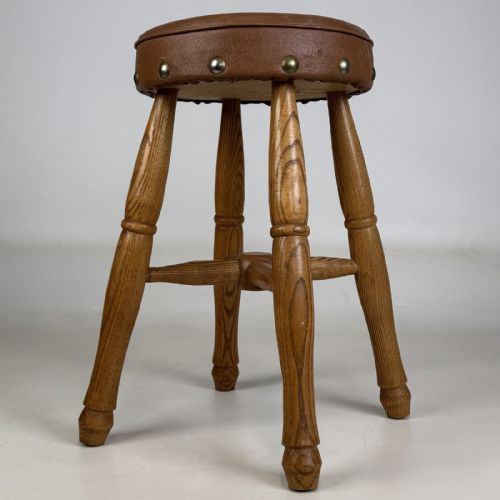
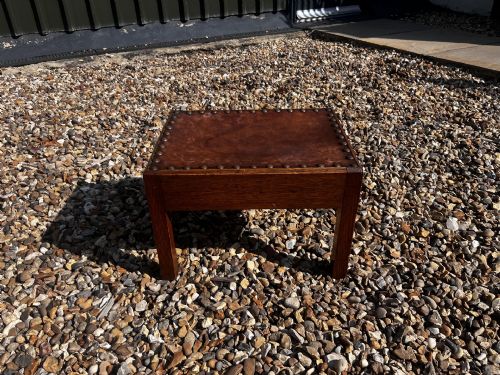


Leather Top Stool
These leather top stool examples combine sturdy timber frames with durable hides, offering practical seating and library access.
Leather Top Stool
A leather top stool combines solid timber structures with hide upholstery, serving functional roles from library access to piano seating across different periods.
The selections available here range from Victorian mahogany library steps to Edwardian oak stools and Arts and Crafts oak designs.
Forms span simple footstools and piano stools alongside multi-tiered library steps fitted with leather treads.
Materials and construction
Frames rely on timbers such as mahogany, oak, walnut, beech, and metal, shaped into steps, swivel seats, and adjustable bar stools.
Upholstery uses leather, frequently secured with brass studs along the edges of treads and seats.
Leather Top Stool Retail Price Guide 2026
Typical asking prices for leather top stool among the pieces listed under this phrase on Sellingantiques today, from the lower quarter to the upper quarter. They describe what is for sale here now, not the wider market.
The inventory includes items from the nineteenth century, Edwardian period, and the nineteen-twenties and thirties, utilising oak, mahogany, walnut, and leather.
Assessing quality and craftsmanship
Quality rests in the selection of timbers like figured mahogany or quarter-sawn oak, alongside the precision of joinery in frames and steps.
Maker marks, such as stamps by J.Jarvis or attributions to Arthur Simpson of Kendal, distinguish standard pieces from documented workshop productions.
Arthur Simpson Of Kendal·J.Jarvis
The Leather Top Stool Glossary
- Library steps
- A set of tiered steps designed for reaching high bookshelves, often featuring leather inserts on the treads to prevent slipping. These incorporate spiral columns or folding mechanisms.
- Piano stool
- A seat designed for keyboard players, sometimes featuring a swivel mechanism or a Canterbury compartment underneath for sheet music. Walnut and mahogany examples are common.
- Canterbury stool
- A low seat combined with vertical partitions beneath for holding music folios or periodicals. Victorian variations frequently employ walnut timber.
- Brass studded
- A method of securing leather upholstery to timber frames using individual metal tacks with decorative heads. This detail appears on 20th century oak and Victorian pieces.
- Swivel seat
- A rotating mechanism allowing the top of the stool to turn independently of the base. These are typically found on piano stools from the Victorian era.
Leather Top Stool: Frequently Asked Questions
What periods do these stools date from?
The pieces span the nineteenth century, the Victorian and Edwardian eras, through to the nineteen-twenties and nineteen-thirties.
Materials and styles shift accordingly, from Regency mahogany to Arts and Crafts oak.
How were library steps used?
Library steps provided access to high bookshelves in domestic and institutional settings.
Leather treads offered grip and protected the timber steps from heavy footwear.
What timber types are common?
Construction relies heavily on traditional hardwoods including mahogany, oak, and walnut.
Beech and metal also appear in structural elements and adjustable mechanisms.
Are piano stools adjustable?
Certain piano stool variations incorporate swivel seats for movement during performance.
Others include integrated compartments beneath the seat for storing sheet music.